The Atomic Standard: A Practitioner’s Compendium for Single-Event Threat Detection
- Category: CTI
- Source article: https://medium.com/@1200km/the-atomic-standard-a-practitioner-s-compendium-for-single-event-threat-detection-570c4241d4d9
- Published: 2025-11-01
- Preserved media: 1 image(s), including cover images, screenshots, diagrams, and infographics where present.
- Preserved technical blocks: 0 code/configuration block(s).
Ecosystem Fit
This page mirrors the original Medium article into the 1200km.com Docusaurus ecosystem. The original article flow, images, screenshots, infographics, and technical blocks are preserved from the export.
Part 1: The Theoretical Foundation of Atomic Detection
1.1 Deconstructing the “Single-Event” Rule: The Professional’s Middle Ground
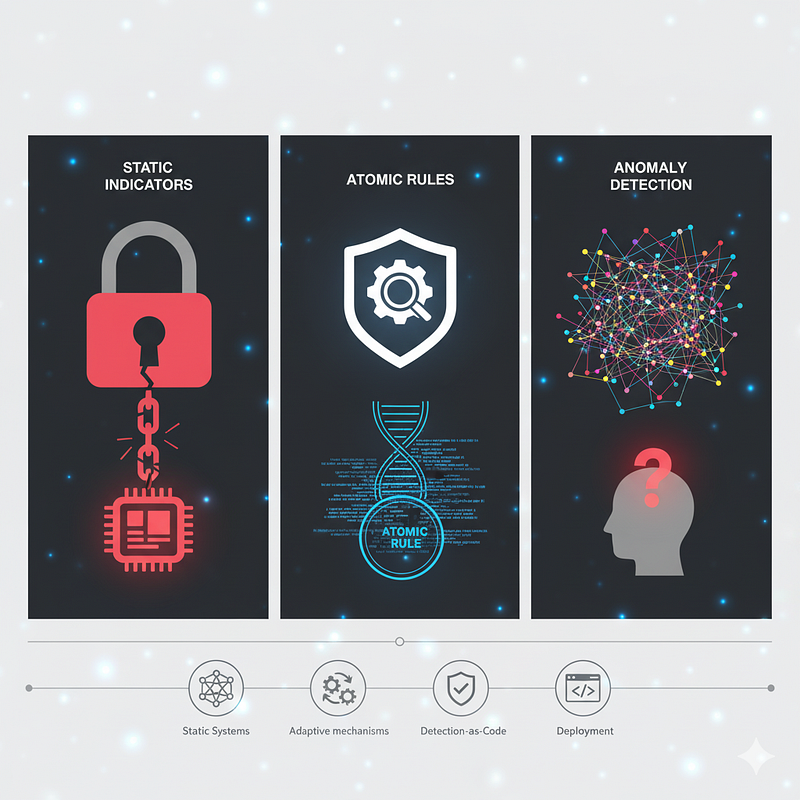
In contemporary security operations, threat detection is not a single practice but a spectrum of methodologies. This spectrum has evolved from rudimentary, static systems to the intelligent, adaptive mechanisms now available.1 At one end lies the classic, static Indicator of Compromise (IOC) — a file hash, an IP address, or a domain name. This detection method is fast and precise but brittle; as security principle dictates, attackers can “easily change” these static indicators, rendering the detection logic obsolete.
At the other end of the spectrum is anomaly-based detection. These systems, often powered by machine learning, “learn patterns of ‘normal’ behavior” and subsequently flag any deviations. While highly adaptive, this approach is notoriously problematic in practice, often suffering from “high false positive rates, as benign activities may be misclassified as malicious”.
The practitioner’s demand for “single-event” or “atomic” behavioral rules represents a necessary and effective middle ground. This approach is a direct reaction to the dual failures of traditional tools. It rejects the brittleness of static IOCs and the untenable noise of pure anomaly detection.
An atomic rule is hereby defined asa pre-defined behavioral signature that can be identified from the content of a single log event, without requiring stateful correlation.
It is a hybrid 1 approach that combines the best of both worlds:
-
**Like a Signature:**It isstaticandpre-defined. The logic is an explicit “if-then” statement, referred to in some literature as a “static correlation rule”. This makes it testable, auditable, and manageable.
-
**Like an Anomaly:**It targetsbehavior(a TTP), not an artifact.
The guiding principle is to “Focus on Attacker Behavior, Not Static Indicators”. For example, instead of detecting a specific malicious IP (a static IOC), an atomic rule detects thebehaviorof the PowerShell process itself — such as powershell.exe launching with encoded command parameters (-enc or -encodedcommand). This targets thetechniqueof obfuscation, which is far more resilient than an IP that will be changed tomorrow. This entire catalog is built on this “hybrid” philosophy: creating high-fidelity, manageable detections that are resilient to simple attacker tradecraft.
1.2 The Fidelity Spectrum: Managing the “Atomic Alert” Problem
The primary operational challenge of implementing a wide-ranging catalog of atomic detections is not logic, but volume. Atomic rules, by their nature, can generate a significant number of “atomic alerts”. These are often described as “vanilla security alerts” that highlight a specific behavior in isolation. A single sophisticated attack can “result in dozens of individual… atomic alerts within minutes,” which “capture only the individual pieces of an attack,” not the “full picture”. This leads directly to the “alert fatigue” that plagues and ultimately paralyzes many Security Operations Centers (SOCs).
To move from a state of alert fatigue to one of operational efficiency, a mature detection program must stop treating all alerts as equal. The solution is to manage detections on afidelity spectrum, classifying rules into two distinct categories :
-
**High-Fidelity (HF) Alarms:**These are rules that detect events “considered so critical that an alarm requires a SOC analyst” to investigate. A detection for procdump.exe dumping the LSASS process memory is a clear-HF alarm; its malicious-to-benign ratio is extremely high. These events must be triaged.
-
**Low-Fidelity (LF) Alerts:**These are “small, often obscure indicators that something badmightbe happening”. The powershell.exe -enc rule is a perfect example; as noted, “many legitimate tools also encode PowerShell,” making it a noisy, LF indicator.
A novice security team’s response to LF alerts is to “fine-tune” them with exclusions, but this is a “thankless process” that risks “missing some pieces of an attack chain”.
A mature program, by contrast, uses conditional logic and data routing. A single detection rule can be written to dynamically assign fidelity based on the content of the event itself. A practical Splunk example demonstrates this: … | eval alert_type = if(match(action,”allowed”),”HF”,”LF”).
This logic is then used to architecturally fork the data stream. The HF alarms are sent to the analyst queue. The LF alerts, however, are not discarded; they are collected and routed to a separate index (e.g., collect index=low_fidelity). This low_fidelity index is not for triage; it is a rich, high-volume data source forhuntingandenrichment. When a true HF alarm fires (like an lsass dump), the analyst can pivot and query this LF index for all other atomic events on that same host and user. This architectural choice transforms the “noise” of LF alerts into thecontextneeded to build the “full picture” of the attack.
1.3 Detection Engineering as a Discipline (Detection-as-Code)
A “wide-ranging catalog” of detection rules is not a static document. It is a living, breathing codebase that must be managed with the same rigor as production software. This practice is the formal discipline of Detection Engineering (DE).
The core process of modern DE isDetection-as-Code (DaC), which applies “the best implementation practices of software engineering by using the modern agile CI/CD (continuous integration and continuous delivery) pipeline” to detection logic.
This catalog, therefore, is best implemented as a DaC program. This ecosystem consists of three main components:
-
The Standard (Source of Truth):****Sigmais the open-source, generic, and vendor-agnostic format for writing detection rules. The entire detection catalog should be written and version-controlled in Sigma’s YAML format.11 This repository becomes the single source of truth.
-
**The Pipeline (CI/CD):**Conversion tools act as the “compilers” in the DaC pipeline. These tools ingest the generic Sigma rules and automatically translate them into vendor-specific query languages. Key tools include the official sigma-cli, pySigma, and commercial or web-based platforms like SOC Prime’s Uncoder.
-
**The Deployment (Targets):**The output of the pipeline is native detection logic, ready to be deployed to specific SIEM, EDR, and XDR platforms. This includes Splunk (SPL), Microsoft Sentinel (KQL), XPLG and Elastic Security (EQL).
Practitioners can build this catalog by leveraging several key public and commercial repositories:
-
**SigmaHQ:**The main open-source repository for Sigma rules.10
-
**Elastic Detection Rules:**A large, public GitHub repository for rules used by Elastic Security.
-
**Microsoft Sentinel GitHub:**The official repository for Sentinel analytics, data connectors, and playbooks.
-
**Splunk ESCU:**The Splunk Enterprise Security Content Update (ESCU) is a commercial package of pre-built detections mapped to MITRE ATT&CK.
-
**SOC Prime:**A commercial platform that aggregates, curates, and validates a massive collection of DaC, offering both free and premium rules.
More Information in part 2.