Phase 1: Source Gathering
AI-assisted deep research across 71 candidate sources. Parallel Gemini + OpenAI passes, review gate, 8 government/vendor sources promoted.
Read phaseAI-assisted CTI pipeline: MuddyWater public sources → OpenCTI → 11 detection records → 14 PASS / 1 PARTIAL / 1 FAIL across 16 rule checks → Kibana
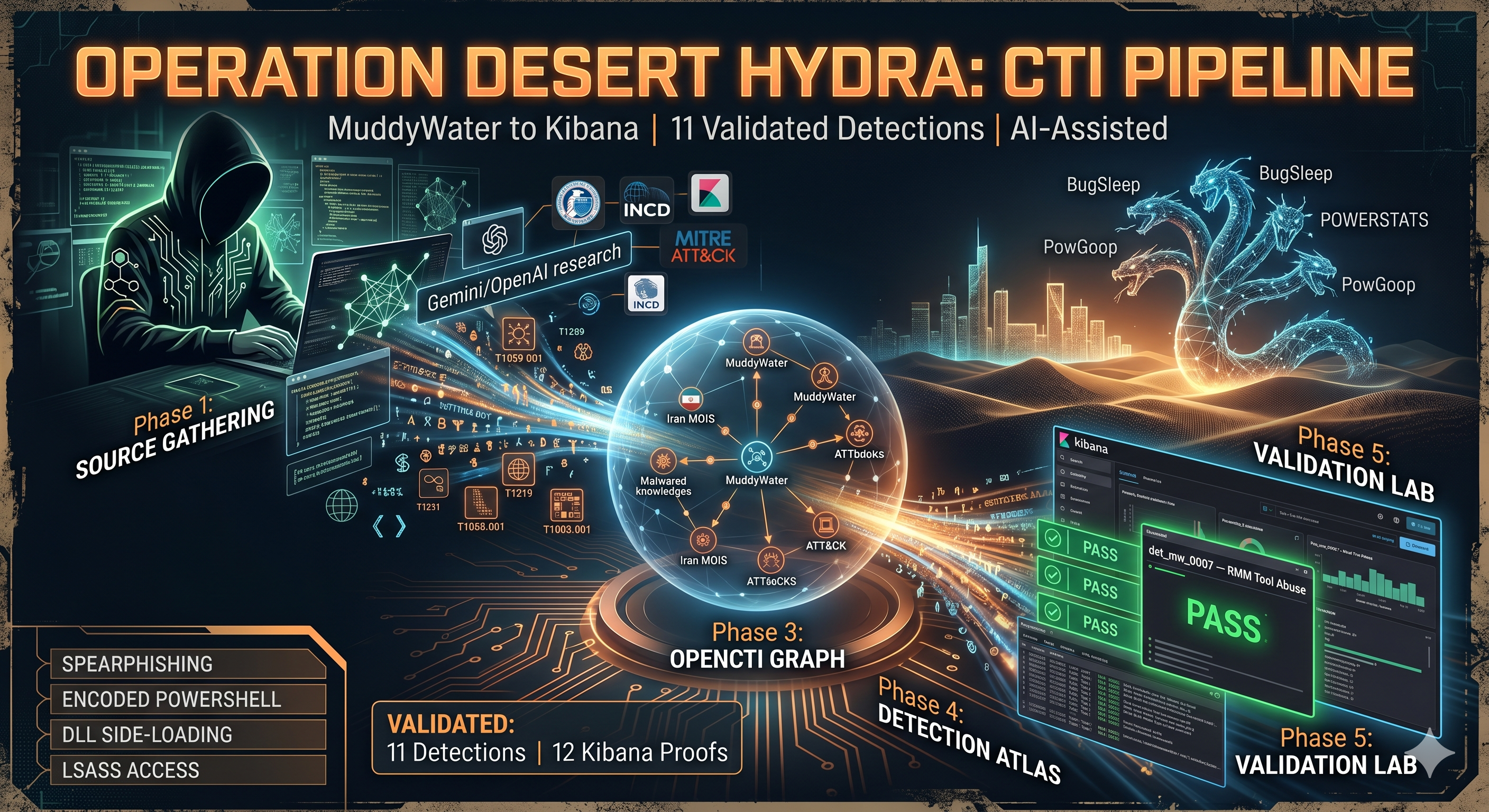
Operation Desert Hydra is a complete CTI-to-detection pipeline focused on MuddyWater / Seedworm — widely reported by government and vendor sources as Iran-linked activity associated with MOIS, targeting Israeli government, defense, and critical infrastructure. The pipeline enforces a full chain: public sources → structured procedures → OpenCTI knowledge graph → detection rules → benign lab simulation → Kibana proof screenshots.
Everything is on GitHub: github.com/anpa1200/operation-desert-hydra. One repository contains everything needed to reproduce the full pipeline from a clean machine.
AI-assisted deep research across 71 candidate sources. Parallel Gemini + OpenAI passes, review gate, 8 government/vendor sources promoted.
Read phase10 source-bound procedure records with evidence labels (Observed/Reported/Assessed), ATT&CK mappings, and detection opportunity notes.
Read phaseSelf-hosted OpenCTI 6.2 knowledge graph: MuddyWater intrusion set, 9 malware, 4 tools, 21 ATT&CK techniques, 20 source reports.
Read phase11 detection records with SIEM-agnostic pseudologic, coverage scores, false positive classes, and design rationale.
Read phaseOne-command lab: Docker + Vagrant Windows 10 VM + Ansible provisioning. 11 benign simulations, 12 Kibana proof screenshots.
Read phase21 procedure techniques + 7 from source set. 16 techniques (76%) fully validated. 6 capability gates that determine your effective coverage floor.
Read phase16 rule checks across 11 detection records — some detections have multiple rules tested separately. Every PASS has a Kibana screenshot. Failures are documented with root cause and fix path. 9 of 11 detections have coverage score ≥ 4 (lab-validated).
SIEM-agnostic pseudologic (Sigma, KQL, Elastic JSON, SPL). Coverage scores: 5 = lab-validated multi-source, 4 = lab-validated single-source, 3 = validation incomplete or failed (documented reason). 9 detections score ≥ 4; 2 score 3.
From 71 AI-assisted candidate sources, 8 government and vendor sources survived the analyst review gate: CISA AA22-055A, INCD 2023, INCD 2024, and five supporting vendor sources.
Mapped across 8 tactics. 16 techniques (76%) fully lab-validated. 6 capability gates determine your effective coverage floor.
Deploy the full stack from a single command:
git clone https://github.com/anpa1200/operation-desert-hydra.git
cd operation-desert-hydra
cp stack/.env.template stack/.env
# fill in ELASTIC_PASSWORD, OPENCTI_ADMIN_PASSWORD, OPENCTI_ADMIN_TOKEN
bash start.sh
# → OpenCTI: http://localhost:8080
# → Kibana:  http://localhost:5601
Prerequisites: Docker, VirtualBox, Vagrant, Ansible, Python 3 + pywinrm. All 11 simulations run automatically (~10 min).
Full Reproduce InstructionsPractitioner tradecraft: PIRs, evidence handling, attribution, source reliability, infrastructure pivoting, hunting hypotheses, detection backlog, SOC handoff, and 10 reusable analyst templates.
Open ManualLab platform and structured training framework. Docker Compose stack (OpenCTI, TheHive, Cortex, Elastic SIEM) and 8 analyst assignments — including reactive exercises that cover the MuddyWater tradecraft this pipeline investigates.
Open LabDefensive knowledge base for threat actors targeting Israeli government, public-sector, critical infrastructure, and adjacent suppliers. Actor profiles, ATT&CK mappings, and detection examples. Blue-team only.
Open ProjectGate-controlled CTI-to-detection delivery methodology from customer requirements and PIRs/SIRs to detection backlog, SOC handoff, and measurable defensive outcomes.
Open ProjectHow AI-assisted offense changes the threat model: skill-floor collapse, Pyramid of Pain reanalysis, legacy detection failures, behavioral detection strategy, and the SOC 90-day adaptation playbook.
Open Guide