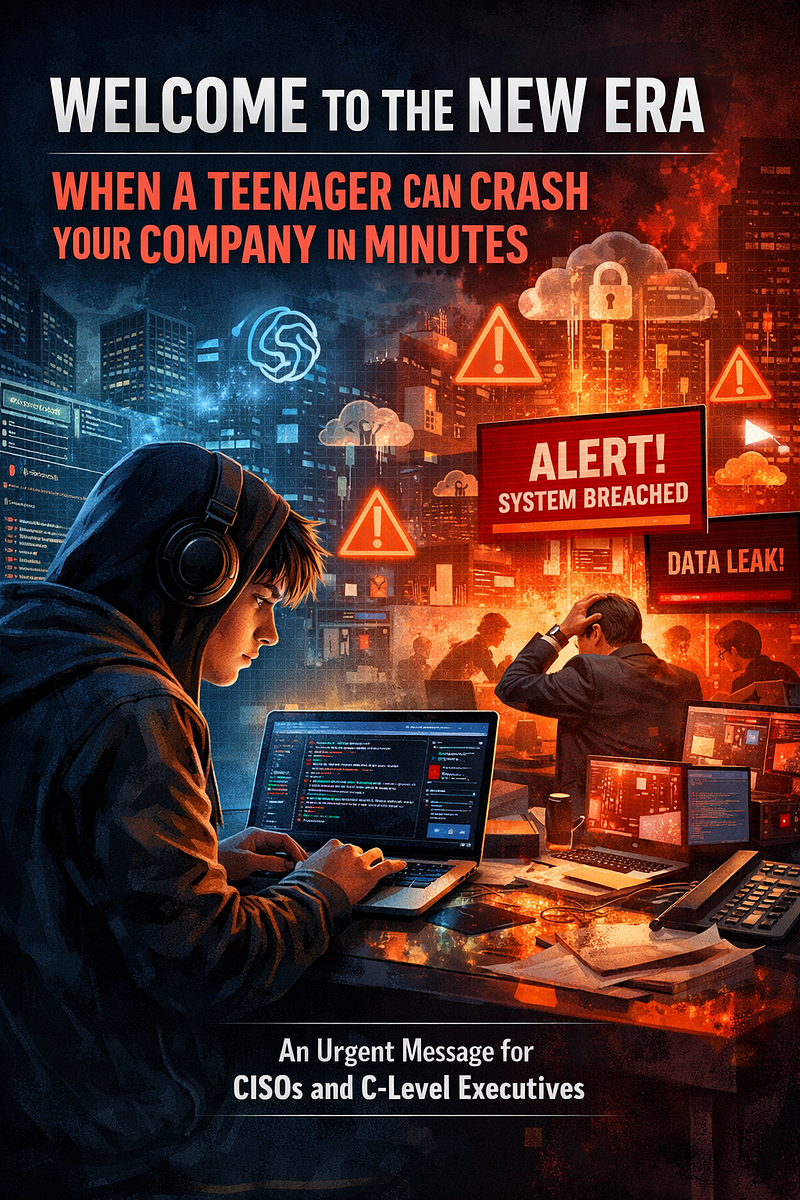
Welcome to the New Era: When a Teenager Can Crash Your Company in Minutes
- Category: CTI
- Source article: https://medium.com/@1200km/welcome-to-the-new-era-when-a-teenager-can-crash-your-company-in-minutes-8818fb6c0503
- Published: 2026-02-06
- Preserved media: 1 image(s), including cover images, screenshots, diagrams, and infographics where present.
- Preserved technical blocks: 0 code/configuration block(s).
Ecosystem Fit
This page mirrors the original Medium article into the 1200km.com Docusaurus ecosystem. The original article flow, images, screenshots, infographics, and technical blocks are preserved from the export.
An Urgent Message for CISOs and C-Level Executives. The threat landscape has fundamentally changed. Your legacy security assumptions are not just outdated — they’re dangerous.
Executive Summary
In 2024, a 17-year-old with access to ChatGPT and free AI security tools successfully breached a Fortune 500 company’s cloud infrastructure in under 3 hours. The attack wasn’t sophisticated — it was automated. The teenager didn’t understand Kubernetes architecture, didn’t know Python beyond basic syntax, and had never taken a cybersecurity course. Yet, they achieved what would have required a team of experienced penetration testers just two years ago.
This is not a hypothetical scenario. This is today’s reality.
The democratization of AI-powered attack tools has fundamentally altered the cybersecurity equation. What once required years of training, deep technical knowledge, and expensive tooling can now be accomplished by anyone with internet access and a subscription to an AI service. Your organization doesn’t need to be specifically targeted — you might simply be one address on an automated scanning list.
The Death of Traditional Security Assumptions
“If Our Penetration Test Didn’t Find Domain Controller Compromise, We’re Secure”
This assumption is fundamentally flawed in the AI era. Traditional penetration testing follows a linear methodology: reconnaissance, scanning, enumeration, exploitation, and reporting. The process takes weeks, costs tens of thousands of dollars, and provides a snapshot of security at a specific point in time.
**The new reality:**AI-powered tools can perform the same assessment in hours, continuously, and at scale. As demonstrated in real-world testing, AI-driven penetration testing frameworks can:
-
Automate full network discovery and exploitationfrom a single prompt
-
Generate custom exploit codefor identified vulnerabilities in seconds
-
Orchestrate multi-stage attack chainsfrom reconnaissance through privilege escalation to complete system compromise
-
Adapt attack strategiesbased on target responses without human intervention
In one documented case, an AI-assisted penetration test achieved complete network compromise — from initial scan to domain controller access — in under 4 hours. The same assessment would have taken a human team 2–3 weeks.
**The implication:**Your last penetration test report is already outdated. Attack TTPs (Tactics, Techniques, and Procedures) evolve daily. What was secure yesterday may be exploitable today.
“We Use Open-Source Tools, So We’re Safe”
Open-source software is not inherently secure. In fact, the rapid development cycles and community-driven nature of many open-source projects create significant security risks:
-
Supply Chain Vulnerabilities: Attackers can inject malicious code into popular open-source packages
-
Delayed Patching: Community-maintained projects may have slower response times to critical vulnerabilities
-
Wide Attack Surface: Popular open-source tools are extensively analyzed by attackers using AI tools
-
Configuration Complexity: Many open-source security tools require expert-level configuration — misconfigurations are common and exploitable
**The AI amplification effect:**Attackers using AI can:
-
Rapidly identify vulnerable versions of open-source components in your stack
-
Generate exploits for known CVEs before patches are applied
-
Create custom attack payloads targeting specific open-source tool configurations
-
Automate the discovery of misconfigured open-source services across thousands of targets
“Our Legacy Security Systems Protect Us”
Legacy security systems were designed for a different threat model. They assume:
-
Attacks follow predictable patterns
-
Attackers have limited automation capabilities
-
Threats can be detected using signature-based methods
-
Human analysts can respond to alerts in time
AI-powered attacks break all these assumptions:
-
Polymorphic Malware: AI can generate unique malware variants that evade signature detection
-
Behavioral Mimicry: AI can learn normal user behavior patterns and mimic them to avoid detection
-
Rapid Adaptation: Attackers can modify attack techniques in real-time based on defensive responses
-
Scale: A single attacker can launch thousands of simultaneous attacks, overwhelming traditional security operations
The New Threat Actor: The AI-Enabled “Script Kiddie”
From Bored Teenager to Dangerous Hacker
The term “script kiddie” used to describe inexperienced hackers who used pre-written scripts without understanding them. They were considered a nuisance, not a serious threat. That classification is obsolete.
**Today’s reality:**A teenager with AI assistance can:
- Create functional malwareusing only natural language prompts, as demonstrated in real-world testing where a complete Trojan Horse with process hollowing, C2 communication, keylogging, and data exfiltration was built using only AI assistance
[⚠️ WARNING: I Just Built Real Malware by using just human language prompts! A Complete Walkthrough: From “I Want to Build Malware” to Fully Functional Trojan with C2, Keylogger, and Data…
2. Enumerate cloud infrastructurewithout understanding cloud architecture — AI tools can identify misconfigurations, exposed services, and vulnerable endpoints automatically
[AI-Assisted Web and Cloud Penetration Testing with Cursor + MCP HexStrike and Burp Suite MCP. A Complete Guide to Modern AI-Powered Security Testing. From One Prompt to Full Attack Surface Coverage (Recon →…
3. Generate exploit codein any programming language within minutes, even if the attacker has never written code in that language
[Hacker Tool Development Workflow: Android Rubber Ducky Payloads in Cursor AI From plain-English prompts to reliable HID flows — validated with emulator screenshots and telemetry
4. Orchestrate complex attack chainsfrom reconnaissance through exploitation to data exfiltration, all automated
[HexStrike + Cursor (MCP): From Single Target → Full Subnet Compromise (Lab PT Walkthrough) A real end-to-end lab engagement: recon → credential discovery → share abuse → lateral movement → multi-host compromise…
Real-World Example: The Malware Creation Case
[⚠️ WARNING: I Just Built Real Malware by using just human language prompts! A Complete Walkthrough: From “I Want to Build Malware” to Fully Functional Trojan with C2, Keylogger, and Data…
In a documented educational scenario, a security researcher used AI assistance to create fully functional malware in a matter of hours. The process involved:
-
Planning: AI generated a comprehensive malware development scenario
-
Implementation: AI assisted in writing code for process hollowing, C2 communication, and evasion techniques
-
Compilation: Cross-compilation from Linux to Windows was automated
-
Testing: The malware successfully evaded initial detection and established C2 communication
**The critical point:**This wasn’t a nation-state actor or an experienced malware developer. This was someone using AI as a force multiplier to bridge knowledge gaps and accelerate development.
**The business impact:**If a security researcher can create functional malware this quickly, imagine what a motivated attacker can do. And they’re not just creating malware — they’re using AI to:
- Crack passwordswith intelligent wordlist selection and multi-tool orchestration
[AI-Driven Office Documents Password Recovery with HexStrike-AI and Gemini-CLI From Encrypted Document to Readable Content Using LLM-Orchestrated Tooling
[AI-Driven PDF Password Recovery with HexStrike-AI and Gemini-CLI From Encrypted Document to Readable Content Using LLM-Orchestrated Tooling
- Perform wireless attackswith automated handshake capture and password cracking
[AI-Driven Wireless Penetration Testing. One Promt WIFI cracking Using Aircrack-ng with HexStrike-AI and Gemini-CLI
- Conduct web application attackswith AI-assisted vulnerability discovery and exploitation
[Burp Suite MCP + Gemini CLI Connect Burp Suite to Gemini CLI using Model Context Protocol (MCP) and Turn Burp into an AI-callable toolset and…
The Automation Revolution: Seconds, Not Hours
Traditional vs. AI-Powered Attack Timelines
Traditional Attack Timeline (Human-Operated):
-
Reconnaissance: 2–5 days
-
Vulnerability scanning: 1–2 days
-
Exploit development: 1–2 weeks
-
Privilege escalation: 1–3 days
-
Lateral movement: 2–5 days
-
Total: 2–4 weeks
AI-Powered Attack Timeline:
-
Reconnaissance: 5–15 minutes
-
Vulnerability scanning: 10–30 minutes
-
Exploit generation: 30 seconds — 2 minutes
-
Privilege escalation: 5–15 minutes
-
Lateral movement: 10–30 minutes
-
Total: 30 minutes — 2 hours
The Targeting Problem: You Don’t Need to Be Targeted
Automated Scanning and Mass Exploitation
Traditional threat models assume attackers target specific organizations. This assumption is dangerous in the AI era.
The new reality:
-
Attackers use AI to automate vulnerability scanning across millions of IP addresses
-
Exploits are generated automatically for discovered vulnerabilities
-
Successful compromises are prioritized for further exploitation
-
Your organization might be compromised simply because you appeared in a scan
The “Spray and Pray” Attack Model
AI enables a new attack model: automated, large-scale exploitation with minimal human intervention.
-
Mass Scanning: AI tools scan entire IP ranges for common vulnerabilities
-
Automated Exploitation: Discovered vulnerabilities are automatically exploited
-
Intelligent Prioritization: Successful compromises are flagged for deeper exploitation
-
Automated Lateral Movement: AI attempts to move laterally within compromised networks
-
Data Exfiltration: Sensitive data is automatically identified and exfiltrated
**The business impact:**Your organization doesn’t need to be specifically targeted. You might be one of thousands of organizations scanned daily. If you have a single misconfiguration, exposed service, or unpatched vulnerability, you’re at risk.
The SSO Dependency: A Single Point of Failure
“All of Your Life in Your SSO Account”
Modern organizations depend heavily on Single Sign-On (SSO) solutions from providers like Google, Microsoft, and Okta. This creates a critical dependency:
-
Employee accounts: Access to email, documents, collaboration tools
-
Customer accounts: User authentication for web applications
-
Administrative access: Cloud infrastructure, databases, internal systems
-
Third-party integrations: SaaS applications, APIs, services
**The risk:**A compromise of SSO credentials can provide attackers with access to:
-
All corporate data and communications
-
Customer databases and personal information
-
Administrative systems and infrastructure
-
Third-party service accounts
**AI amplification:**Attackers using AI can:
-
Rapidly identify SSO misconfigurations
-
Generate sophisticated phishing campaigns targeting SSO providers
-
Exploit SSO integration vulnerabilities
-
Automate credential harvesting and reuse attacks
Real-World Impact
Consider a scenario where an attacker compromises a single SSO account:
-
Immediate accessto all integrated services
-
Data exfiltrationfrom multiple systems
-
Lateral movementacross the entire organization
-
Reputation damagefrom public data breaches
-
Regulatory penaltiesfrom compliance violations
-
Business disruptionfrom service outages
**The timeline:**This entire attack chain can be executed in hours, not days or weeks.
The HR Problem: Filtering for the Wrong Skills
“We Filter Candidates Based on Education and Years of Experience”
Traditional hiring practices in cybersecurity focus on:
-
Formal education (degrees, certifications)
-
Years of experience
-
Familiarity with specific tools
-
Traditional skill assessments
**The problem:**These metrics don’t capture the most critical skill in the AI era:the ability to effectively use AI tools.
The AI Skill Gap
Traditional hiring looks for:
-
Python programming experience (5+ years)
-
Cloud architecture knowledge (AWS, Azure, GCP)
-
Penetration testing certifications (OSCP, CEH)
-
Experience with specific tools (Metasploit, Burp Suite, Nmap)
What you actually need:
-
Ability to use AI to generate code in any language
-
Skill in orchestrating AI-powered security tools
-
Understanding of AI-assisted attack methodologies
-
Experience with AI-driven security frameworks
The “AI as Cheating” Fallacy
Many organizations prohibit AI use in technical assessments, viewing it as “cheating.” This perspective is fundamentally flawed.
The reality:
-
Attackers use AI as a tool, not a crutch
-
AI-assisted development is the new standard
-
Prohibiting AI in assessments filters out candidates who understand modern workflows
-
You’re hiring for yesterday’s threats, not tomorrow’s
What to Look For Instead
Effective AI-era security professionals:
-
Understand AI capabilities and limitations
-
Can orchestrate AI tools effectively
-
Know when to use AI vs. traditional methods
-
Understand AI-assisted attack methodologies
-
Can defend against AI-powered attacks
Assessment approach:
-
Provide candidates with AI tools during assessments
-
Evaluate their ability to use AI effectively
-
Test their understanding of AI-assisted workflows
-
Assess their knowledge of AI-powered attack techniques
Real-World Breaches: The Proof
Case Study 1: The Cloud Misconfiguration Breach
**Incident:**A mid-size technology company experienced a data breach affecting 2.3 million customer records.
**Attack vector:**An attacker used AI-powered cloud enumeration tools to discover misconfigured S3 buckets. The entire attack took less than 2 hours:
-
Cloud enumeration: 15 minutes
-
Bucket discovery: 5 minutes
-
Access verification: 2 minutes
-
Data exfiltration: 90 minutes
**Attacker profile:**19-year-old college student with no cloud security training. Used free AI tools and ChatGPT to understand cloud misconfigurations.
Business impact:
-
$4.2 million in regulatory fines —Average cloud breach costs
-
15% customer churn —Customer impact studies
-
6-month recovery timeline —Breach recovery statistics
-
Reputation damage lasting 2+ years —Long-term breach impact analysis
Case Study 2: The Supply Chain Attack
**Incident:**A financial services company’s customer portal was compromised through a supply chain attack.
**Attack vector:**Attacker identified a vulnerable open-source component in the company’s web application stack. Used AI to:
-
Generate exploit code for the vulnerability
-
Create a backdoor that evaded detection
-
Automate credential harvesting
-
Exfiltrate customer financial data
**Attacker profile:**22-year-old with basic programming knowledge. Used AI to bridge knowledge gaps and accelerate attack development.
Business impact:
-
$12.8 million in direct costs —Supply chain attack costs
-
Regulatory investigation —Compliance impact
-
Class-action lawsuit —Legal consequences
-
Complete application rebuild required —Supply chain remediation
Case Study 3: The Ransomware Attack
**Incident:**A healthcare organization was hit with ransomware that encrypted patient records and administrative systems.
**Attack vector:**Attacker used AI-powered tools to:
-
Perform automated network reconnaissance
-
Identify vulnerable services
-
Generate and deploy ransomware payload
-
Establish persistence mechanisms
-
Encrypt critical systems
**Timeline:**Initial compromise to full encryption: 4 hours.
**Attacker profile:**17-year-old high school student. Used AI-assisted penetration testing framework to orchestrate the entire attack.
Business impact:
-
$8.5 million ransom payment —Ransomware payment statistics
-
3 weeks of operational disruption —Ransomware downtime
-
Patient care delays —Healthcare breach impact
-
Regulatory violations —HIPAA and healthcare compliance
-
Ongoing legal issues —Healthcare breach legal consequences
The Numbers: Statistics That Should Terrify You
Attack Frequency and Speed
-
75% increasein AI-powered attacks in 2024 —CrowdStrike Global Threat Report 2024
-
Average time to compromise: Reduced from weeks to hours —Mandiant M-Trends 2024
-
Automated attack volume: Up 300% year-over-year —SonicWall Cyber Threat Report 2024
-
Detection evasion rate: 40% of AI-generated malware evades initial detection —Microsoft Digital Defense Report 2024
Attacker Demographics
-
Average age of attackers: Decreasing (now includes teenagers) —CrowdStrike Global Threat Report 2024
-
Technical skill requirement: Decreasing (AI bridges knowledge gaps) —Microsoft Digital Defense Report 2024
-
Cost of attack tools: Decreasing (many AI tools are free or low-cost) —ENISA Threat Landscape Report 2024
-
Time to develop attacks: Decreasing (hours instead of weeks) —Mandiant M-Trends 2024
Business Impact
-
Average breach cost:$4.45 million (2024)—IBM Cost of a Data Breach Report
-
Time to identify breach:204 days (median)—Verizon DBIR 2024
-
Time to contain breach:73 days (median)—IBM Cost of a Data Breach Report
-
Business disruption:Average 23 days—CrowdStrike Global Threat Report
The Defense Problem: Legacy Systems Can’t Keep Up
Why Traditional Security Fails
Signature-based detection:
-
AI can generate unique malware variants that evade signatures
-
Polymorphic code generation creates infinite variations
-
Behavioral analysis can be mimicked by AI
Rule-based monitoring:
-
AI attacks can learn and adapt to security rules
-
Attack patterns evolve faster than rules can be updated
-
False positives overwhelm security teams
Human response times:
-
AI attacks execute in minutes
-
Human analysts need hours to investigate
-
By the time threats are identified, damage is done
The Detection Gap
Traditional security assumes:
-
Attacks follow known patterns
-
Attackers make mistakes
-
Defenders have time to respond
AI-powered attacks:
-
Generate novel attack patterns
-
Minimize mistakes through automation
-
Execute faster than human response times
What You Need to Do: Actionable Recommendations
1. Rethink Your Security Posture
Immediate actions:
-
Assume you will be compromised (adopt a “zero trust” mindset)
-
Implement continuous security monitoring (not periodic assessments)
-
Deploy AI-powered defense tools (fight AI with AI)
-
Assume attacks will succeed (focus on detection and response)
Strategic changes:
-
Move from prevention-focused to detection-focused security
-
Implement security automation and orchestration
-
Deploy behavioral analytics and anomaly detection
-
Build incident response capabilities that can operate at AI attack speeds
2. Update Your Hiring Practices
Stop filtering for:
-
Years of experience with specific tools
-
Traditional certifications alone
-
Formal education requirements
-
Ability to code from scratch
Start looking for:
-
AI tool proficiency
-
Ability to orchestrate automated workflows
-
Understanding of AI-assisted attack methodologies
-
Adaptability and continuous learning mindset
Assessment changes:
-
Allow AI use in technical assessments
-
Evaluate AI-assisted problem-solving
-
Test understanding of modern attack techniques
-
Assess ability to defend against AI-powered attacks
3. Modernize Your Security Stack
Legacy tools to replace:
-
Signature-based antivirus
-
Rule-based intrusion detection
-
Manual security assessments
-
Periodic penetration testing
Modern tools to implement:
-
AI-powered threat detection
-
Behavioral analytics platforms
-
Automated security orchestration
-
Continuous security assessment tools
4. Change Your Security Culture
From:
-
“We’re secure because we passed our audit”
-
“We haven’t been breached, so we’re doing fine”
-
“Our security team handles threats”
-
“We follow industry best practices”
To:
-
“We assume we’re compromised and monitor accordingly”
-
“We test our defenses continuously”
-
“Everyone is responsible for security”
-
“We adapt faster than attackers”
5. Invest in AI-Powered Defense
Critical investments:
-
AI-powered threat detection and response
-
Automated security orchestration
-
Behavioral analytics and anomaly detection
-
Security AI research and development
Budget allocation:
-
Reduce spending on legacy signature-based tools
-
Increase investment in AI and machine learning
-
Fund security automation initiatives
-
Support continuous security assessment
The Future: What’s Coming Next
Emerging Threats
AI-powered social engineering:
-
Deepfake voice and video for sophisticated phishing
-
AI-generated personalized attack content
-
Automated social media reconnaissance
-
Real-time conversation manipulation
Autonomous attack systems:
-
Self-learning malware that adapts to defenses
-
AI agents that operate independently
-
Automated attack chain orchestration
-
Self-propagating attack networks
Supply chain attacks:
-
AI-assisted code injection into open-source projects
-
Automated vulnerability discovery in dependencies
-
AI-generated malicious packages
-
Automated dependency confusion attacks
The Arms Race
**The reality:**We’re in an AI arms race. Attackers are using AI to develop new attack techniques faster than defenders can develop countermeasures.
**The challenge:**Traditional security approaches can’t keep up. You need to:
-
Adopt AI-powered defense tools
-
Implement security automation
-
Build adaptive security capabilities
-
Invest in security research and development
Conclusion: The New Reality
The cybersecurity landscape has fundamentally changed. The assumptions that guided security strategy for decades are no longer valid. A teenager with AI assistance can now achieve what required a team of experienced professionals just years ago.
The critical points:
-
Legacy security assumptions are dangerous— they create false confidence
-
You don’t need to be targeted— automated attacks scan and exploit at scale
-
Traditional hiring practices miss critical skills— AI proficiency is essential
-
Response times must match attack speeds— automation is required
-
AI-powered defense is not optional— it’s necessary for survival
The question is not:“Will we be attacked?”
The question is:“Are we prepared to detect and respond when we are?”
**The time to act is now.**Every day you delay is a day your organization becomes more vulnerable. The threat landscape is evolving at AI speed. Your security strategy must evolve faster.
References and Further Reading
Author’s Research and Articles
-
The AI Revolution in Cybersecurity— Comprehensive overview of AI in cybersecurity
-
AI-Driven Penetration Testing at Home Using HexStrike-AI— Real-world examples of AI-powered attacks
-
⚠️ WARNING: I Just Built Real Malware by using just human language prompts!— Demonstration of AI-assisted malware development
-
Integrating Shodan with HexStrike-AI Using Gemini-CLI— Examples of cloud infrastructure attacks
-
AI-Driven ZIP Password Recovery with HexStrike-AI and Gemini-CLI— Demonstration of accelerated attack capabilities
-
AI-Assisted Web and Cloud Penetration Testing with Cursor + MCP HexStrike and Burp Suite MCP— Full workflow examples
-
HexStrike + Gemini vs. HackerAI “Ops Copilot” vs. “Chatbot with Tools”— Comparative analysis
Industry Reports
-
IBM Cost of a Data Breach Report 2024— Comprehensive analysis of breach costs, detection times, and attack vectors
-
Verizon Data Breach Investigations Report 2024 (DBIR)— Annual analysis of real-world security incidents and attack patterns
-
CrowdStrike Global Threat Report 2024— Analysis of threat actor trends, attack speeds, and emerging techniques
-
Mandiant M-Trends 2024— Annual threat intelligence report on attacker behaviors and detection times
-
Microsoft Digital Defense Report 2024— Analysis of cloud security, nation-state threats, and attack trends
-
Unit 42 Cloud Threat Report 2024— Cloud security misconfigurations and attack statistics
-
ENISA Threat Landscape Report 2024— European cybersecurity threat analysis
-
SonicWall Cyber Threat Report 2024— Malware, ransomware, and attack volume statistics
-
Check Point Security Report 2024— Global attack trends and threat intelligence
-
Rapid7 State of Exposure Report 2024— Vulnerability and exposure analysis
-
OWASP Top 10 2021— Most critical web application security risks
-
CISA Cybersecurity Alerts and Advisories— Government-issued security advisories and threat intelligence
This article is based on real-world research, documented attack scenarios, and analysis of the evolving threat landscape. The examples provided are based on actual testing and documented incidents, adapted to protect specific organizational details while illustrating the real risks organizations face in the AI era.