The Incident Response Lifecycle: From First Alert to Verified Recovery
Build a repeatable response workflow that connects evidence, business decisions, containment, and recovery—and makes every claim of progress something you can verify.

Published: 2026-11-08 · Source review: 2026-11-02
An endpoint alert fires. An analyst isolates the laptop, resets the user's password, and closes the ticket. Later, the same account accesses a cloud application from an unfamiliar session. Was the incident contained?
The answer depends on what access the attacker had, what the response actually interrupted, and what evidence exists afterward. A successful action in one console answers only part of the question.
Incident response, or IR, connects those questions across people, systems, identities, and business operations. This guide is for SOC analysts, incident responders, detection engineers, and security leaders who need to turn lifecycle diagrams into decisions they can execute and defend. It covers the current NIST model, six practical work areas, evidence handling, a synthetic investigation, and the outputs that make the next response better.
The approach follows the evidence discipline used in my CTI Analyst Field Manual: show what is known, identify the gaps, and make the next action follow from the evidence.
Scope: This is a defensive field guide for authorized response. Disruptive actions require the authority defined in your organization's response plan. The scenario, timing, and decision gates below are illustrative. Production, cloud, identity, and operational technology procedures must account for their own dependencies and safety constraints.
Table of contents
- What changed in the IR lifecycle
- Turn phases into decisions and outputs
- Preparation: build the ability to respond
- Detection and analysis: establish what happened
- Evidence: preserve what supports the investigation
- Containment: interrupt the attacker's access
- Eradication: remove persistence and close the path back
- Recovery: demonstrate that operations can be trusted
- A worked incident from alert to recovery
- Communication and incident command
- Lessons learned: turn findings into tested changes
- Where CTI, detection engineering, and AI fit
- Measure outcomes and exercise the lifecycle
- Limitations and common failure modes
- Conclusion
- References
- Follow My Work
What changed in the IR lifecycle
Many practitioners learned the four phases from NIST SP 800-61 Rev. 2: preparation; detection and analysis; containment, eradication, and recovery; and post-incident activity.
NIST published SP 800-61 Rev. 3 in April 2025, superseding Rev. 2. Its model uses the Cybersecurity Framework 2.0 functions. Govern, Identify, and Protect provide the broader risk-management foundation; Detect, Respond, and Recover describe incident response itself. Improvement, within Identify, feeds lessons across the functions. These are concurrent areas of work, rather than six sequential incident stages. See NIST's publication record and Rev. 3, Section 2.1.
The familiar six-step SANS model—Preparation, Identification, Containment, Eradication, Recovery, and Lessons Learned—remains useful vocabulary for organizing response tasks. SANS describes that model here.
The practical relationship is:
| Work area used in this guide | Relationship to the current NIST model |
|---|---|
| Preparation | Govern, Identify, Protect |
| Detection and analysis | Detect, with ongoing improvement |
| Containment and eradication | Respond |
| Recovery | Recover |
| Lessons and improvements | Identify: Improvement, informing all functions |
This is an operational crosswalk, not a replacement standard. NIST's own Table 1 maps the previous four-phase model to CSF functions, including Improvement during detection, response, and recovery.
The infographic shows how the work areas interact. It is an original explanatory model, not a reproduction of the NIST figure.
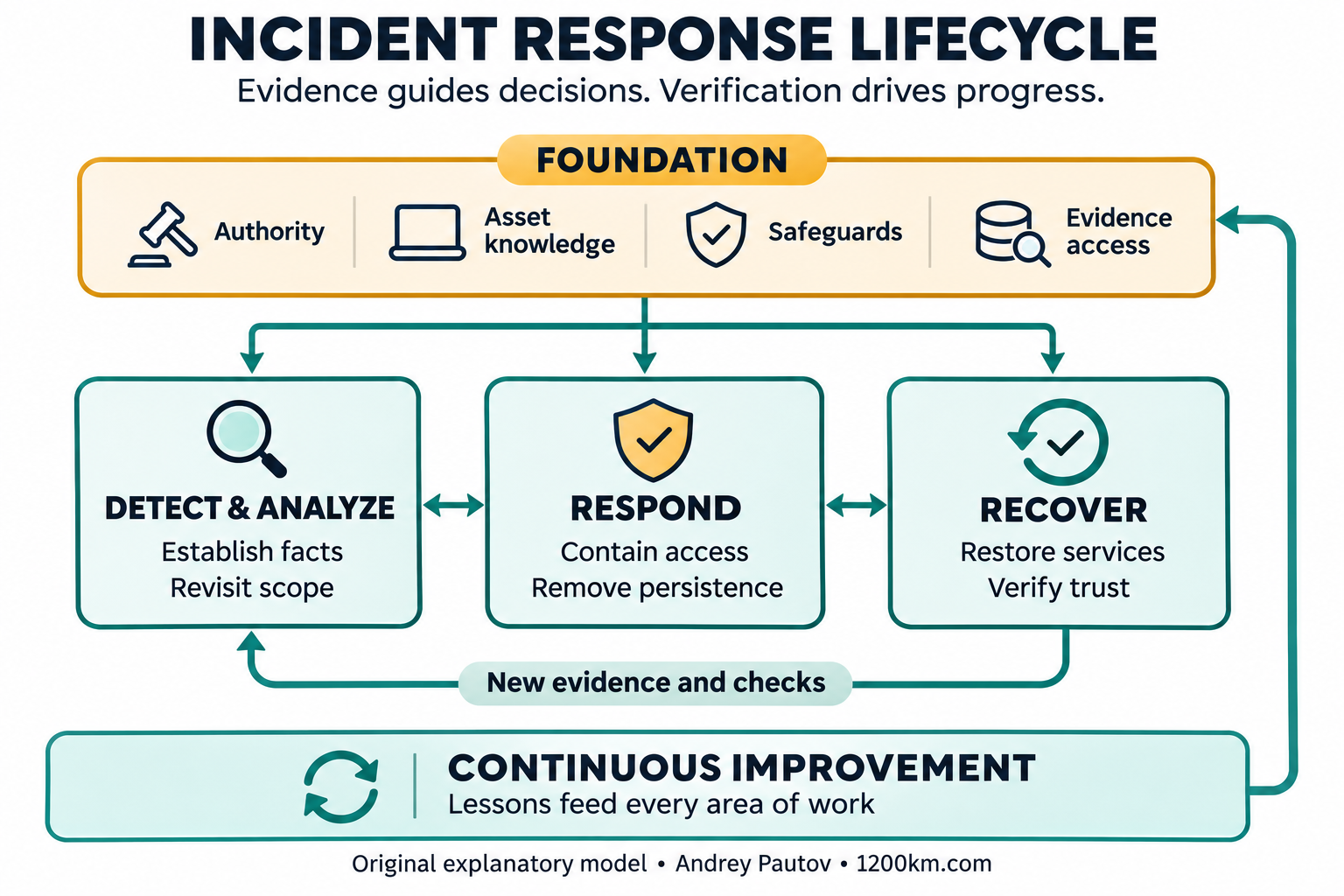
Figure 1. Preparation supports the response cycle; new evidence revises decisions, and lessons improve both readiness and response.
For a working team, the consequence is straightforward: continue analyzing while containing; revisit scope when new evidence appears; improve a failing collection process during the incident. A diagram should help coordinate work without preventing those loops.
SANS's newer Dynamic Incident Response material also emphasizes verification, triage, and iterative scoping. That supports a useful operating habit: revisit the question each action was supposed to answer.
Turn phases into decisions and outputs
A phase name alone does not tell an analyst when enough work has been done. Attach a question, an output, and a verification requirement to each work area.
The following gates are proposed operating criteria for this guide. Adapt them to the incident and the organization's authority model.
| Work area | Decision to make | Reviewable output | Evidence of progress |
|---|---|---|---|
| Preparation | Can we execute the required response? | Contacts, authority matrix, telemetry map, exercised procedures | Demonstrated access, collection, and restore capability |
| Detection and analysis | What warrants incident handling, and how urgent is it? | Case record, initial timeline, scope and severity assessment | Source-backed findings and explicit gaps |
| Containment | Which harmful capabilities must be interrupted now? | Coordinated action plan and action log | The targeted access or behavior is blocked in the relevant scope |
| Eradication | What must change to prevent persistence or re-entry? | Remediation record tied to findings | Specified persistence and access paths addressed and checked |
| Recovery | Can this service return under acceptable risk? | Restore evidence, functional checks, monitoring and rollback plan | Technical validation and service-owner acceptance |
| Improvement | What will change before the next incident? | Owned backlog with deadlines and acceptance tests | Changes exercised and accepted |
An emergency does not require completion of every row before action. It requires enough evidence and authority to choose an action, document the tradeoff, and test the result.
Preparation: build the ability to respond
Preparation determines what choices remain available when the environment is already under pressure.
The UK NCSC's response-planning guidance calls for contacts, escalation criteria, decision authority, coordination, and links to continuity and communication plans. A practical implementation starts by testing whether those arrangements work outside normal hours.
Assign authority before the emergency
Document who can declare an incident, isolate an endpoint, disable a privileged identity, suspend a customer-facing service, and accept residual risk during restoration. Include deputies and delegated emergency authority.
For a small team, one person may fill several roles. Still identify the roles separately: incident coordination, technical investigation, service ownership, evidence management, and stakeholder communication. This makes handovers clearer and exposes decisions that otherwise have no owner.
Build a telemetry and dependency map
Use a table that answers operational questions:
| Source | Questions it can help answer | Readiness check |
|---|---|---|
| Endpoint detection and response (EDR) | What executed, under which identity, on which host? | Confirm sensor health, collection scope, and approved isolation behavior |
| Identity provider | Which sign-ins, authentication changes, and access decisions occurred? | Test export access and retention for relevant event types |
| Email and collaboration audit | Which messages, rules, permissions, or sharing settings changed? | Confirm required auditing is enabled and retrievable |
| Cloud control-plane audit | Which identities changed resources or policies? | Verify account, region, service, and retention coverage |
| Application and data-access logs | Which records or objects were accessed or changed? | Check whether the necessary operations are actually recorded |
| Network telemetry | Which connections and transfers were visible? | Establish coverage, timestamps, and attribution limits |
A deployed product is not evidence that the needed telemetry exists. Retrieve a representative record and check its fields, timestamps, and retention before relying on it.
For critical services, document dependencies such as directory services, secrets, DNS, certificates, deployment systems, and backup administration. A restore plan that depends on an unavailable identity system may fail before application restoration begins.
Exercise the awkward conditions
Test response when corporate email is unavailable, an administrator's device cannot be trusted, the primary responder is absent, or the external provider needs emergency access. Keep approved alternate communications and secure access procedures ready.
Preparation output: an exercised response plan, usable access, known evidence coverage, service dependencies, and a record of unresolved readiness gaps.
Detection and analysis: establish what happened
An alert is a reason to investigate. Incident declaration is a decision based on the organization's criteria and the available evidence.
Start with four questions:
- What does the underlying source record actually show?
- Which assets, identities, data, or services may be affected?
- What harm is occurring or reasonably plausible?
- What decision cannot wait for a complete investigation?
Separate observation from interpretation
Consider an unfamiliar sign-in:
| Evidence state | Example |
|---|---|
| Observed | An identity audit record shows a successful sign-in from an unfamiliar network |
| Inferred | The session may be unauthorized because it conflicts with the user's verified activity |
| Unconfirmed | The session was used to download sensitive documents |
| Collection task | Retrieve application access records and correlate the session |
Geolocation, reputation, or an unusual hour can strengthen a hypothesis. They do not establish who operated the session or what data they obtained.
Use the same discipline for malware alerts. A detection label, a suspicious command line, and confirmed execution are different findings.
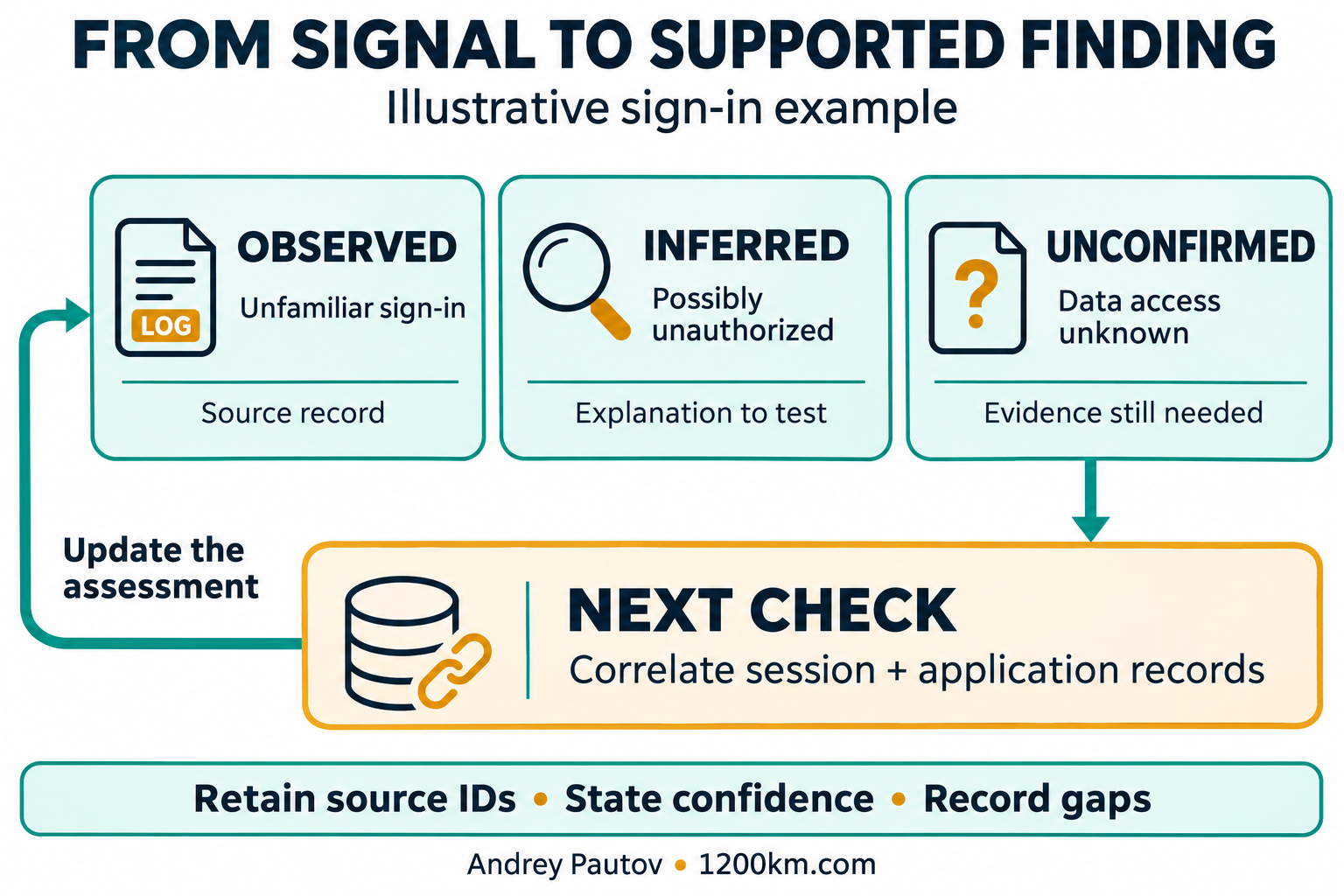
Figure 2. Observations, interpretations, and open questions remain distinct. Additional collection can strengthen, revise, or reject the explanation.
Build a timeline with source references
Record event time, time zone, collection time, source identifier, entity identifiers, interpretation, and uncertainty. Keep original timestamps alongside any normalized UTC value. Document clock skew and delayed ingestion where known.
Do not describe the earliest retained malicious event as the initial compromise unless the evidence supports that conclusion. The start of available visibility is a collection boundary.
Scope across trust relationships
Expand from the first entity along relevant relationships: user to devices, device to credentials, identity to applications, application to data, and administrative access to managed systems.
For each scope expansion, record the reason, query window, source coverage, and result. A clean search of five monitored endpoints says little about an unmanaged sixth endpoint.
Severity should reflect business consequences and access potential as well as observed activity. For example, confirmed compromise of a privileged deployment identity may justify urgent escalation before service disruption is visible. Record why the severity was chosen and what finding would change it.
Analysis output: an incident record, initial severity, evolving timeline, bounded scope, competing explanations, and prioritized collection tasks.
Evidence: preserve what supports the investigation
Evidence collection is part of response throughout the lifecycle. The collection plan should reflect what may disappear, what decisions depend on it, and what continued harm makes urgent.
The joint government advisory Technical Approaches to Uncovering and Remediating Malicious Activity recommends broad artifact review and coordinated mitigation. It is useful context for avoiding a single-IOC investigation.
A practical evidence register should include:
| Field | Purpose |
|---|---|
| Evidence ID and case ID | Link the item to the investigation |
| Source and scope | Identify the host, account, tenant, service, or resource |
| Collector, time, and method | Explain how the evidence was obtained |
| Tool version, query, filters, and pagination | Make the export interpretable and repeatable |
| Original storage and working copy | Preserve provenance while supporting analysis |
| Integrity digest, where applicable | Check whether a saved file later changes |
| Access and transfer history | Document handling and custody |
| Limitations | Record missing fields, truncation, retention, or acquisition effects |
A file digest can demonstrate that a collected export remained unchanged. It cannot establish that the export contained every relevant event, that upstream logs were authentic, or that a compromised system reported truthfully.
For cloud investigations, preserve resource identifiers, policy state, relevant control-plane and data-access records, and suitable snapshots before destructive changes when operationally feasible. A disk snapshot does not substitute for identity history or application logs.
The October 2023 StopRansomware Guide, Part 2 prioritizes isolation and warns that powering down loses volatile evidence; it reserves shutdown for situations where other disconnection methods are unavailable. Apply that tradeoff to the actual incident. Active destruction can make immediate interruption more important than a complete acquisition.
Record what was lost, why the action was necessary, and who made the decision. For operational technology, involve the responsible operator before actions that could affect a physical process.
Evidence output: preserved originals, an acquisition and handling record, working copies, and explicit completeness limits.
Containment: interrupt the attacker's access
Containment should target the capability causing harm: execution, remote access, privileged administration, data access, lateral movement, or destructive activity.
The affected laptop may be one part of that capability. Review the identity, applications, secrets, and management systems connected to it.
Match the control to the access path
| Access path under investigation | Candidate containment action | Verification question |
|---|---|---|
| Compromised endpoint | EDR isolation or network restriction | Which communications remain possible, including management exceptions? |
| Compromised user identity | Restrict access, reset credentials, revoke applicable sessions | Are resource access attempts blocked as intended? |
| Application-owned session | Invoke the application's supported revocation mechanism | Has the application stopped accepting the session? |
| Cloud access key or workload credential | Disable or replace the credential and review derived access | Can existing sessions or alternate credentials still operate? |
| Malicious forwarding or delegated access | Remove the unauthorized configuration and address its authorizing identity | Does forwarding or delegated access recur? |
| External exploitation path | Restrict the exposed service or affected route | Is another entry point or established foothold still available? |
These are candidate controls, not universal commands. Check platform behavior and dependencies before execution.
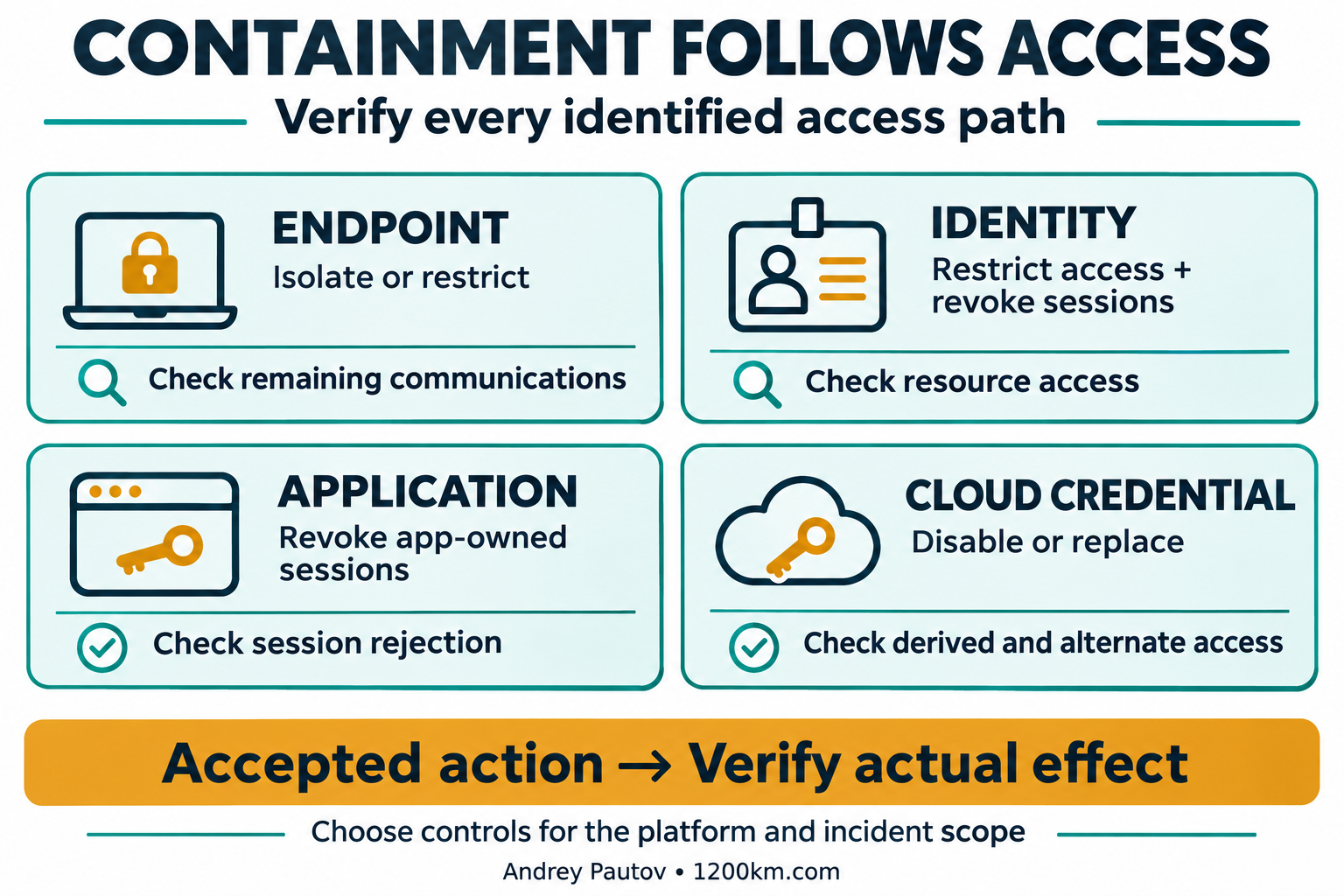
Figure 3. Match containment to each identified access path and verify its practical effect. These four examples complement the broader control table above.
For example, Microsoft's Entra access-revocation documentation distinguishes access tokens, refresh tokens, and application sessions. An application can control its own session token, which Entra cannot directly revoke. Revocation may also take time to become effective. A password reset therefore needs resource-specific verification.
Coordinate urgent and sustained containment
Immediate containment reduces harm. Sustained containment creates a workable environment for investigation and restoration. The first may isolate an endpoint; the second may establish clean administration, restrict affected identities, and monitor related services while analysis continues.
Avoid broad credential rotation from an administrative environment that may still be compromised. Identify trusted administration paths and coordinate changes across the relevant scope. The joint advisory above specifically stresses strategic credential resets to reduce the attacker's opportunity to adapt.
After execution, compare the intended control with actual state and relevant activity. A successful API response is evidence that a request was accepted; verification must establish its practical effect.
Containment output: actions, targets, authority, timing, verified effects, business impact, and remaining access uncertainty.
Eradication: remove persistence and close the path back
Eradication turns investigation findings into a remediation plan. Tie each change to an access path, persistence mechanism, or enabling condition.
| Finding | Remediation task | Acceptance evidence |
|---|---|---|
| Unauthorized scheduled task | Preserve its definition, remove it or rebuild the affected host | Recheck the task state and investigate any recreation |
| Exposed application secret | Replace it, update dependencies, invalidate the old credential | Confirm legitimate operation and rejection of the old credential |
| Unauthorized application permission | Remove the grant and review related application identities and credentials | Confirm effective permissions and absence of recreation |
| Exploited external service | Address the vulnerability and investigate the host for existing compromise | Verify remediation and separately assess established footholds |
| Untrusted administrative system | Recover through a trusted process and coordinate affected identity remediation | Validate management access and the trust assumptions used |
Patching an entry point addresses that weakness. It does not remove persistence already established elsewhere. Similarly, deleting the first detected payload does not establish that all compromised credentials or systems have been addressed.
When the entry method remains unknown, record the unresolved hypothesis and compensating controls. Confidence in a particular persistence finding can be high while confidence in the completeness of eradication remains limited.
Eradication output: a finding-to-remediation register, verification results, and unresolved paths requiring additional controls or investigation.
Recovery: demonstrate that operations can be trusted
Recovery combines service functionality with security validation. The organization needs evidence that the service works, that the recovery materials are suitable, and that known attacker access has been addressed.
NIST SP 800-184, particularly Sections 2.2 and 2.3, explains why recovery planning must account for trust, identity, functional dependencies, and control of the management environment. A recovered application remains exposed if the attacker can still administer its infrastructure.
Use explicit acceptance criteria. The following is a proposed recovery checklist:
- Validate backup provenance, integrity, and suitability against the known incident window.
- Restore in an appropriately restricted environment and assess restored assets for known compromise.
- Confirm the relevant identity, secrets, permissions, and management controls.
- Test logging and detection before reconnecting the service to its intended exposure.
- Exercise critical business transactions with the service owner, including important data-integrity checks.
- Define monitoring responsibilities, escalation conditions, and rollback triggers.
- Record the restoration decision, remaining uncertainty, and accountable risk owner.
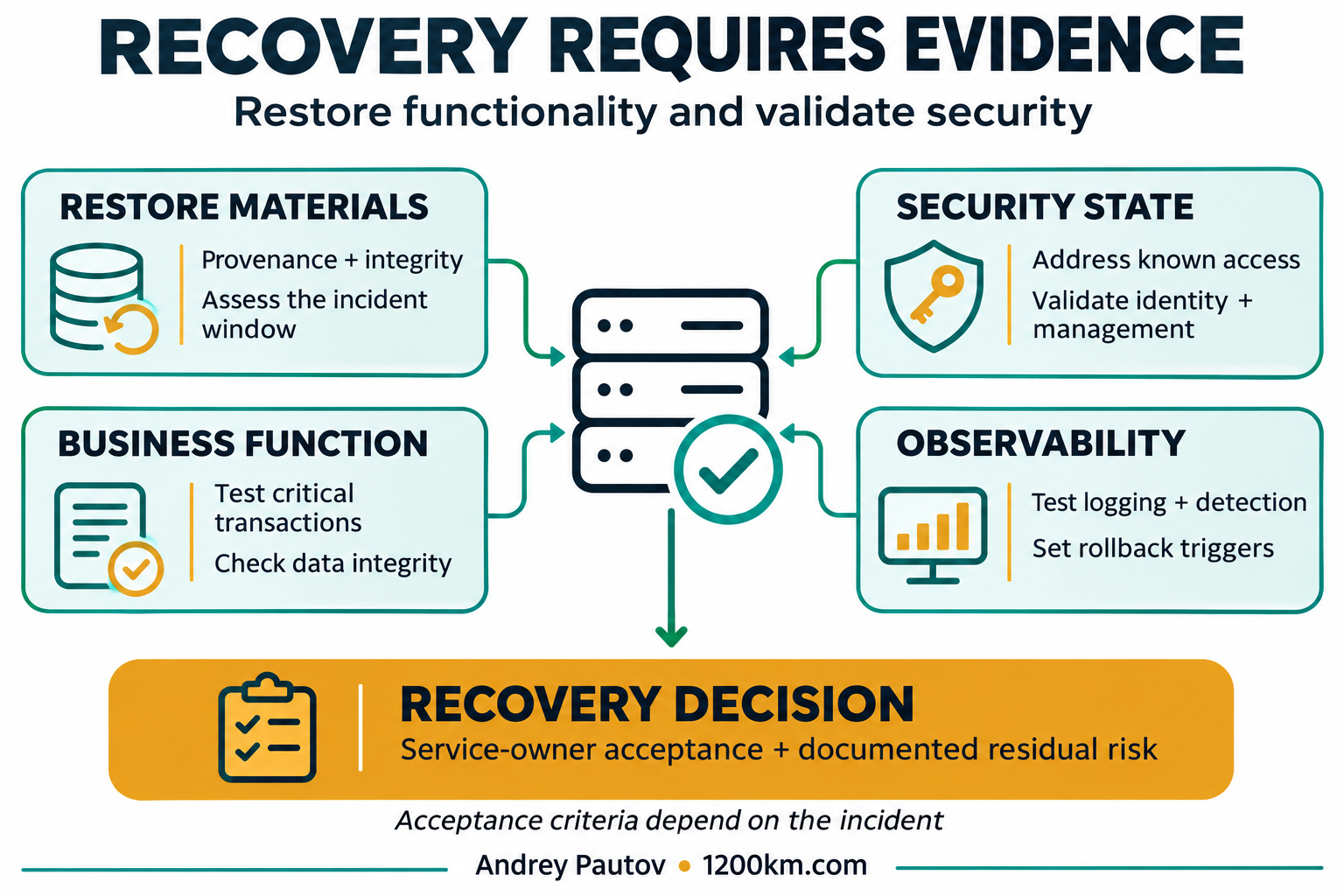
Figure 4. Recovery acceptance draws on technical and business evidence. The checks support a scoped decision; they do not establish the absence of every possible compromise.
Recovery time objective, or RTO, describes the target restoration time. Recovery point objective, or RPO, describes the target point in time to which data should be recovered. Meeting those targets does not by itself validate the security of a restore.
Choose monitoring duration from the incident's known behaviors, environment, visibility gaps, and consequences. A fixed quiet period cannot demonstrate safety if the required telemetry is absent. Specify the sources and behaviors monitored, the observation window, and what would reopen investigation.
Restoration and investigation can proceed at different speeds. A business may accept restricted service while forensic work continues, provided the decision and safeguards are explicit.
Recovery output: validated restoration, service-owner acceptance, monitoring and rollback arrangements, and documented residual risk.
A worked incident from alert to recovery
Synthetic training scenario: All events and elapsed times below are invented to demonstrate decisions. They are not observations from a real customer, performance benchmarks, or response-time requirements.
An employee reports a suspicious document. EDR records a suspicious process chain on WS-042. Later, the employee denies a cloud session associated with the account analyst@example.invalid.
| Elapsed time from first alert | Available evidence | Decision and next action |
|---|---|---|
| T+0 | Suspicious endpoint execution alert | Open a case, retrieve underlying events, identify the device and user |
| T+12 minutes | Process evidence and user report support unauthorized execution | Declare an incident under local criteria; isolate the endpoint and preserve available evidence |
| T+24 minutes | Identity records show an unfamiliar session; user denies it | Expand scope to identity and applications; restrict access and invoke applicable revocation controls |
| T+41 minutes | Application audit shows an unauthorized forwarding rule | Preserve its definition, remove it, and review related permissions and message activity |
| T+65 minutes | Available network logs show a large outbound transfer | Investigate destination, process, timing, and data-access records; do not call it confirmed exfiltration yet |
| T+2 hours | Review identifies a second unauthorized application session | Revisit containment scope; verify application-specific revocation and related access |
| T+6 hours | Specified endpoint persistence and unauthorized access paths have been addressed | Begin restricted restoration of the affected workspace while remaining data-impact questions stay open |
| Later review | Relevant checks and business tests pass within documented scope | Approve the applicable recovery stage and retain investigation tasks for unresolved impact |
What the evidence supports
Within this fictional scenario, endpoint records and the user's report support unauthorized execution. The denied session and application records support an identity-and-application investigation. The forwarding rule is a specific unauthorized configuration to remediate.
A large outbound transfer alone does not identify its contents. It may support an exfiltration hypothesis, but determining data impact requires additional evidence. Record whether the missing detail reflects unavailable logging, retention expiry, encryption, or an unfinished analysis task.
Why containment had to be revisited
Endpoint isolation did not answer whether application sessions remained usable. The second session expanded the scope and changed the verification requirement.
A useful status statement would be:
Within the synthetic exercise, the identified endpoint and application access paths have been addressed and checked. The contents of the observed outbound transfer remain undetermined because the available records do not identify the transferred objects.
That statement gives decision-makers both the progress and its boundary.
Communication and incident command
Maintain one coordinated case record even when responders use several technical tools. Record an incident lead, workstream owners, current priorities, decision authority, and the next update time.
The NCSC guidance cited earlier emphasizes coordination and careful tracking of findings, actions, missing data, and communications. Translate that into a short update format:
Current impact:
Confirmed findings and evidence references:
Scope under investigation:
Actions completed and verification results:
Important unknowns:
Decisions required, owner, and deadline:
Next update time:
Make updates audience-specific. Analysts need source identifiers and task status. Service owners need dependencies, operational consequences, and restoration conditions. Leadership needs impact, options, uncertainty, and decisions.
For external or regulatory communications, involve the designated legal, privacy, and communications owners. Determine applicable duties from the affected entity, jurisdiction, data, contracts, and incident facts; a technical lifecycle diagram cannot supply a universal notification deadline.
Use handover notes whenever ownership changes. Record what was attempted, what failed, what remains active, and which decision is next. This prevents a new shift from repeating a disruptive action or assuming an unfinished check passed.
Lessons learned: turn findings into tested changes
A review has operational value when it changes a control, workflow, or capability and produces evidence that the change works.
For the synthetic incident, the improvement backlog might look like this:
| Finding | Change | Acceptance test |
|---|---|---|
| Analysts assumed password reset covered application sessions | Add application-specific revocation requirements | Demonstrate the supported behavior in a non-production test application |
| The transfer could not be tied to objects | Review feasible data-access logging and its cost, privacy, and retention requirements | Retrieve the required object-level event from a controlled test |
| The endpoint-to-identity link took manual effort | Add a documented correlation workflow | A second analyst can reproduce the correlation from supplied evidence |
| Handover omitted an unresolved application session | Add access-path status to handover notes | A replacement responder correctly identifies pending containment checks |
Assign an owner, deadline, priority, and evidence requirement to each change. Close the item when the acceptance test passes and someone accountable accepts it.
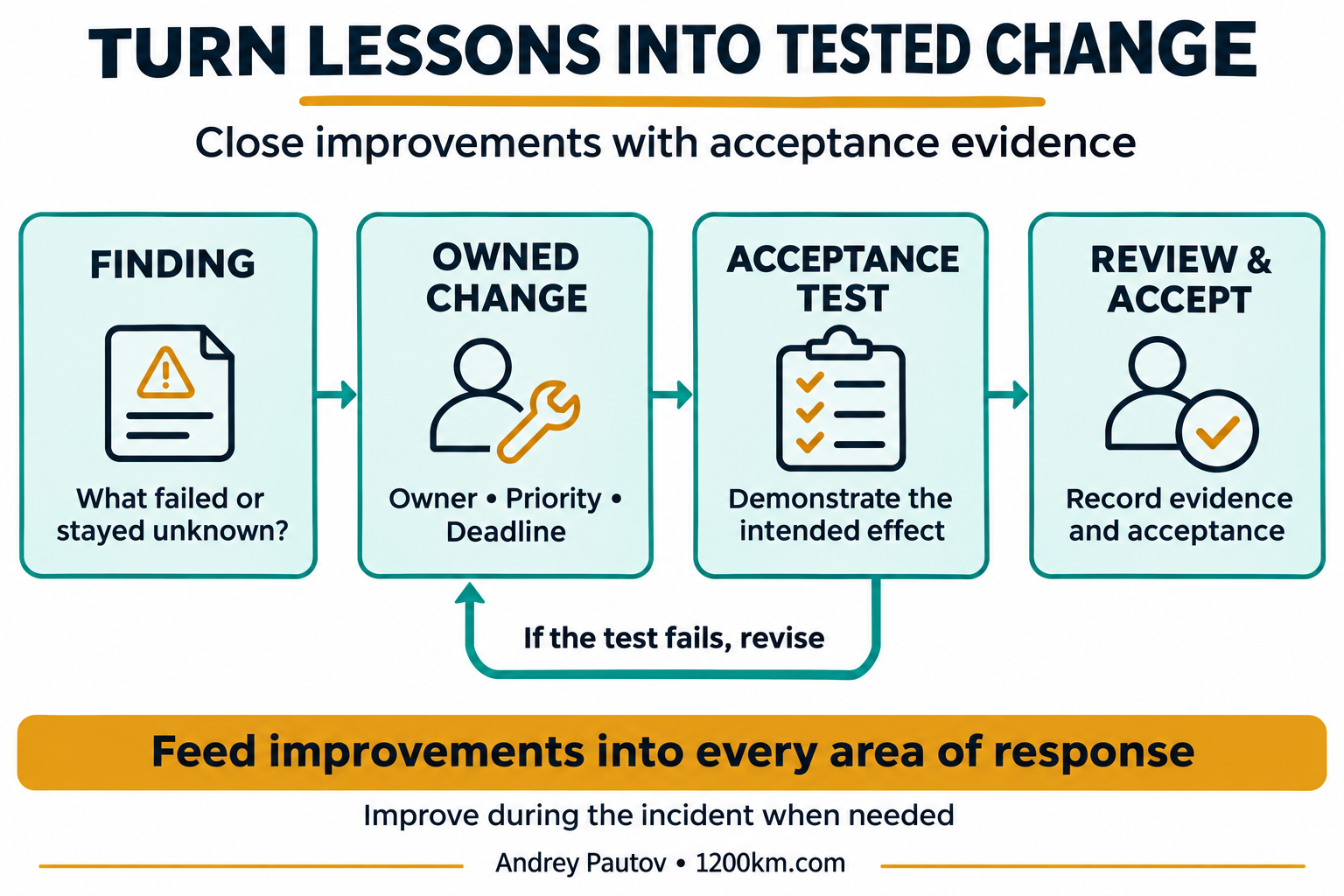
Figure 5. Close the improvement loop with acceptance evidence. Apply useful changes during the incident when needed, and revise changes that fail their tests.
This is consistent with Rev. 3's emphasis on continuous improvement: lessons can inform work while the incident is still active. Do not postpone an urgent logging or access correction simply because the final report is unfinished.
Where CTI, detection engineering, and AI fit
Threat intelligence helps responders ask better questions. It can suggest persistence locations, likely access paths, affected technologies, or behaviors worth searching. Those suggestions remain hypotheses until local evidence supports them.
For example, a report describing application permission abuse can justify a permission review. It does not establish that the local incident uses the same technique or involves the same actor.
Convert incident findings into detection work
A useful detection handoff contains the observed procedure, source evidence, required telemetry, candidate logic, benign alternatives, test plan, and intended response.
For the synthetic forwarding-rule event, investigate whether the mail platform records rule creation or modification, actor identity, destination, and relevant sign-in context. Candidate logic might correlate an unusual external destination with identity-risk context and the absence of an expected administrative change. Validate legitimate forwarding and migration workflows before deployment.
Map ATT&CK techniques only after checking the official technique definition against the actual procedure evidence. A mapping names a behavior; it does not demonstrate detection coverage.
This connects to CTI as a Code: maintain the evidence, reasoning, detection candidate, and validation results as reviewable artifacts. Keep sensitive incident evidence in an appropriately restricted repository or case system.
Give AI bounded tasks and human review
AI can assist with organizing an approved evidence subset, drafting timeline entries, suggesting follow-up questions, or preparing a status update. Give it explicit source IDs and require it to mark missing information.
Treat these as proposed uses, with acceptance checks:
| AI-assisted task | Required human validation |
|---|---|
| Timeline draft | Verify material events, timestamps, and source references |
| Suggested hunt | Check syntax, schema, time range, cost, and investigative relevance |
| Remediation draft | Verify platform behavior, scope, dependencies, authority, and rollback |
| Executive update | Check every impact statement and preserve important uncertainty |
Keep credentials, tokens, personal information, and sensitive evidence within approved processing boundaries. Incident artifacts may contain text designed to influence an AI system; treat their content as evidence, not instructions.
A generated plan is a draft. Destructive remediation, broad identity changes, external statements, and incident closure require the assigned human decision-maker's review. AI confidence does not replace evidence of successful containment or recovery.
Continue with related guides
Use the surrounding 1200km material to take the next operational step:
| Next task | Related resource | How it connects |
|---|---|---|
| Plan forensic collection | Digital Forensics and Incident Response | Extend the evidence register into endpoint, memory, network, cloud, and identity investigation |
| Improve triage and escalation | Blue Team and Defensive Security | Connect alert handling to an accountable incident handoff |
| Validate a detection improvement | Detection Engineering Techniques | Define telemetry prerequisites, test cases, and acceptance evidence |
| Place adversary behavior in context | Cyber Kill Chain reading paths | Explore attack-stage evidence while keeping the attack model distinct from the response lifecycle |
| Exercise the lifecycle | Incident response learning path | Use the synthetic scenario to produce a scoped containment and recovery decision record |
Measure outcomes and exercise the lifecycle
Define timestamps before calculating response metrics. Detection time, incident declaration, first containment action, verified containment, service restoration, and investigation closure describe different milestones.
The following are suggested internal measures, not industry benchmarks:
| Measure | Operational question |
|---|---|
| Detection to declaration | How long did classification and escalation take? |
| Declaration to verified containment | How long until the specified harmful access was interrupted? |
| Restore decision to validated service | Where did recovery execution or acceptance stall? |
| Cases with documented telemetry gaps | How often was an important question unanswerable? |
| Reopened incidents and their causes | Did scope or validation fail, or did new evidence change the case? |
| Improvements with accepted tests | Did the review create a working change? |
For containment, define the scope being measured. The first isolated host and all identified access paths may have different completion times. Preserve that distinction rather than hiding it inside one number.
Compare distributions and similar incident classes. An average across phishing triage, privileged cloud compromise, and destructive enterprise incidents can conceal the problems you need to fix.
Run a tabletop with a technical follow-through
Start with the synthetic scenario above. Ask participants to identify the incident owner, evidence sources, containment authority, and recovery criteria. Then introduce a new application session after endpoint isolation and a logging gap that prevents a data-impact conclusion.
Score whether the team revisits scope, chooses a relevant control, preserves uncertainty, and records the decision.
Follow the discussion with safe, authorized tests of export permissions, session revocation, telemetry correlation, and a restore in a suitable test environment. A tabletop tests decision-making; a technical exercise tests whether the supporting mechanisms work.
Limitations and common failure modes
This article synthesizes public guidance and proposes operating patterns. It does not report a production investigation, demonstrate a tool's effectiveness, or establish that any particular organization is ready to respond.
Several failure modes deserve explicit checks:
| Failure mode | Corrective habit |
|---|---|
| Treating the first alert as the full incident | Follow evidence-backed entity and trust relationships |
| Calling an action successful because the console accepted it | Verify resulting access, state, and relevant behavior |
| Treating a quiet dashboard as proof of eradication | State telemetry coverage and unresolved blind spots |
| Restoring from a backup merely because it predates encryption | Assess its relationship to the suspected compromise window |
| Closing recovery without a business test | Obtain service-owner acceptance against defined checks |
| Writing a report without implementing improvements | Require owners, deadlines, and acceptance evidence |
Cloud, SaaS, endpoint, identity, and operational technology environments require different acquisition and containment procedures. Retention, licensing, encryption, compromised logging infrastructure, and third-party access can all limit what can be established.
A defensible closure statement should identify the systems and access paths reviewed, checks performed, observation period, missing evidence, and accepted residual risk. Avoid claiming complete attacker removal when the investigation cannot support that scope.
Conclusion
The incident response lifecycle becomes useful when it connects each decision to evidence and each action to a check of its effect.
Prepare usable authority and access. Establish what the evidence supports. Interrupt the relevant attacker capabilities. Remediate known persistence and re-entry paths. Restore services against technical and business criteria. Turn the remaining weaknesses into tested improvements.
The discipline is to keep asking: What changed, how do we know, and what remains unresolved? That question belongs at every stage, including closure.
References
Primary guidance reviewed for this article on 2 November 2026:
- NIST SP 800-61 Rev. 3 — publication record. April 2025; supersedes Rev. 2.
- NIST SP 800-61 Rev. 3 — full publication. Section 2.1, Figures 1–2, and Table 1 for the lifecycle; Section 3 for the CSF profile.
- UK NCSC — Plan: Your cyber incident response processes. Planning, authority, incident coordination, severity, and review.
- SANS — Incident Response. Six-phase operational model.
- SANS — Dynamic Incident Response. Iterative verification, triage, and scoping; no outcome statistics from this page are used here.
- CISA joint advisory AA20-245A — Technical Approaches to Uncovering and Remediating Malicious Activity. Original CISA distribution, 1 September 2020.
- Joint StopRansomware Guide — October 2023 edition, hosted by the U.S. Treasury CDFI Fund. Part 2 for isolation and evidence-preservation tradeoffs; this is the dated edition reviewed, not a claim about the newest edition.
- Microsoft Learn — Revoke user access in Microsoft Entra ID. Token, session, and application revocation boundaries.
- NIST SP 800-184 — Guide for Cybersecurity Event Recovery. December 2016; Sections 2.2–2.3 for trust, dependencies, and recovery planning.
Related work:
Follow My Work
I publish practical cybersecurity research, CTI workflows, detection engineering notes, malware-analysis projects, AI-security research, open-source tools, labs, and technical guides.