Research and evidence
Read the consolidated foundations, incident analysis, telemetry contracts, and validation boundaries.
From unusual activity to defensible evidence.
Research, illustrated explanations, statistical models, and collection requirements—connected to your tools, simulations, and detection workspaces.
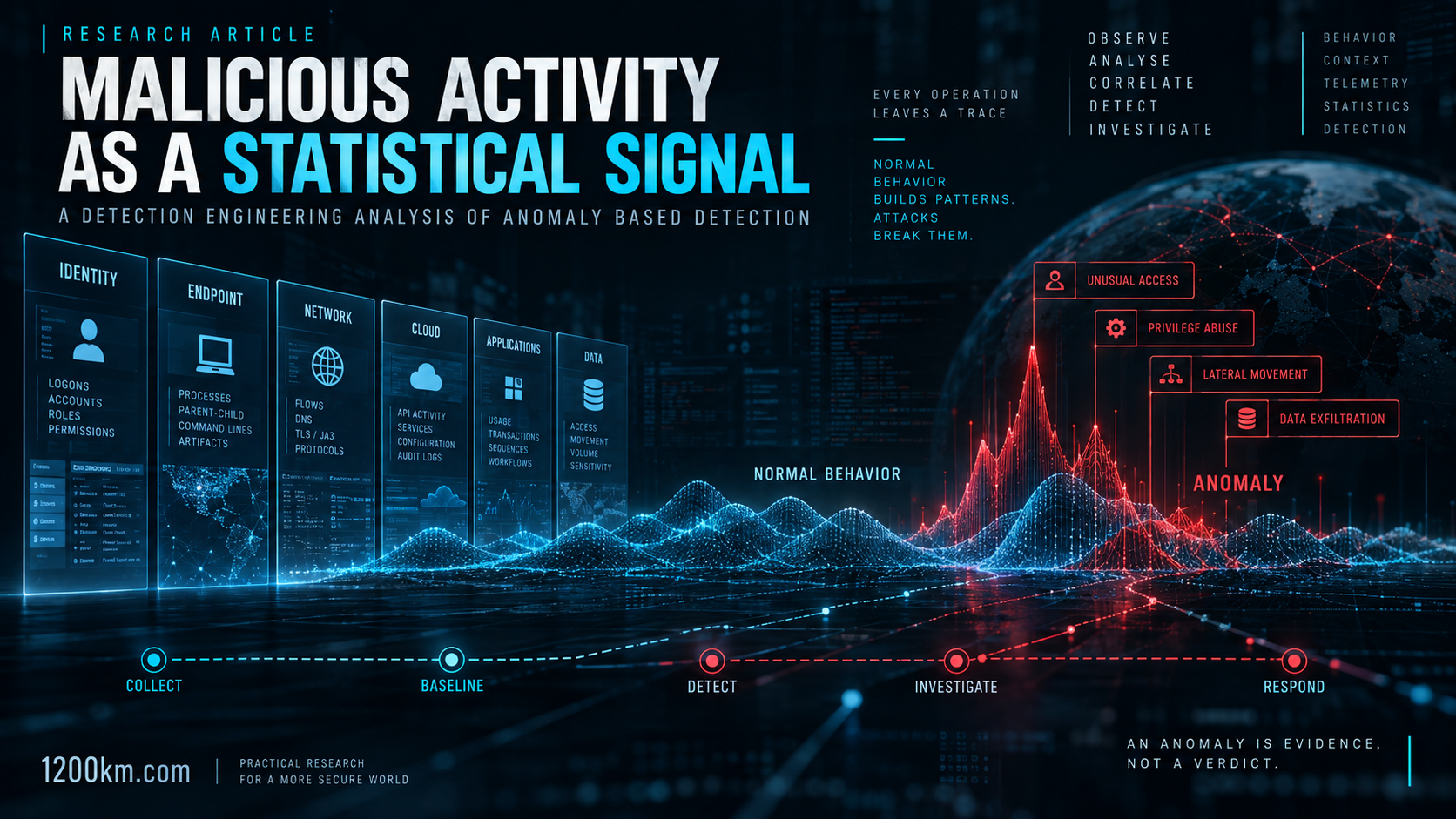
An anomaly is an investigation lead, not a maliciousness verdict. Follow the evidence from explanation to collection and testing.
Read the consolidated foundations, incident analysis, telemetry contracts, and validation boundaries.
Fourteen practical views of unusual behavior, plus multi-event correlation.
Compare an entity with an explicit expectation, then identify observable deviation.
Explore 118 overlapping statistical concepts without conflating them with operational families.
Browse 175 source categories and verify actual collection requirements.
Inspect deterministic concepts alongside the evidence-linked visual library.
The revised research now lives within the Atlas as focused chapters and family pages. Its 55 current figures remain beside the explanations, with text equivalents and original source links.
Browse the visual index · Read the evidence and migration scope
The original article remains a publication snapshot; this Atlas is the maintained reference. Existing citations and deep links continue to work.
Password spraying · SaaS downloads · Kerberoasting zero-match. Follow hypotheses, fields, queries, fixtures, reported results and limits.
These are operational feature families, not 15 mutually exclusive statistical classes. Correlation combines evidence from the other views.
Use Telemetry Library pages to verify collection, Detection Rules to inspect original rules and models, Attack Simulations for documented authorized-lab candidates, and Attack Tools for tool references and existing guides.
Keep technique and actor context in the Threat Matrix; use AdversaryGraph for evidence-driven investigation. These connections do not imply successful live execution or detector effectiveness.
ATT&CK activity catalog · Search the ecosystem · Existing guides