The Right Question: A Framework for Auditable Question Discovery
This published article remains available in the archive, but its technical currentness has not yet been reverified. Validate it against current authoritative sources before use.
A practical definition and selection framework for moving AI beyond plausible prompts toward bounded, adversarial, and testable empirical questions.
Artificial intelligence can answer questions, summarize evidence, and generate new text at extraordinary speed. It can also produce an almost unlimited number of research questions. But an abundance of questions is not the same as an abundance of discovery.
Douglas Adams gave us 42. The difficult part was not producing the answer; it was working out what anyone had actually asked—a problem modern AI can now reproduce at industrial speed.
Most generated questions are easy to write and expensive to investigate. Some are paraphrases of established work. Some hide false assumptions. Some sound important but cannot be connected to an observable. Others are technically testable, yet every possible answer would leave our beliefs and decisions unchanged.
My idea, The Right Question, begins from a different premise: the central problem is not generating more questions. It is finding questions that are worth the cost of answering—and making the reasoning behind that choice auditable.
The framework treats a research question as a structured proposal for changing a bounded state of knowledge. It combines diverse question-forming operators, adversarial criticism, scoped prior-art search, hard validity gates, explicit assumptions, observable consequences, and multiobjective selection. AI helps expand and challenge the search space, but it does not receive authority to declare truth or novelty.
I am currently performing empirical tests of this framework. This article explains the idea and its claim boundaries, then reports the current validation state without presenting incomplete tracks as successful evidence.
First published on Medium on 2 October 2026. This expanded 1200km edition adds the current validation results and self-hosted figures. The project repository, validation plan, and full evidence report preserve the implementation, protocols, raw-result boundaries, and reproduction artifacts.
Table of contents
- The problem is not a shortage of questions
- The central thesis
- Positioning against related work
- Knowledge must be bounded before questions are generated
- A question is a proposed knowledge transition
- Question discovery requires multiple operators
- Adversarial roles make the reasoning inspectable
- Novelty is a documented search result
- Hard gates come before scoring
- Why there should not be one universal question score
- The Question Frontier
- Questions should evolve without erasing their failures
- The proper division of labor between AI, code, and people
- A conceptual cybersecurity example
- What I am testing now
- Current validation results
- Limitations
- Conclusion
- References
- Follow My Work
The problem is not a shortage of questions
Question generation has become cheap. A model can transform a paragraph into dozens of apparently reasonable research prompts. This creates a misleading impression that the difficult part of discovery has been automated.
The difficult part is selection under uncertainty.
A research team has limited time, data, compute, laboratory access, reviewer attention, and tolerance for risk. Choosing one question means postponing many others. A useful system must therefore do more than produce fluent sentences. It must expose why a question deserves scarce investigative resources.
This requires distinguishing four objects that are often collapsed:
| Object | What it means |
|---|---|
| A new sentence | Wording that has not appeared before |
| A new question | A distinct relation, boundary, mechanism, or uncertainty |
| A useful experiment | A feasible observation with interpretable outcomes |
| New knowledge | A justified update to a claim, model, boundary, or decision |
These objects can overlap, but none guarantees the next. A new sentence may express an old question. A novel question may be impossible to investigate. A successful engineering artifact may improve operations without establishing a new causal or explanatory claim.
The Right Question is designed around those separations.
The central thesis
The framework’s central thesis is simple:
A valuable empirical question is one for which at least one plausible answer would produce a material, auditable update to a bounded state of knowledge, while the meaning of the other important outcomes is specified in advance.
This definition makes question value relational rather than absolute. A question is valuable for a particular knowledge state, decision context, and evidence boundary. The same question can be transformative for one team, routine for another, and meaningless for a third. The framework is scoped to empirical questions with inspectable evidence and possible observables. It does not claim to rank purely normative, philosophical, aesthetic, or personal questions.
The word material is operational rather than rhetorical. An answer produces a material update when it causes at least one of these declared changes:
- confidence in a claim moves by at least two steps on a declared five-bin
scale:
very low,low,medium,high, andvery high; - an evidence status changes, such as
unresolvedtosupportedorcontradicted; - the next justified action changes;
- a candidate mechanism enters or leaves the viable explanation set.
A useful question does not require every answer to cause a large update. One outcome may change the model substantially while another preserves the current view. The requirement is that at least one plausible outcome matters and that the no-change, null, and contradictory outcomes have explicit interpretations. If every plausible answer leads to the same belief, model, or action, the question may be interesting but it has low decision value. If the only acceptable answer is the answer preferred by the researcher, the question is not genuinely discriminating. If the required observable cannot exist, the question is not ready for investigation.
The framework therefore asks six questions about every candidate:
- What do we currently believe?
- Which evidence supports or contradicts that belief?
- Which assumption makes the proposed question meaningful?
- What could we observe?
- Which possible outcomes would change our knowledge?
- What would count against the proposed mechanism?
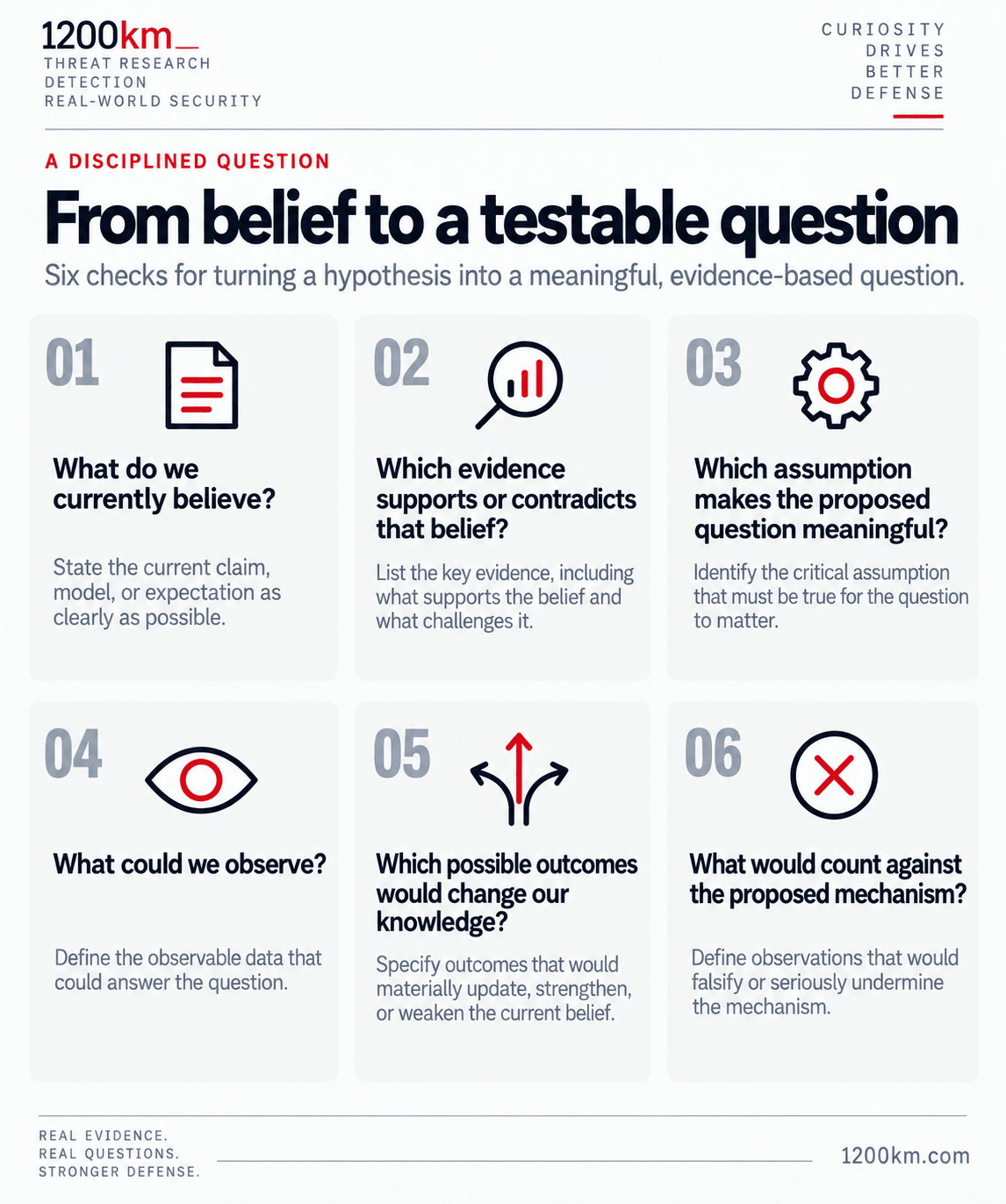
Figure 1. A question becomes testable only after its belief, evidence, assumptions, observables, material outcomes, and falsifier are explicit.
The question text is only the visible tip of this record.
The framework also makes one falsifiable comparative claim:
Given the same bounded evidence and resource constraints, a multioperator, adversarial, gated workflow should produce a lower false-question rate and a higher proportion of questions that blinded domain experts independently judge worth testing than free-form generation followed by generic self-critique.
This claim can fail. If controlled comparisons show no reliable improvement, or show that simpler methods perform as well at lower cost, then the added workflow is not justified.
Positioning against related work
The Right Question does not claim to invent question formation, falsifiability, information gain, assumption breaking, causal reasoning, novelty search, research agents, or Pareto selection. Several recent systems overlap directly with important parts of the framework.
-
FirstResearch: Establishes a Research Question Certificate that records primitives, assumptions, mechanisms, tension, falsifiability, a decisive test, and failure updates. The configuration tested here adds explicit multioperator generation, a scoped novelty ledger, assumption dispositions, hard gates, and grouped frontier selection.
-
InciteResearch: Establishes pre-question ideation through assumption-breaking hypothesis generation and necessity validation. The configuration tested here integrates assumption breaking with collision search, explicit evidence states, and downstream selection policy.
-
ResearchStudio-Idea: Establishes an evidence-grounded ideation skill suite with paper search and prior-art collision checking. The configuration tested here centers the artifact on empirical question records, provisional assumptions, outcome-dependent knowledge updates, and non-scalar comparison.
The distinction is therefore not any single component. It is the combined workflow and its decision policy: diverse operators generate candidates; adversarial roles attack them; evidence states determine whether assumptions are eligible, provisional, or rejected; and a small grouped objective vector preserves tradeoffs among survivors. Whether this configuration improves question selection is the empirical claim now being tested, not an established result.
Knowledge must be bounded before questions are generated
The process begins with a bounded knowledge state:
K = {C, E, X, M, O, U}
where:
Crepresents current claims;Erepresents supporting and contradicting evidence;Xrepresents tensions, anomalies, and unexplained residuals;Mrepresents the current mechanism or causal model;Orepresents available observables;Urepresents uncertainty, missing access, and unresolved assumptions.
This boundary is not merely documentation. It determines which questions can be justified and which claims can later be made.
For example, a model that sees only endpoint events cannot honestly infer an identity mechanism without additional evidence. A system with current literature cannot be used to simulate historical discovery unless later terminology and outcomes are excluded. A question based on private telemetry cannot be described as broadly generalizable before it is tested elsewhere.
A useful evidence boundary records:
- the domain and decision context;
- the sources supplied or searched;
- the relevant dates;
- excluded or inaccessible sources;
- what is directly observed;
- what is inferred;
- what remains unconfirmed.
This prevents a common failure in AI-assisted research: allowing the model to mix evidence, background knowledge, plausible invention, and hindsight into one fluent narrative.
A question is a proposed knowledge transition
In this framework, a question is not just a sentence ending with a question
mark. It is a proposed transition from K to a possible future state
K-prime.
Conceptually, a complete question record can be represented as:
q = {P, A, Y, T, delta-K}
where:
Pis the proposition or relation under investigation;Ais the set of load-bearing assumptions;Yis the set of observable outcomes;Tis the minimal discriminating observation or test;delta-Kdescribes how each important outcome changes knowledge.
This formulation forces the researcher to define more than a preferred positive result. A strong question explains what a null result means, what a contradictory result means, and which result would invalidate the framing itself.
Consider the difference between these two questions:
Can identity graphs detect attackers?
and:
Within a defined environment, does adding a temporal relationship between privilege change, new-device authentication, and remote execution provide discriminating information beyond the same events without identity links?
The first question contains an undefined technology, population, outcome, and baseline. It invites a demonstration rather than a knowledge update. The second identifies a relation, a comparison, a boundary, and a possible observable difference. It can still be wrong, but it is structured so that being wrong is informative.
Question discovery requires multiple operators
Free-form brainstorming tends to collapse into paraphrases. If an agent is asked to “find a research gap,” it often generates several versions of the same missing fact.
The Right Question instead uses explicit discovery operators. Each operator interrogates the evidence from a different direction.
| Operator family | What it asks |
|---|---|
| Missing relation | Which expected connection has not been examined? |
| Contradiction | Which observation could distinguish conflicting claims? |
| Anomaly | Which mechanism could explain a residual the current model misses? |
| Assumption inversion | What changes if a load-bearing premise is false? |
| Hidden variable | Which unobserved factor could produce the apparent relation? |
| Causal reversal | Could the proposed effect be producing the supposed cause? |
| Boundary condition | Where does an accepted relation stop holding? |
| Negative space | Which expected event or relation is absent, and does that absence matter? |
| Scale transfer | Does a mechanism survive a change in scale or granularity? |
| Domain bridge | Is there a justified structural mapping to another field? |
| Tool-created observability | What became askable only because a new measurement is available? |
| Counterfactual | What should differ if an alternative mechanism were true? |
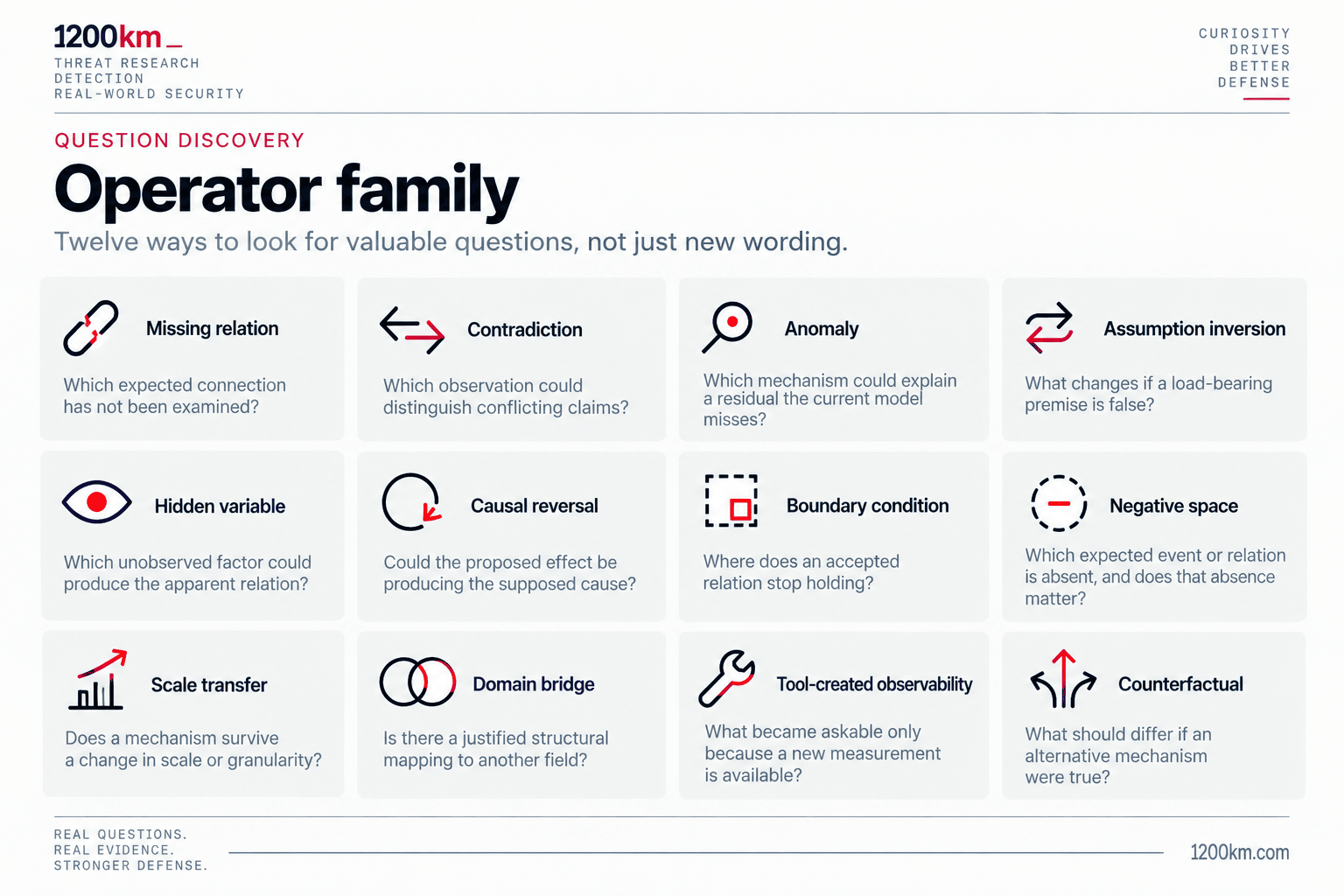
Figure 2. Twelve operator families search for different structures in the same bounded evidence instead of generating paraphrases of one generic gap.
The goal is not to maximize the number of operators used. The goal is to avoid letting one style of reasoning define the entire candidate pool.
A contradiction operator may produce a discriminating comparison. A boundary operator may expose where a known relation fails. A causal-reversal operator may show that the original premise was backwards. These are not cosmetic rewrites; they imply different observations and different knowledge updates. The causal operators inherit the basic discipline emphasized by Judea Pearl: causal direction and intervention claims cannot be recovered from fluent association alone.
Adversarial roles make the reasoning inspectable
The framework separates question development into adversarial roles. This is not intended to imitate a committee for its own sake. Each role has a narrow responsibility and produces a different inspectable artifact.
| Role | Responsibility |
|---|---|
| Generator | Expand the candidate space through distinct operators |
| Assumption critic | Expose causal, sampling, measurement, and scope assumptions |
| Nonsense filter | Reject category errors, circular logic, undefined variables, and inaccessible observables |
| Novelty hunter | Search for semantic collisions, older terminology, adjacent fields, and negative results |
| Experiment designer | Identify the cheapest observation that separates leading explanations |
| Paradigm challenger | Replace one load-bearing frame while preserving established constraints |
The generator cannot certify its own novelty. The novelty hunter cannot decide that a question is scientifically important. The experiment designer cannot rescue an incoherent premise merely by proposing a sophisticated measurement.
This separation creates productive friction. It also leaves a trail that a human reviewer can inspect. When a question survives, the reader can see which assumptions were challenged, which collisions were considered, and why the remaining uncertainty was accepted.
The roles do not guarantee independence. Several models may reproduce the same bias, and a single model playing several roles may remain anchored to its first answer. The benefit is therefore procedural transparency, not automatic truth. The paradigm-challenger role is influenced by Thomas Kuhn’s account of how prevailing frames shape legitimate questions, but it receives no automatic value merely for being distant from the current frame.
Novelty is a documented search result
Global novelty cannot be established by a finite search. Literature is distributed across languages, disciplines, patents, theses, datasets, proprietary systems, failed experiments, and unindexed practice. Even a careful search can miss the nearest work.
The Right Question therefore avoids the label “novel” as an unrestricted property. It uses four bounded statuses:
known: substantially the same material question and discriminating test are documented;collision: wording differs, but located work materially answers or operationalizes the question;not_found: no collision was located within the recorded search scope;unresolved: access, terminology, coverage, or evidence is insufficient.
Candidates marked known or collision remain in the audit record but cannot
enter the eligible frontier. An unresolved candidate may proceed only with
its uncertainty and search limits attached; not_found remains a scoped
search result rather than proof of global novelty.
The novelty ledger records queries, sources, dates, filters, inspected hits, nearest prior work, access failures, and collision reasoning. Search passes move beyond exact wording to include:
- mechanisms and semantic equivalents;
- historical names, acronyms, and translations;
- predicted observables rather than preferred explanations;
- adjacent disciplines and structural analogies;
- reviews, citation chains, patents, datasets, theses, and negative results;
- evidence that the premise is false or that the proposed observation is routine.
“Not found” therefore means exactly what it says: not found in the documented scope. It never means that no one has asked the question before.
Hard gates come before scoring
Many ranking systems allow strength on one dimension to compensate for a fundamental failure elsewhere. A candidate can receive a high novelty score and survive despite being incoherent or unmeasurable.
The Right Question applies four hard gates before any comparative scoring:
- Soundness: no known category error or premise contradiction already defeats the question.
- Informativeness: at least one plausible answer would materially change a belief, model, investigation, or decision, while other important outcomes have declared interpretations.
- Evidence binding: assumptions and evaluations refer to declared evidence rather than unsupported model prose.
- Nonsense-filter passage: terms, units, causal direction, population, observables, and comparison logic cohere, and at least one stated observation could count against the proposed mechanism or framing.
The gate requires a falsifier to exist. After that binary requirement is met, the falsifiability judgment inside empirical viability evaluates how precise, feasible, and discriminating that falsifier is.
A model, a human reviewer, or an evidence-backed review procedure supplies the gate judgments. Deterministic code does not know whether a question is sound or informative. It validates that the required judgments and rationales are present, then enforces the declared disposition consistently.
Assumption status is handled separately and explicitly:
- a contradicted critical assumption rejects the candidate;
- an unresolved critical assumption makes the candidate
provisionaland keeps it off the eligible frontier until the assumption is resolved; - an unresolved noncritical assumption may remain eligible only when the uncertainty is recorded;
- supported assumptions do not prove the question, but they allow evaluation to continue.
Evidence binding therefore does not mean that every assumption must already be supported. It means that assumptions have explicit evidence states and that unresolved critical uncertainty cannot be silently treated as eligibility.
A question that fails a gate is rejected. High surprise, broad reach, or apparent novelty cannot compensate for a false premise. This preserves the falsifiability discipline associated with Karl Popper: a candidate must expose what could count against it rather than merely describe a desirable outcome.
This makes rejection a legitimate output. The framework is not designed to rewrite every candidate until it passes. A failed question may reveal that the ontology is wrong, that the evidence is inaccessible, or that the proposed answer would not matter. Preserving that failure is part of the knowledge process.
Why there should not be one universal question score
Research questions contain real, irreducible tradeoffs. One may be inexpensive and narrow. Another may be difficult but capable of changing several important claims. A third may be highly falsifiable but dependent on evidence that is not yet accessible.
To avoid an eleven-axis frontier that retains almost everything, the selection policy groups value judgments into four objectives:
| Grouped objective | Constituent judgments |
|---|---|
| Epistemic value | Scoped novelty, information gain, and surprise |
| Empirical viability | Testability, falsifiability, plausibility, and evidential accessibility |
| Scope | Reach of the possible knowledge update |
| Burden | The inverse of cost, time, coordination, and ethical burden |
Information gain follows the experimental perspective developed by Dennis Lindley: the value lies in how much an observation can change uncertainty, not in how impressive the question sounds.
Operator family, cross-domain bridging, contradiction origin, and paradigm distance remain descriptive or diagnostic metadata. They explain where a question came from and help audit diversity, but they are not benefits by themselves. If a cross-domain bridge or contradiction resolution creates real value, that value must appear through information gain, empirical viability, or reach rather than receiving a second score for its origin.
Each retained value judgment requires a rationale and evidence references. These are structured judgments, not calibrated probabilities. Grouping reduces frontier sparsity, but it does not make the groups objective facts.
Collapsing them into one “discovery score” would create false precision. There is no universal exchange rate between reach, testability, novelty, and cost. A weighted sum can be useful for a specific organization, but its weights express policy. They should be visible, justified, and tested for sensitivity.
The default framework therefore preserves four explicit objectives instead of pretending that every individual feature naturally deserves its own axis or that all values share one universal scale.
The Question Frontier
Rather than selecting a universal winner, the framework constructs a Pareto frontier across the four grouped objectives: the set of surviving questions that are not dominated across epistemic value, empirical viability, scope, and burden.
Candidate q-a dominates q-b only if q-a is at least as strong on every
grouped objective and stronger on at least one. A non-dominated question
remains on the Question Frontier.
This produces a more honest decision surface:
- an accessible, narrow question can survive beside an expensive, high-reach question;
- a high-information question can survive beside a more empirically accessible question;
- two questions can remain legitimate because they represent different resource and knowledge tradeoffs.
The frontier does not say that every surviving question should be investigated. It says that no surviving candidate is obviously inferior under the declared groups. Even four dimensions may leave a broad frontier, especially when the candidate pool is small or judgments are noisy. Frontier size is therefore a diagnostic: if almost everything survives, the groups or evidence need better discrimination rather than additional dimensions.
If a team must choose one question, it can apply a context-specific cost rule, resource limit, ethical constraint, or strategic priority. The important point is that this final decision is explicit. It is not hidden inside an opaque model score.
Questions should evolve without erasing their failures
Research questions change when evidence changes. A collision with prior art may force a narrower boundary. A failed observation may invalidate a mechanism. A new instrument may make a previously abstract variable measurable.
The framework treats a material revision as a new version. A question-evolution record preserves:
- the trigger for revision;
- evidence added or removed;
- assumptions changed;
- observables changed;
- novelty-ledger changes;
- selection-feature changes;
- the reason the previous version failed or became incomplete.
This matters because polished final wording can erase the actual path of discovery. The useful history often includes vague questions, false premises, prior-art collisions, measurement failures, and null observations.
A failed question is not always wasted effort. It can reveal a broken classification, a hidden dependency, a missing instrument, or an unproductive research direction. The framework preserves those outcomes rather than presenting every surviving question as if it emerged fully formed.
The proper division of labor between AI, code, and people
The Right Question separates three kinds of work.
AI expands and challenges
Language models are useful for generating structural alternatives, surfacing assumptions, proposing search terms, translating between disciplines, and challenging the current frame. They are especially valuable when the goal is to explore several possible ways of asking rather than immediately converging on one polished answer.
AI output remains a lead. A fluent rationale is not evidence, and agreement between several models is not independent corroboration.
Deterministic code enforces declared policy
Schemas and deterministic logic can verify that required fields exist, values are in range, supplied gate verdicts are enforced, rejected and provisional candidates remain visible, and Pareto selection follows the stated rule.
This layer does not judge soundness, informativeness, novelty, or scientific truth. Those verdicts come from people, models, or review procedures and must carry evidence and rationales. Code owns only consistency and enforcement: the same structured judgments should produce the same policy output.
People retain responsibility
Domain experts decide whether the evidence is meaningful, whether the assumptions are acceptable, whether the proposed observation is ethical, and whether the remaining uncertainty justifies the cost.
People also define the decision context. A frontier cannot determine an organization’s risk tolerance, scientific priorities, legal duties, or moral constraints.
The framework is therefore not an autonomous scientist. It is an audited collaboration between generative reasoning, deterministic policy, evidence, and human judgment.
A conceptual cybersecurity example
Consider a security team investigating privileged activity. It has endpoint events, authentication records, identity-role changes, and administrative context. Existing detections evaluate individual events, but the team suspects that temporal relations across these sources may contain additional information.
A free-form system might ask:
Can AI use identity graphs to detect sophisticated attacks?
The question sounds current, but it is weak. “AI,” “identity graph,” “sophisticated,” and “detect” are undefined. There is no population, baseline, boundary, or falsifier.
Different operators produce more useful candidates:
| Operator | Conceptual candidate |
|---|---|
| Missing relation | Does a privilege-change-to-execution path add information beyond the same events considered separately? |
| Causal reversal | Do emergency administrative actions cause both the identity change and the alert pattern? |
| Boundary condition | At what temporal separation does the identity relation stop contributing useful information? |
| Negative space | Does the absence of expected administrative context distinguish otherwise similar sessions? |
The assumption critic would then expose identity-resolution quality, clock alignment, label construction, observation-window comparability, and missing administrative records. The nonsense filter would require a declared population, observable, comparison, and causal direction. The novelty hunter would search academic work, commercial capabilities, patents, public detections, and older terminology.
The important output is not the most impressive sentence. It is a question record that shows what is known, which assumptions remain unresolved, what observation could distinguish explanations, and how different outcomes would change the investigation.
This example is conceptual and sanitized. It is not a reported experiment, customer finding, detection result, or claim of novelty.
What I am testing now
The framework is intentionally stronger than a prompt pattern: it makes claims about the quality, auditability, and selection of questions. Those claims need evidence.
At the time of writing, I am performing a structured validation program. The work examines whether the framework can:
- classify evidence status without confusing support, contradiction, and unresolved information;
- generate questions that compile into objective, measurable predictors;
- avoid rewarding questions that are incoherent or impossible to execute;
- identify prior-art collisions without treating a failed search as proof of novelty;
- produce selections that remain useful when compared with simpler baselines;
- preserve tradeoffs without hiding them inside one arbitrary score;
- support reliable review by independent human experts;
- remain honest when outcomes are delayed, inaccessible, or negative.
Some parts of this work require future outcomes, licensed datasets, or human review. Those dependencies cannot be replaced with model opinion. The validation process therefore separates implementation checks, synthetic checks, existing expert labels, prospective outcomes, and human judgments.
The completed, failed, blocked, and future-dependent results are reported below and preserved in the repository. Until the required real-world and human comparisons are complete, The Right Question should be understood as a testable framework and research instrument—not as a proven method for increasing scientific discovery.
Current validation results
The validation snapshot below is dated 1 October 2026. It combines machine checks, one completed SciFact model cell, a frozen prospective vulnerability ranking, and explicit non-results. The shared model-call ledger stopped at the preregistered boundary of 128 of 160 attempts. No future KEV outcome was opened early, no human judgment was simulated, and no unavailable dataset or model was silently replaced.
| Track | Observed result | What it establishes |
|---|---|---|
| Implementation and integrity | The preserved JUnit record contains 62 tests with zero failures, errors, or skips. Workflow and baseline ranking artifacts rebuilt byte-for-byte. | Deterministic implementation consistency and artifact reproducibility—not question quality or scientific discovery. |
| SciFact evidence-status classification | GPT-4.1 reached 84.0% majority agreement, below the fixed 85% threshold. Its 2.0% contradicted-called-supported rate passed the 10% ceiling. Anthropic evidence coverage was incomplete; the local Qwen cells produced no responses. | The only complete evidence-model cell missed the primary threshold. The three-model experiment failed to complete. |
| Prospective KEV workflow | Three of 12 generated questions were unexecutable: 25%, above the fixed 10% maximum. The selected EPSS-free ranking covers 379,952 eligible CVEs and reproduced byte-identically. | The operational rule already failed. Future recall remains unevaluated and cannot repair that failure. |
| PatentMatch collision retrieval | Official licensing and label meaning were confirmed, but official dataset bytes were unavailable and no third-party substitute was accepted. | Dataset readiness only; no retrieval metric. |
| Human preference study | The protocol, rubric, evidence packs, and synthetic analysis check exist, but the required candidate corpus, blinded forms, sealed keys, and reviewer ratings do not. | Preparation only; no expert-preference or reliability result. |
| LANL telemetry | No authorized local dataset was supplied, so no telemetry records or outcomes were inspected. | No end-to-end telemetry result. |
The most informative result is not a win. The SciFact threshold miss shows that high repeatability does not guarantee sufficient agreement with evidence labels. The prospective track shows that a theoretically attractive workflow can still fail operationally when too many generated questions cannot compile into measurable predictors. Those failures are exactly the kind of evidence the framework is supposed to retain.
The project’s central comparative claim therefore remains unevaluated. The current evidence does not show that the workflow produces questions that blinded experts prefer, improves real-world discovery, retrieves novelty collisions reliably, or beats simpler baselines on future outcomes. See the full report, SciFact proof report, and prospective KEV report for the exact denominators, failures, deviations, and next evidence dates.
Limitations
The framework cannot guarantee global novelty. No finite search can.
Its feature values remain judgments. Requiring rationales and evidence makes those judgments auditable, but it does not automatically make them correct.
Pareto selection depends on the candidate pool. A valuable question that was never generated cannot appear on the frontier.
Grouping reduces the tendency of a high-dimensional frontier to retain nearly every candidate, but the grouped frontier can still be broad. Arithmetic means inside a group can also hide a weak constituent behind a strong one. Group definitions, minimum constituent floors, frontier size, and sensitivity to judgment uncertainty therefore remain part of the selection audit.
Adversarial roles can share model biases. Role separation improves process visibility but does not create independent evidence.
A question can be sound, informative, and testable while still being unsafe, unethical, or socially unacceptable. Medical, biological, cybersecurity, dual-use, and human-subject research require their own governance.
The framework also cannot guarantee that answering a strong question will produce an important discovery. Research can fail because measurements are noisy, effects are small, mechanisms are more complex than expected, or the world simply does not contain the hoped-for relation.
Finally, formal structure can create an illusion of rigor. A complete JSON record, detailed rationale, or clean frontier is not evidence by itself. The framework is useful only when its fields remain tied to real observations, honest uncertainty, and decisions that can be challenged.
Conclusion
The right question is not the most original sentence an AI can generate. It is a structured proposal for an observation that could change a bounded state of knowledge.
That proposal should reveal its assumptions, survive adversarial criticism, face a documented novelty search, define interpretable outcomes, and compete with alternatives without hiding real tradeoffs. It should also be allowed to fail.
The Right Question reframes AI from an answer machine or creativity oracle into an audited collaborator. AI can expand the space of possibilities. Deterministic policy can preserve consistency. Human judgment can set boundaries and accept responsibility. Evidence still decides what we learn.
Testing has begun, and the first results include threshold misses, blocked tracks, reproducible machine artifacts, and deliberately unopened future outcomes. Until the comparative evidence is established, the most important claim is also the most modest: question discovery can be made more explicit, more adversarial, and more auditable than free-form brainstorming alone.
References
- The Right Question project repository
- Real-World Validation Plan v0.3
- Feasible Validation Report, 1 October 2026
- Original Medium publication
- FirstResearch: Auditable Question Formation for LLM Scientific Discovery Agents
- More Than Can Be Said: A Benchmark and Framework for Pre-Question Scientific Ideation
- ResearchStudio-Idea: An Evidence-Grounded Research-Ideation Skill Suite
- Karl Popper, The Logic of Scientific Discovery
- Thomas S. Kuhn, The Structure of Scientific Revolutions
- Dennis V. Lindley, “On a Measure of the Information Provided by an Experiment”
- Judea Pearl, Causality
Follow My Work
I publish practical cybersecurity research, CTI workflows, detection engineering notes, malware-analysis projects, AI-security research, open-source tools, labs, and technical guides.