1. Why Insider Detection Is Structurally Harder
Insider threat detection is structurally harder than external attack detection for a single reason: the attacker is already authenticated. There is no perimeter to cross, no credential to steal, no exploit to fire. The insider has a valid account, knows where sensitive data lives, understands what monitoring exists, and can operate at a pace that blends into normal work activity.
External attacker detection relies on the contrast between attacker behaviour and the environment's baseline — unusual protocols, new source IPs, first-logon anomalies, unexpected tools. The insider is the baseline. Their legitimate access is the attack vector.
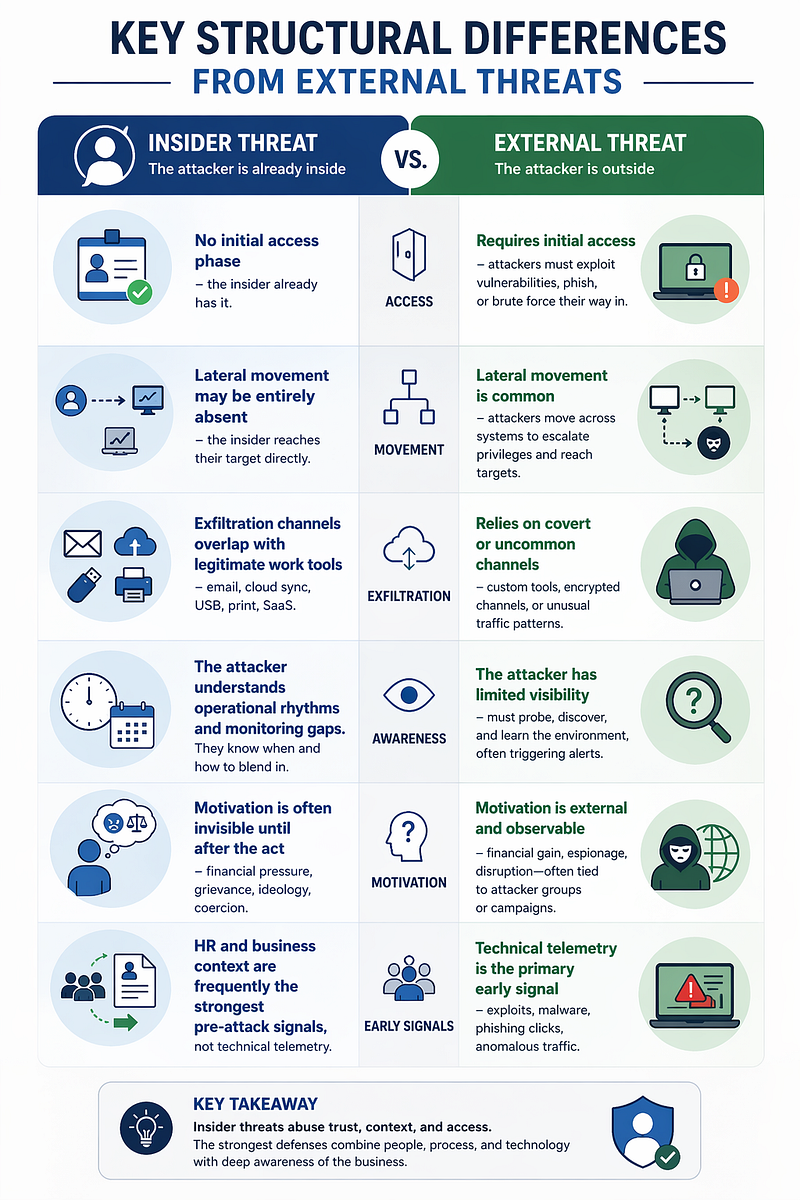
Key Structural Differences from External Threats
- No initial access phase — the insider already has it
- Lateral movement may be entirely absent — the insider reaches their target directly
- Exfiltration channels overlap with legitimate work tools: email, cloud sync, USB, print, SaaS
- The attacker understands operational rhythms and monitoring gaps
- Motivation is often invisible until after the act — financial pressure, grievance, ideology, coercion
- HR and business context (resignation, performance dispute, role change) are frequently the strongest pre-attack signals, not technical telemetry
Statistical Context
The CERT/CMU Insider Threat Center has documented more than 1,500 cases across its research programme, spanning IT sabotage, IP theft, fraud, and espionage categories. These cases form the empirical foundation for the detection patterns in this guide.
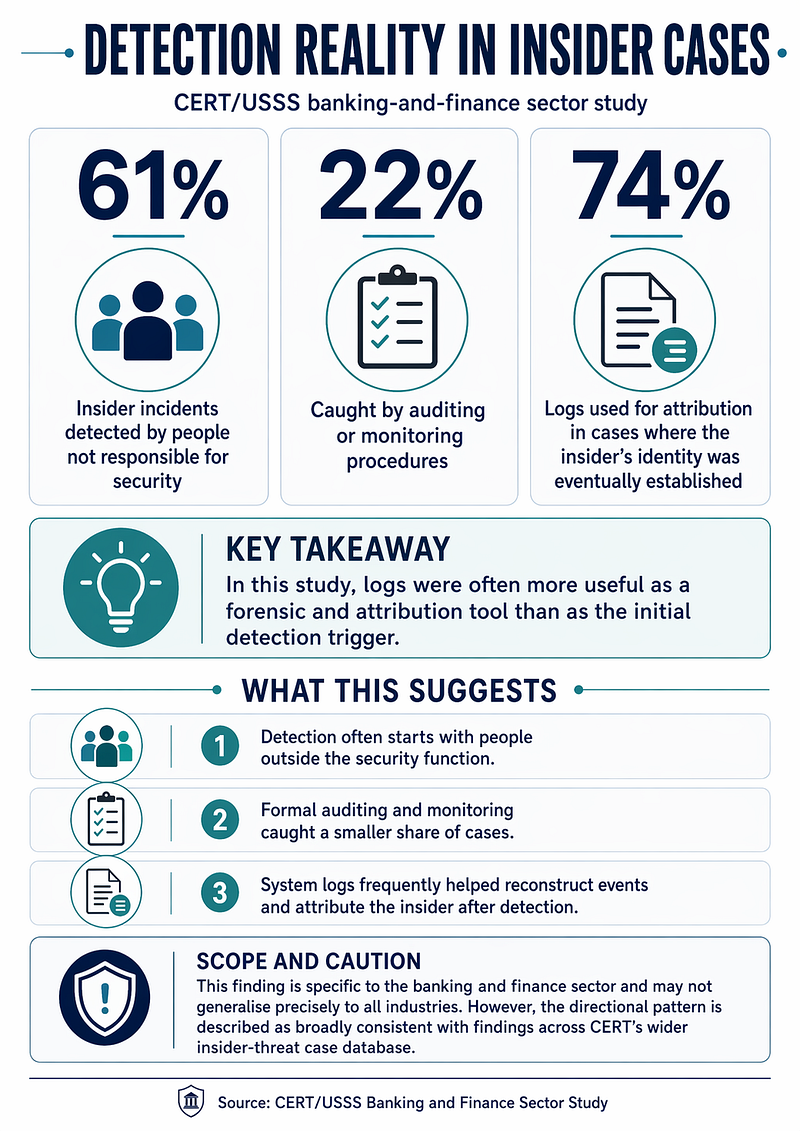
On detection method: the CERT/USSS banking-and-finance sector study found that:
- 61% of insider incidents were detected by people not responsible for security
- Only 22% were caught by auditing or monitoring procedures
- Logs were used for attribution in 74% of cases where the insider's identity was eventually established — meaning logs are most often a forensic tool rather than a detection trigger
On incident containment: the 2023 Ponemon Cost of Insider Risks Global Report found that organisations took an average of 86 days to contain an insider incident.
The most dangerous insider — technically sophisticated, patient, motivated — is also the one most likely to understand and evade the controls in place. The cases that are detected are frequently caught by non-technical means: a colleague tip, an external referral, a law enforcement notification, or a forensic artefact left during covering-tracks activity.
Building a programme that supports and amplifies human observation is as important as the detection engineering itself.
Where DLP Consistently Fails
DLP fails most consistently when the programme is content-only, threshold-only, or channel-limited. It struggles when:
- The actor copies data to a workstation and then to removable media in sub-threshold chunks
- The exfiltration channel is an approved SaaS workflow
- The destination is hidden behind long-lived OAuth tokens or encrypted messaging
- The exfiltration is transformed into print, screenshots, or staged archives rather than raw document transfer
- The encoding is steganographic — legitimate-looking image files carrying hidden payloads
The Desjardins regulatory findings are the most explicit documentation of this failure: over at least 26 months, an insider's activity was not detected because monitoring was partial, log review was passive, and transfer controls were threshold-based rather than sensitivity-aware. The Office of the Privacy Commissioner of Canada explicitly required that monitoring cover access and transfers below the minimum volume threshold.
Privileged Users vs Standard Employees
Detection differs materially by user type. CERT's sabotage research found that most sabotage insiders held technical or privileged roles and that administrator access was common. These users can:
- Create persistence
- Alter logs
- Destroy backups
- Make destructive changes that look like normal administration
...unless control-plane actions are monitored separately.
Standard employees are more often detected through repository-drain patterns, role-scope deviations, departure-linked volume spikes, and human observation.