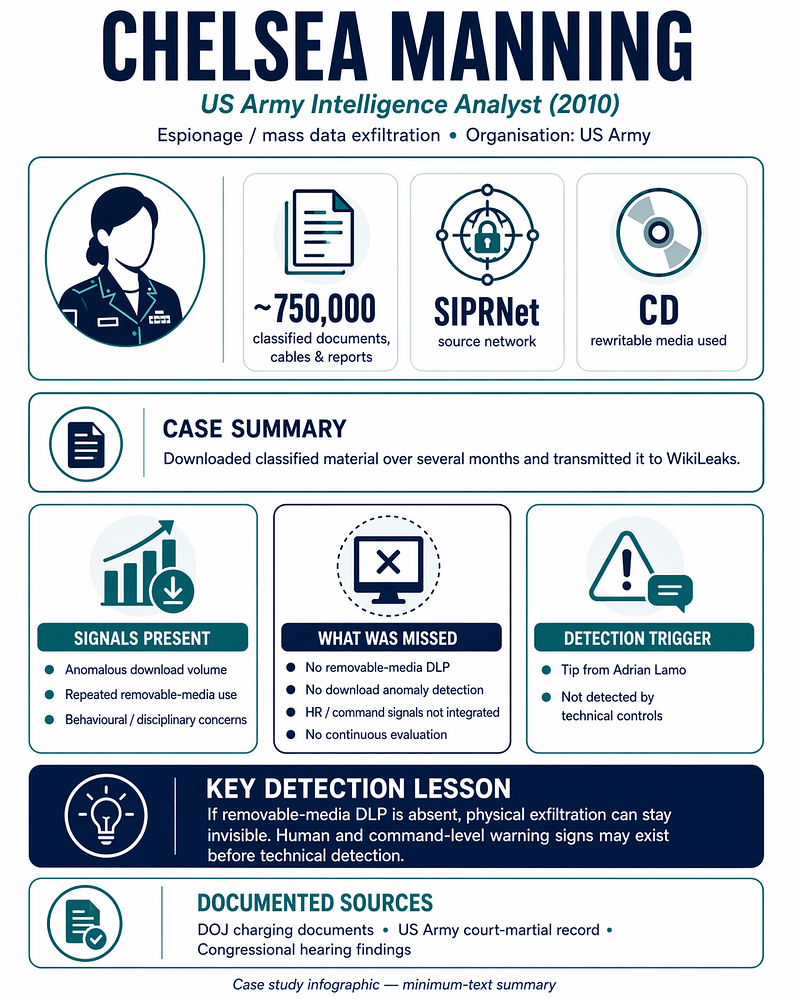
2. Insider Threat Taxonomy and Kill Chain
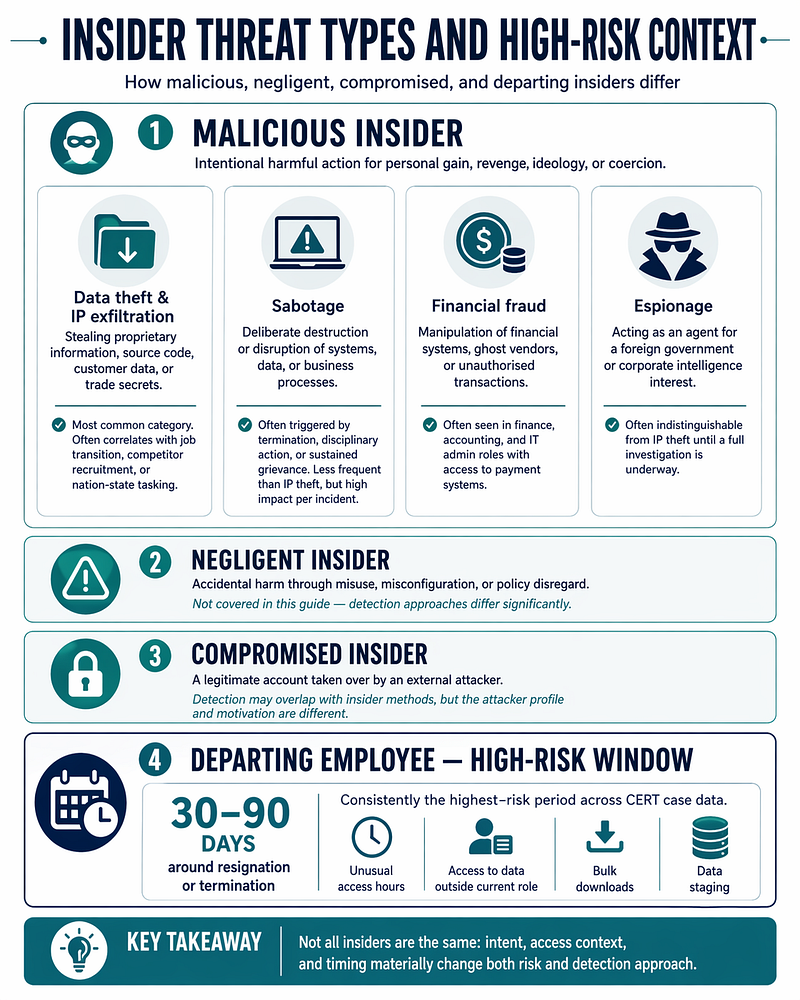
2.1 Threat Categories
The CERT/CMU Division classifies insider threats across three primary types, based on analysis of more than 1,500 documented cases:
Malicious Insider
Intentional harmful action for personal gain, revenge, ideology, or coercion. Subdivided by goal:
| Sub-type | Description | Common Triggers |
|---|---|---|
| Data theft / IP exfiltration | Stealing proprietary information, source code, customer data, or trade secrets. Most common category. | Job transition, competitor recruitment, nation-state tasking |
| Sabotage | Deliberate destruction or disruption of systems, data, or business processes. | Termination, disciplinary action, sustained grievance |
| Financial fraud | Manipulation of financial systems, ghost vendors, or unauthorised transactions. | High prevalence in Finance, Accounting, IT admin |
| Espionage | Acting as an agent for a foreign government or corporate intelligence interest. | Often indistinguishable from IP theft until full investigation |
Negligent Insider
Accidental harm through misuse, misconfiguration, or policy disregard. Not covered in this guide; detection approaches differ significantly.
Compromised Insider
A legitimate account taken over by an external attacker. Detection overlaps with insider methods but the attacker profile and motivation differ.
Departing Employee
The 30–90 day window around resignation or termination is consistently the highest-risk period across CERT case data. Behaviour patterns shift:
- Unusual access hours
- Access to data outside current role
- Bulk downloads
- Data staging
2.2 The CMU SEI Insider Threat Kill Chain
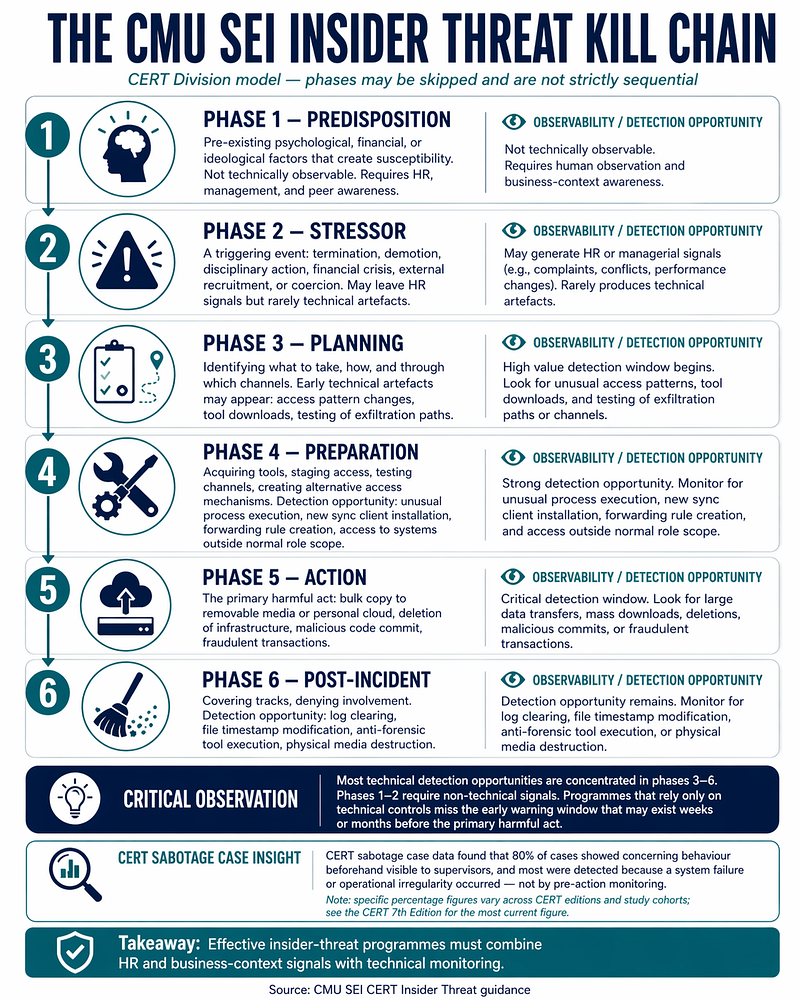
The CERT Division's kill chain model identifies the following phases. Phases are not strictly sequential and some may be skipped:
| Phase | Name | Description | Technical Observability |
|---|---|---|---|
| 1 | Predisposition | Pre-existing psychological, financial, or ideological factors | Not technically observable |
| 2 | Stressor | Triggering event: termination, demotion, financial crisis, coercion | Rarely leaves technical artefacts; HR signals possible |
| 3 | Planning | Identifying what to take, how, and through which channels | Early artefacts: access pattern changes, tool downloads, exfiltration path testing |
| 4 | Preparation | Acquiring tools, staging access, testing channels, creating alternative access | Detection opportunity: unusual process execution, sync client install, forwarding rule creation, out-of-scope access |
| 5 | Action | The primary harmful act: bulk copy, infrastructure deletion, malicious code commit, fraudulent transactions | Primary detection window |
| 6 | Post-incident | Covering tracks, denying involvement | Second detection opportunity: log clearing, timestamp modification, anti-forensic tool execution |
Most technical detection opportunities are concentrated in phases 3–6. Phases 1–2 require non-technical signals. Programmes that rely solely on technical controls miss the early warning window that CERT's data shows is often present weeks or months before the primary harmful act.
CERT's sabotage dataset found that 80% of cases showed concerning behaviour beforehand visible to supervisors, and the substantial majority were detected because a system failure or operational irregularity occurred — not by pre-action monitoring.