8. Implementation Guidance
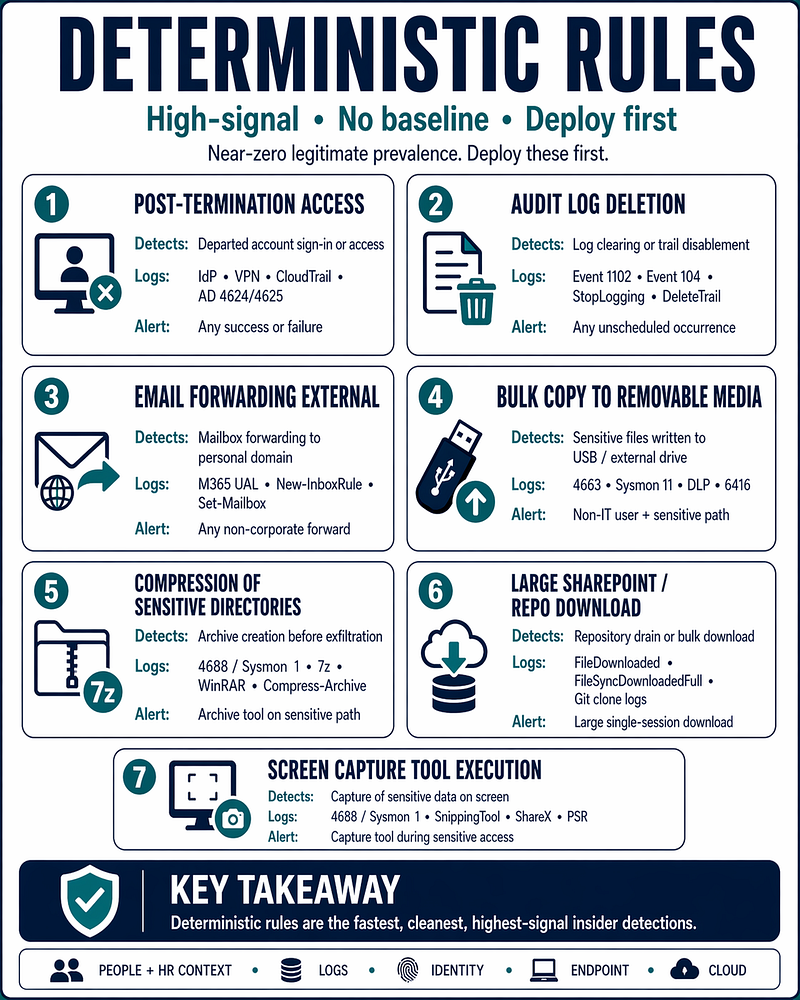
This phased approach prioritises the highest-value, lowest-effort controls first. Do not skip Phase 1 to reach Phase 3 — the foundational telemetry and legal framework established in Phase 1 are prerequisites for everything that follows.
Phase 1 — Foundations (Months 1–3)
Target outcome: Minimum viable insider detection programme. Would have provided real-time detection or materially shortened investigation time in the Cisco, Yahoo, and Morrisons cases.
Actions
-
HR system integration with IdP: departure dates, role changes, leave status reaching SIEM within hours of change. This single integration has the greatest leverage over detection quality of any action in this phase.
-
Enable and forward to SIEM:
- IdP sign-in logs (full field set)
- AD security audit events (4624, 4720, 4728, 1102)
- AWS CloudTrail (all management events)
- M365 UAL
-
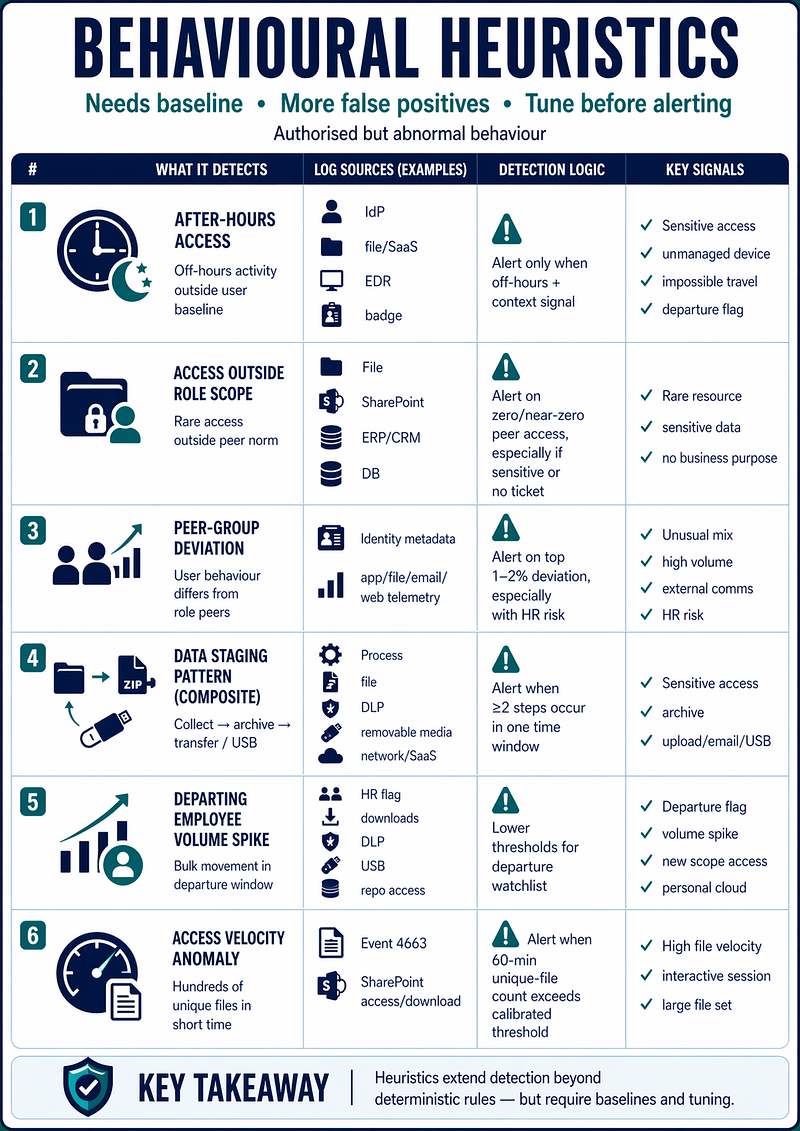
Implement Tier 1 deterministic rules:
- Post-termination access
- Audit log clearing
- Email forwarding to external domain
- New privileged account creation
- Backup deletion outside change window
-
Legal and policy foundation: review and update AUP; engage legal counsel for DPIA or jurisdiction-appropriate assessment; document legal basis for each monitoring activity before enabling it.
-
Offboarding SLA: define and enforce a technical offboarding SLA — all accounts disabled and credentials revoked within 4 hours of documented departure. The Cisco/Ramesh case demonstrates the direct cost of missing this.
Phase 2 — Data Exfiltration Coverage (Months 3–6)
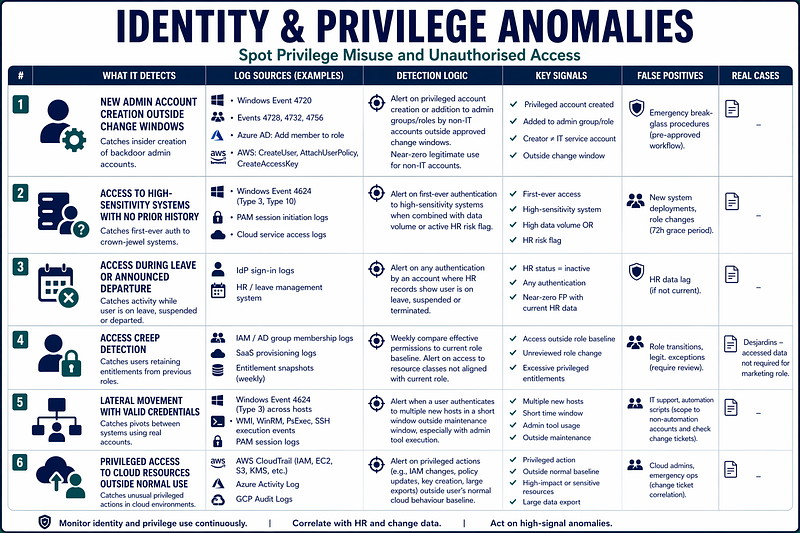
Target outcome: Coverage of the most common insider exfiltration paths. Would have provided detection in the Tesla, Levandowski, and Desjardins cases.
Actions
-
Endpoint DLP deployment: prioritise removable media monitoring and sensitive file-path access logging.
-
File server SACL configuration: enable SACLs on sensitive directories; forward Event 4663 to SIEM. Scope carefully — broad SACLs generate unmanageable log volume.
-
SharePoint/OneDrive download baseline and alerting: 30-day rolling per-user baseline; count-based anomaly alert. Apply sync client user-agent filtering before enablement.
-
CASB or proxy personal cloud category: alerting or blocking for personal cloud storage, with user identity attribution.
-
Sysmon deployment: deploy with a maintained configuration (community baselines from SwiftOnSecurity or Florian Roth are commonly used starting points) across endpoints handling sensitive data. Prioritise Events 1, 2, 11, 12, 13, 23.
-
Departing employee composite rule: triggered by HR departure date flag + volume anomaly + destination change. Begin with analyst review before automating alert escalation.
-
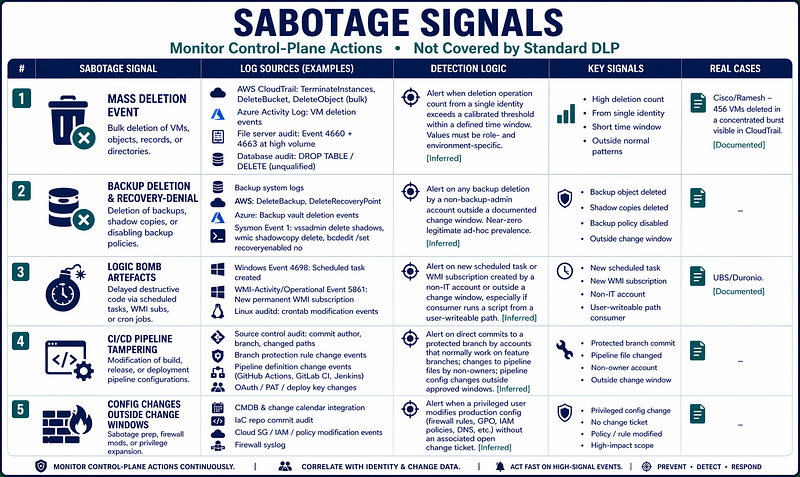
Mass deletion threshold alerting: CloudTrail and Azure Activity Log deletion monitoring; file server deletion count thresholds calibrated per role.
Phase 3 — Behavioural Analytics (Months 6–12)
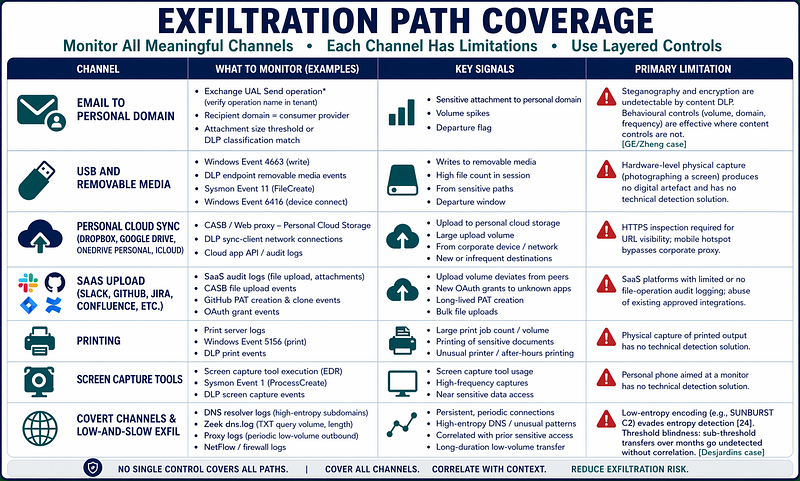
Target outcome: "Authorised but anomalous" detection coverage for patterns that deterministic rules cannot reach.
Actions
-
Role-based peer groups: define user clusters using HR department, job title, and access tier. Validate cluster composition before enabling anomaly scoring.
-
After-hours access detection: integrate HR calendar; deploy composite alerting (after-hours + sensitive resource access, not time-of-day alone).
-
Access outside role scope: build role-to-resource-path baseline; deploy deviation alerting with a 30-day sensitivity baseline.
-
Entity risk scoring: select 5–8 signals and assign each an ordinal risk tier (LOW / MEDIUM / HIGH / CRITICAL); operate in observation-only mode for 30 days before enabling analyst queue entries. Tune false-positive rate before expanding the signal set.
-
CI/CD pipeline tampering: integrate source-control audit; configure protected-branch commit alerting and pipeline configuration change monitoring.
-
Logic bomb artefact alerting: Windows Security Event 4698 and WMI-Activity/Operational Event 5861 scoped to non-IT accounts; correlate with HR departure status.
-
Analyst playbook: create a written escalation process for each alert type that explicitly maps signals to kill-chain phases (planning, staging, exfiltration, sabotage, concealment).
Phase 4 — Mature Programme (Year 2+)
Target outcome: Comprehensive coverage including sophisticated, long-dwell actors.
Actions
-
Graph analytics: deploy access graph with first-occurrence edge tracking; apply community detection to flag novel access to sensitive resource clusters.
-
Sequence anomaly models: for highest-risk role classes (Finance, DBA, sysadmin, cloud engineering) only; build models on longitudinal audit data with careful validation.
-
HR flag integration: with Legal and HR approval, integrate disciplinary flag data into risk scoring for specifically elevated-risk accounts.
-
Quarterly purple-team exercises: simulate documented case scenarios against the programme; measure time-to-detect and coverage gaps.
-
Insider Threat Working Group: cross-functional group (Security + HR + Legal + IT) with defined escalation procedures, investigation protocols, and case management.
-
Long-retention log storage: move identity, control-plane, and network device logs to low-cost long-term storage (minimum 3 years). The Desjardins exfiltration lasted 26 months; the Zheng case involved conduct over more than a decade.
Phase Summary
| Phase | Months | Target Cases Covered | Key Dependency |
|---|---|---|---|
| 1 — Foundations | 1–3 | Cisco, Yahoo, Morrisons | HR→SIEM integration |
| 2 — Exfiltration Coverage | 3–6 | Tesla, Levandowski, Desjardins | Endpoint DLP + Sysmon |
| 3 — Behavioural Analytics | 6–12 | Snowden (partial), Twitter | 30-day baseline + role taxonomy |
| 4 — Mature Programme | 12+ | Zheng, Manning (partial) | Labelled data + cross-functional ITWG |