3. Documented Case Studies
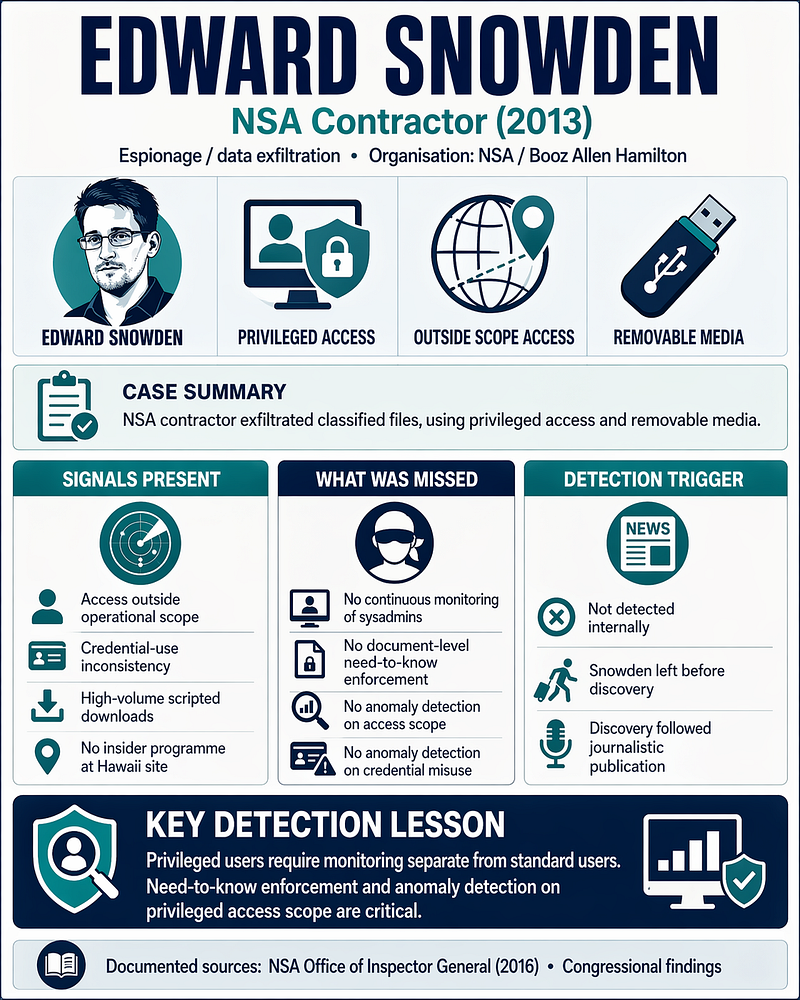
The following cases are drawn from DOJ press releases, criminal complaints, appellate records, regulatory findings, and court judgments. Each entry documents:
- What happened
- Signals present in retrospect
- What was missed
- What triggered detection
- Key detection lesson
Secondary press sources are used only where primary documents are not publicly accessible.
Case Index
| # | Actor | Organisation | Category | Detection Trigger |
|---|---|---|---|---|
| 3.1 | Chelsea Manning | US Army | Espionage / mass exfiltration | Human tip |
| 3.2 | Edward Snowden | NSA / Booz Allen Hamilton | Espionage / data exfiltration | Journalistic publication |
| 3.3 | Roger Duronio | UBS PaineWebber | Sabotage (logic bomb) | Destructive execution |
| 3.4 | Anthony Levandowski | Waymo → Uber | Departing employee / IP theft | Civil litigation discovery |
| 3.5 | Sudhish Kasaba Ramesh | Cisco Systems | Sabotage / post-termination | Service outage |
| 3.6 | Xiaoqing Zheng | GE Aviation | Espionage / IP theft | FBI counterintelligence referral |
| 3.7 | Andrew Skelton | Morrisons | Disgruntled / data exfiltration | Newspaper contact |
| 3.8 | Reyes Daniel Ruiz | Yahoo | Privilege abuse / misuse | Employer observation |
| 3.9 | Nickolas Sharp | Ubiquiti | Data theft / extortion | VPN failure / OPSEC error |
| 3.10 | Volodymyr Kvashuk | Microsoft | Financial fraud | Internal anomaly detection |
| 3.11 | [Employee] | Desjardins Group | Data exfiltration | Police notification |
| 3.12 | [Former employees] | Tesla | Departing employee / exfiltration | Newspaper contact |
| 3.13 | Abouammo / Alzabarah | Insider espionage / state-sponsored | Management observation | |
| 3.14 | Juliana Barile | NY Credit Union | Sabotage / post-termination | Data loss discovery |
Pattern Summary
Of 14 cases, initial detection came from human observation, external notification, law enforcement referral, or operational failure in the large majority of cases. Internal technical monitoring was the primary trigger in at most 2–3 (Kvashuk, arguably Twitter/Alzabarah and Yahoo/Ruiz).
This is not a statistically representative sample — it is directionally consistent with CERT's 61%/22% finding across sectors.