9. Conclusion and Coverage Gaps
What the Evidence Shows
Human detection still leads
CERT's banking-and-finance sector study found 61% of insider incidents were detected by non-security personnel and only 22% by auditing or monitoring procedures. Of the 14 individual incident cases documented in §3, initial detection came from human observation, external notification, law enforcement referral, or operational failure in the large majority of cases; internal technical monitoring was the primary trigger in at most two to three (Kvashuk, and arguably Twitter/Alzabarah and Yahoo/Ruiz).
This is not a statistically representative sample — the pattern is directionally consistent across sectors.
Deterministic rules deliver the best ROI
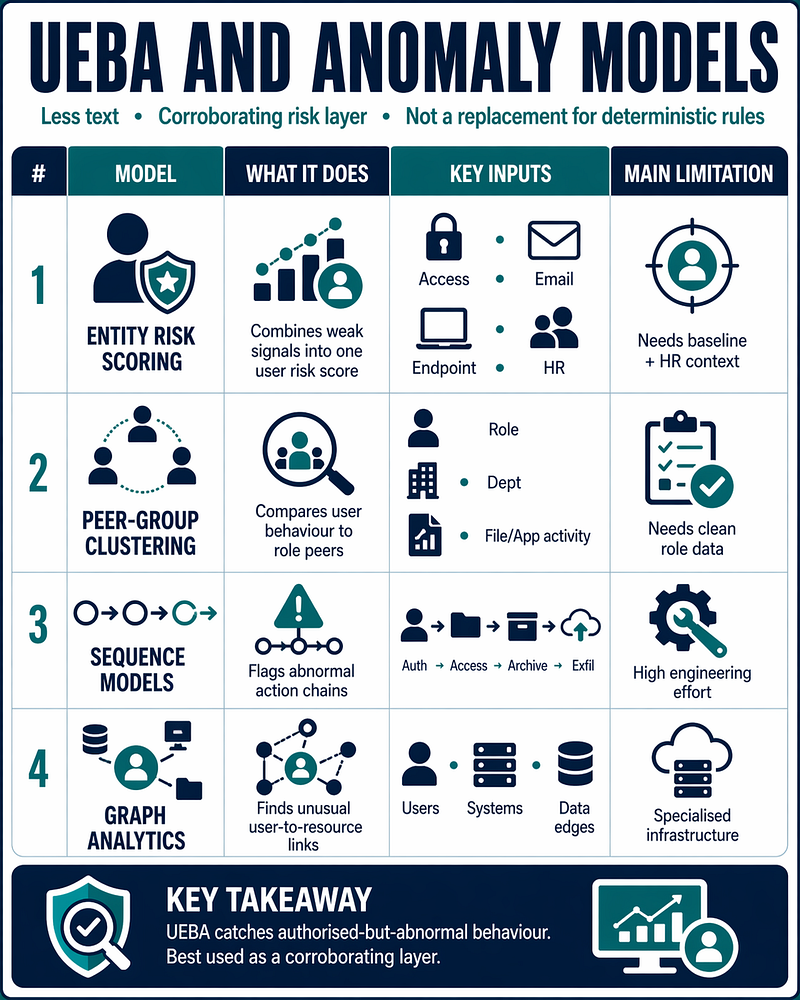
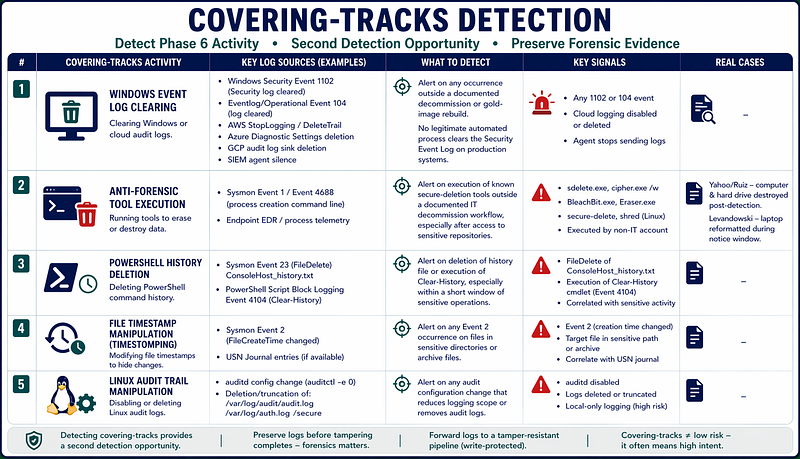
Post-termination access, audit log clearing, email forwarding rules, and privileged account creation are high-signal, low-noise controls that require minimal tuning. They should be the first investment, not deferred in favour of complex UEBA.
DLP is necessary but routinely insufficient
The case evidence consistently shows DLP failing against:
- Steganographic encoding — GE/Zheng
- Physical exfiltration — Manning
- Sub-threshold transfers over extended periods — Desjardins
- Channels outside DLP scope — personal cloud sync, SaaS uploads, physical capture
A DLP-only programme misses a majority of documented exfiltration methods.
Dwell time is the central operational problem
- Desjardins: operated for at least 26 months undetected
- Zheng: conducted spanned more than a decade before a counterintelligence referral
- Ponemon 2023: average of 86 days to contain an insider incident after identification
Detection programmes must account for long-dwell scenarios, require adequate log retention, and must not rely exclusively on volume thresholds.
Privileged users are the highest-risk category
Sysadmins, DBAs, DevOps engineers, cloud admins, and security team members can operate below alert thresholds precisely because they understand the monitoring. This category requires:
- PAM with session recording
- A logging pipeline they cannot access or modify
- Need-to-know enforcement beyond their administrative role
- Tighter change-window controls for their actions
Coverage Gaps — What Standard Enterprise Tooling Cannot Currently Detect
Steganographic Exfiltration
Files hidden in image, audio, or video payloads. No standard DLP product detects this without specialised statistical content analysis. The GE/Zheng case ran over a decade without internal detection.
Physical Exfiltration
Photographing a monitor with a personal device, removing printed documents, verbally memorising credentials. No technical detection is possible. Process controls (clear-desk policy, no-photography zones, escorted access to data rooms) are the only mitigations.
Social Engineering of a Peer
The insider obtains sensitive data by convincing a colleague to send it on their behalf. The insider's account generates no anomalous activity. Detection requires monitoring of the unwitting colleague's outbound behaviour.
Very Slow, Low-Volume Exfiltration
One document per week for 18 months stays below every standard volume threshold. The only effective detection is:
- Sensitivity-aware — any movement of a specific classification label triggers review
- Graph-based — first-ever access to a document cluster outside the user's normal community
Insider with Knowledge of the Detection Programme
A SIEM administrator, security engineer, or detection engineer who knows which rules are deployed and operates below all thresholds. Requires a separate, independent monitoring pipeline and oversight from outside the security team.
Nation-State Planted Insiders
Trained, patient actors who maintain legitimate behavioural envelopes for extended periods. The GE/Zheng case required a counterintelligence referral to surface. Technical controls alone are insufficient; counterintelligence partnership is required.
Personal Devices and Unmanaged Networks
BYOD environments and personal cloud accounts accessed outside corporate networks are largely outside corporate monitoring scope. Data moved to a managed corporate device and then transferred to a personal cloud account via a personal mobile hotspot generates minimal corporate telemetry.