5. Detection Priority Matrix
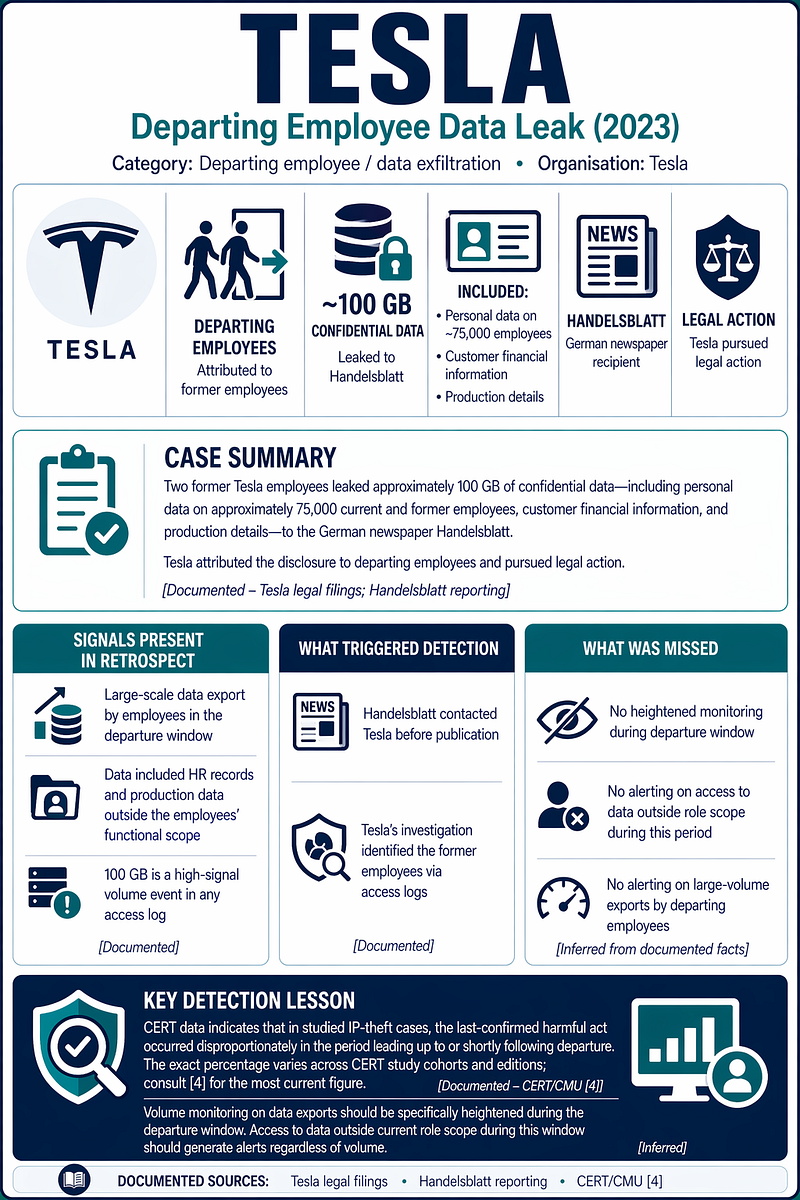
Rated on implementation effort (licensing, configuration, integration complexity) and detection coverage (signal-to-noise ratio against the threat categories in §3), under realistic enterprise conditions.
Tier 1 — Deploy Immediately
Low effort · High signal · Very low FP rate
These rely on events already generated or requiring minor audit policy changes. They have near-zero false-positive rates in properly maintained environments. ROI is highest here.
| Control | Evidence Base | Case Reference |
|---|---|---|
| Post-termination access alerting | Requires HR→IdP feed. Catches departing employee and sabotage categories. | Cisco/Ramesh |
| Audit log clearing alerting | Security/1102 and Eventlog/Operational/104 are already generated; forward and alert. | Multiple |
| Email forwarding rule to external domain | M365 UAL already captures this event. | — |
| New privileged account creation | AD Events 4720/4728/4732/4756 already generated on domain controllers. | — |
| Backup deletion outside change window | Cloud backup and vault logs already generated. | — |
Tier 2 — Deploy Second
Medium effort · High value
These require moderate configuration, baseline setup, or endpoint agent deployment.
| Control | Notes |
|---|---|
| Departing employee composite rule | Requires HR departure date integration. Highest single ROI for IP theft. FP rate: low when HR feed is timely. |
| Mass deletion alerting | Requires cloud and file audit configuration; threshold calibration per role. |
| Bulk repository download anomaly | Requires M365 UAL + 30-day per-user baseline; sync client user-agent filtering required before enablement. |
| USB/removable media DLP | Requires endpoint DLP agent deployment. |
| Logic bomb artefact detection | Windows Security Event 4698 and WMI-Activity/Operational Event 5861; scope to non-IT accounts. |
Tier 3 — Deploy Third
Medium–High effort · High analytical value
Require baseline periods, role taxonomy, or HR metadata integration.
| Control | Notes |
|---|---|
| Access outside role scope | Requires role taxonomy and 30+ day access baseline. Medium FP rate; improves with accurate role data. |
| Peer-group deviation scoring | Requires role cluster definition and feature engineering. Medium FP rate during tuning. |
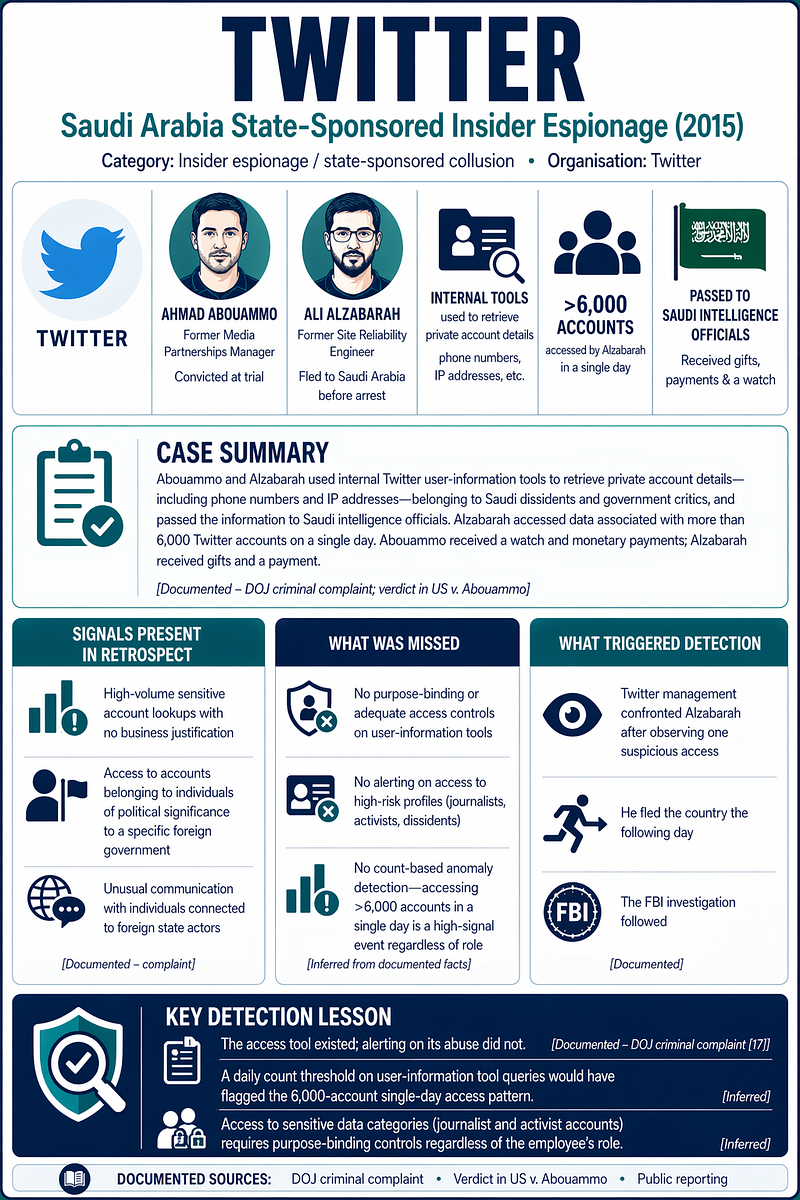
| Entity risk scoring (UEBA) | Requires 30-day baseline and ongoing tuning. Explicitly required by the Desjardins OPC remediation order. |
| CI/CD pipeline tampering detection | Requires source-control audit integration. Low FP rate. |
| Data staging sequence detection | Requires correlated process, file, and egress telemetry. |
| After-hours access with sensitive resource correlation | In async/remote-work/multi-timezone environments, time-of-day is a near-dead standalone signal. Must be paired with identity-context signals. |
| Print volume monitoring | Requires deliberate PrintService/Operational Event 307 forwarding, a mature endpoint log pipeline, and a per-user, per-application 90-day baseline. High FP rate during business cycle peaks. |
After-hours access and print volume monitoring are misclassified as Tier 2 in many reference guides. Practical deployment complexity and FP burden place them in Tier 3.
Tier 4 — Advanced and Mature Programme
High effort · High precision
Appropriate only after Tier 1–3 are operational and tuned.
| Control | Notes |
|---|---|
| Graph analytics on access patterns | Requires graph infrastructure and edge-history tracking. Research-stage capability for most organisations. |
| Sequence anomaly models (LSTM/transformer) | Requires labelled training data, feature engineering, and ongoing maintenance. Not a general-availability default. |
| DNS tunnelling detection | Requires full QNAME capture at resolver. |
| Steganography detection in outbound email attachments | Requires specialised statistical content analysis. No standard DLP product covers this by default. |
Summary Matrix
| Tier | Effort | Signal Quality | Baseline Required | Example Controls |
|---|---|---|---|---|
| 1 | Low | Very high / deterministic | None | Post-termination auth, log clearing, forwarding rules |
| 2 | Medium | High | 30 days (some) | Departing employee composite, mass deletion, USB DLP |
| 3 | Medium–High | Medium–High | 30–90 days | Role-scope deviation, UEBA risk scoring, after-hours (composite) |
| 4 | High | High (when tuned) | 90+ days | Graph analytics, sequence models, DNS tunnelling, steganography |