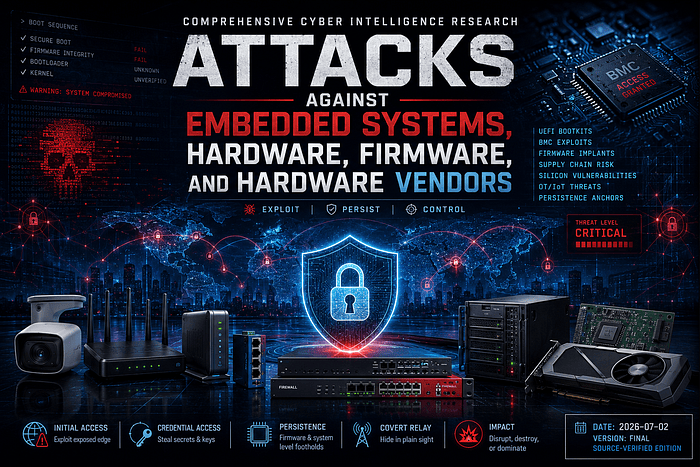
Executive Intelligence Judgment
The highest-priority enterprise risk is not a single firmware bug. It is the intersection of internet-facing edge infrastructure, privileged management planes, missing endpoint-grade telemetry, and ordinary patch workflows that do not remove durable appliance or firmware compromise. This page connects that risk to the wider AdversaryGraph ecosystem: asset attack-surface mapping, CVE Library, attack simulation, and telemetry readiness.
CISA, Google/Mandiant, Cisco, Fortinet, Palo Alto Networks, Ivanti, Juniper, Barracuda, Nozomi, Forescout, and multiple national cyber agencies point toward the same operational conclusion: routers, VPNs, firewalls, mail gateways, BMCs, UEFI components, and unsupported embedded devices need to be managed as a single “firmware + edge + management-plane” risk domain.
Scope
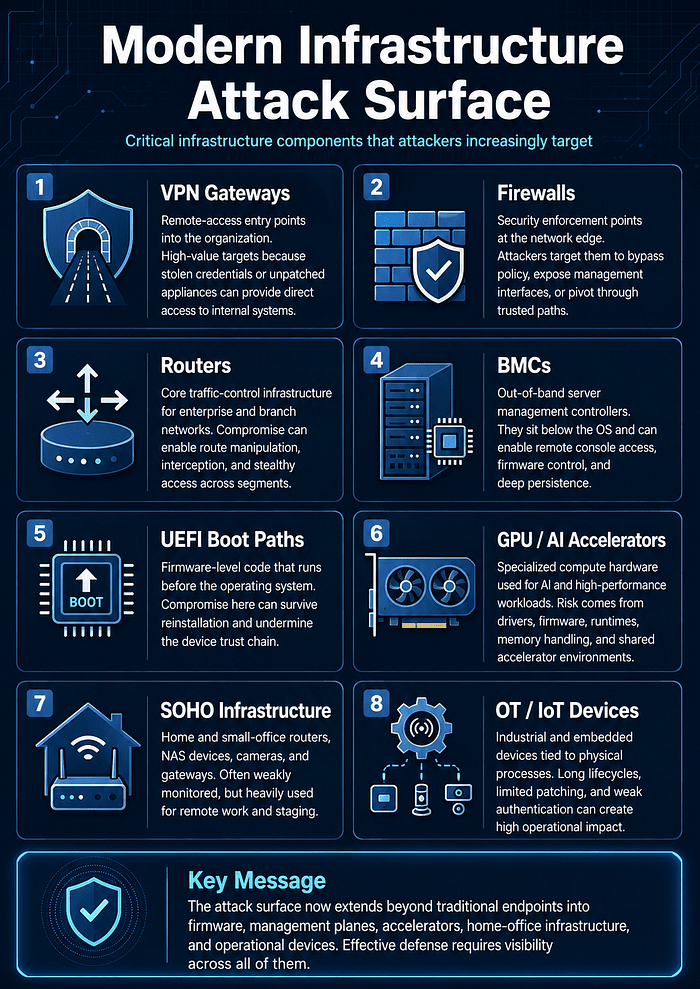
This research covers internet-facing appliances, BMC/IPMI/Redfish interfaces, UEFI and boot trust, CPU microcode and confidential-computing boundaries, GPU local-memory leakage, SOHO/IoT proxy infrastructure, and OT/IoT firmware lifecycle risk. It complements the CTI Analyst Field Manual by turning source reporting into collection requirements, telemetry gaps, and detection engineering priorities.
VPNs, routers, firewalls, mail gateways, BMCs, UEFI, OT/IoT, GPUs, and embedded management planes.
Volt Typhoon, UNC3886, UNC5221, UNC4841, Sandworm, UAT-4356, Mirai-derived botnets, and financially motivated edge exploitation.
Asset inventory fields, CVE/KEV triage, off-device logging, reimage/replace playbooks, and telemetry readiness checks.
Strategic Threat Model
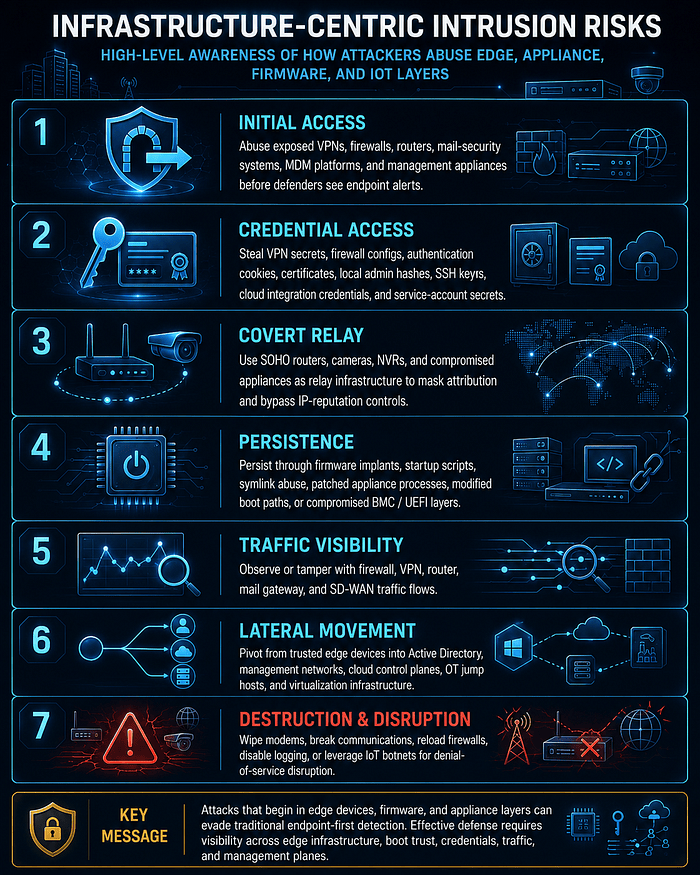
Adversaries use embedded and hardware systems for stealth, persistence, credential access, traffic proxying, collection, and lateral movement. The key advantage is structural: these systems are trusted, hard to instrument, difficult to patch, and frequently unmanaged by the same teams that manage endpoint or cloud telemetry.
In AdversaryGraph terms, this is an asset surface and CVE-to-TTP correlation problem, not only a vulnerability management queue. CTI must answer which exposed assets, firmware versions, inherited components, and management services create a path to a mapped ATT&CK behavior.
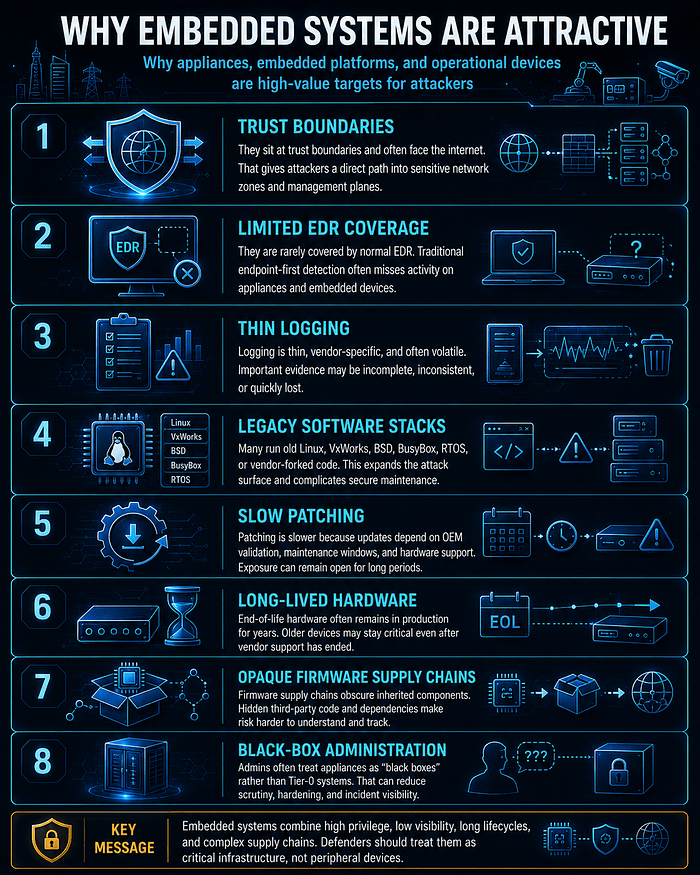
Highest-Priority Intelligence Findings
1. Edge devices are the leading practical attack path
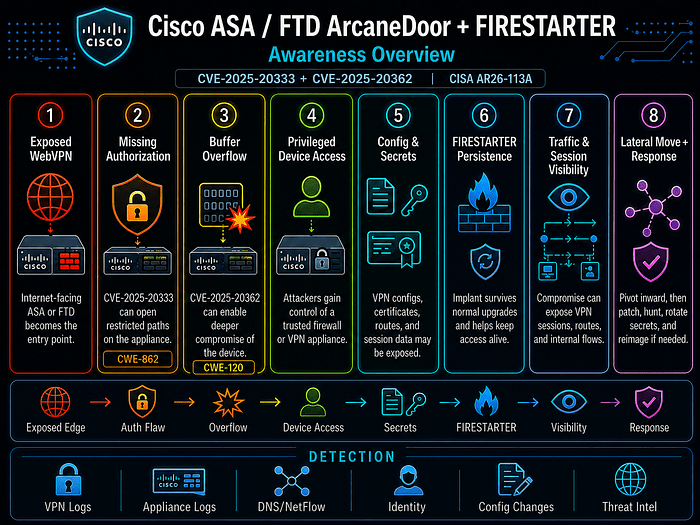
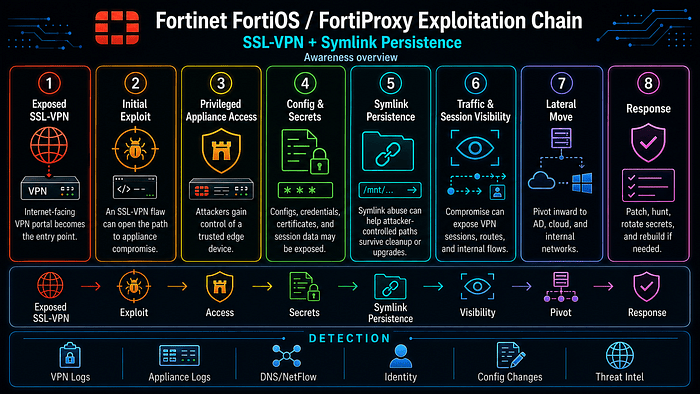
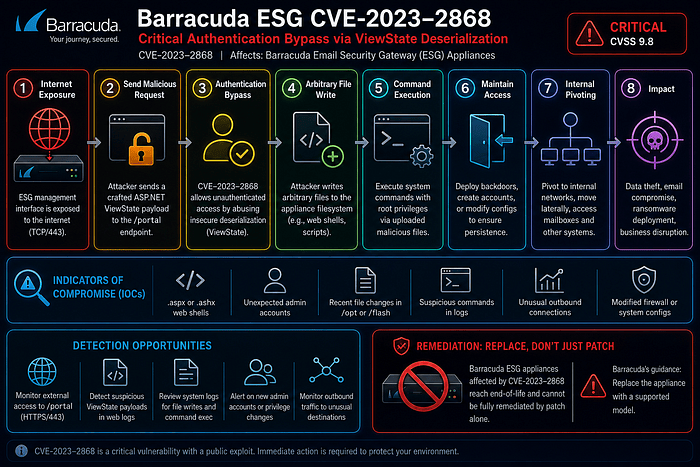
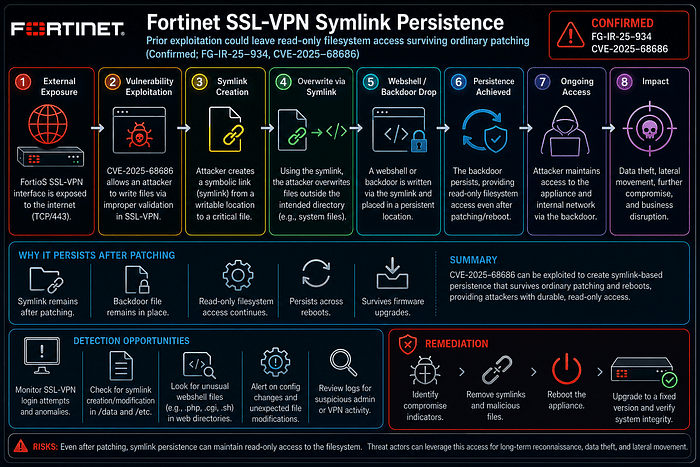
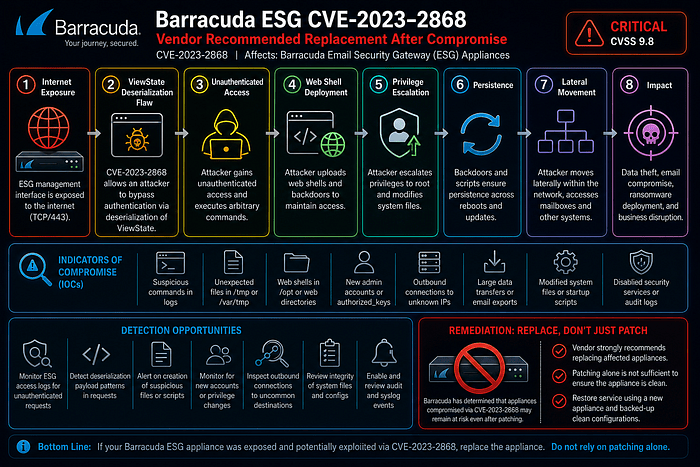
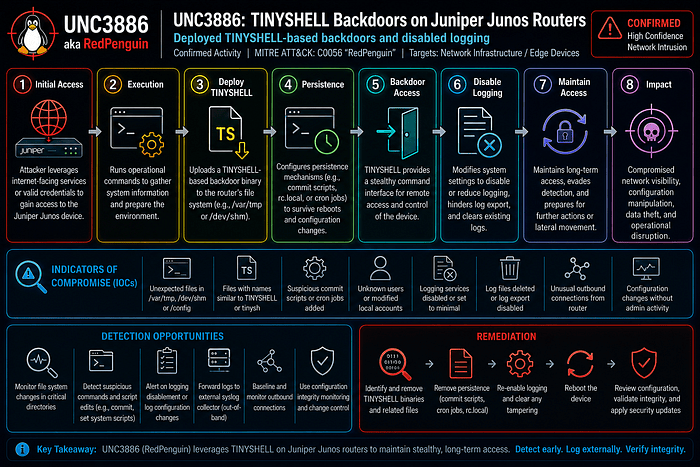
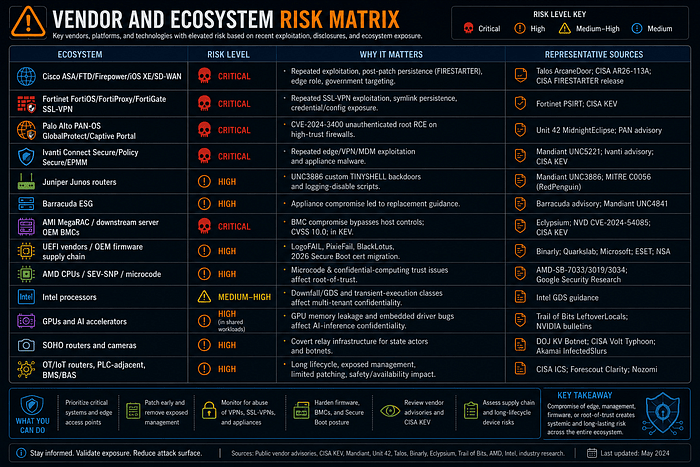
Edge infrastructure concentrates authentication, remote access, inspection, and routing. Recent exploitation across Palo Alto GlobalProtect, Ivanti Connect Secure, Cisco ASA/FTD, Fortinet SSL-VPN, Juniper routers, and Barracuda ESG shows that exposed appliances are both initial-access targets and post-compromise staging points. Relevant ATT&CK mapping includes T1190 Exploit Public-Facing Application, valid account use, defense evasion, and proxy/C2 behaviors.
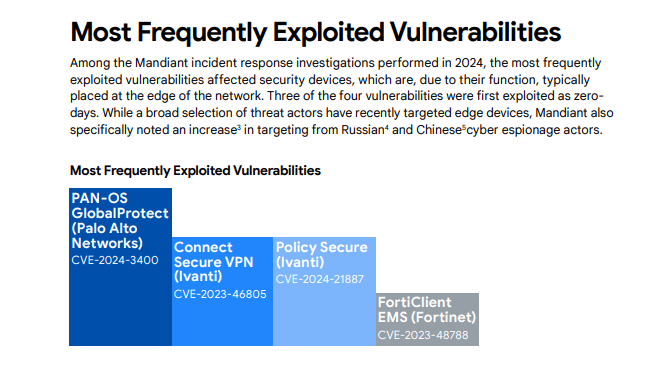
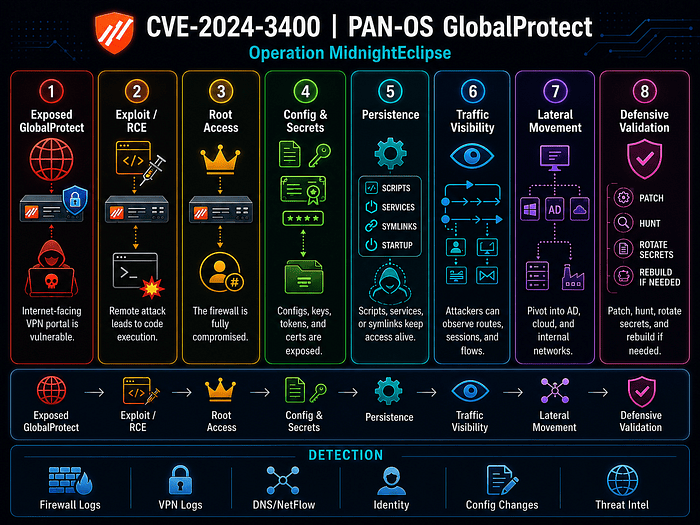
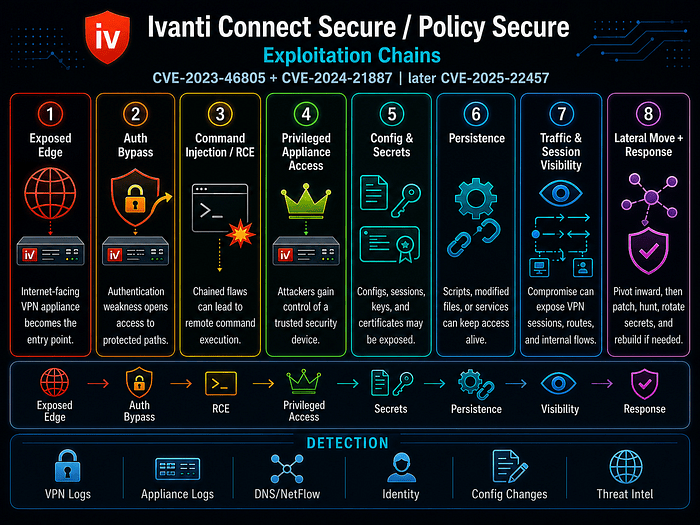
2. Persistence is the durable risk
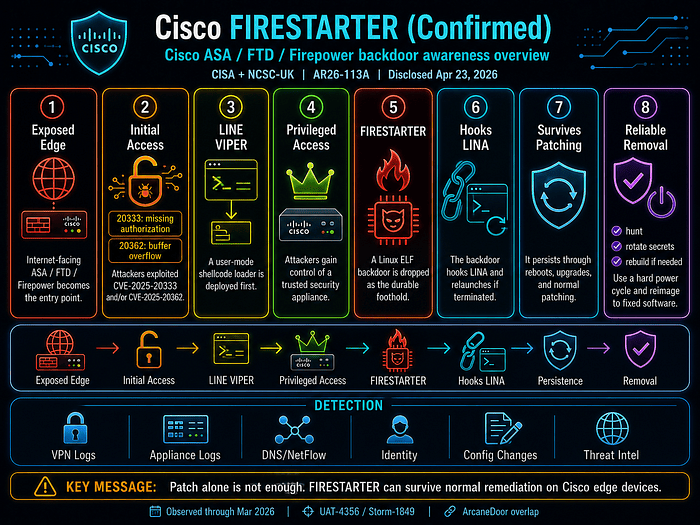
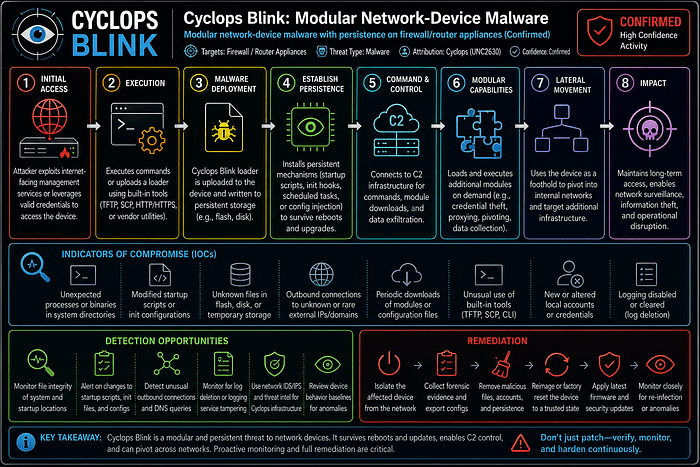
Initial CVE exploitation is only the first control failure. The more damaging pattern is persistence that survives ordinary patching, weak logging, and normal administrative response. In the platform, this should be modeled as a chain from CVE to TTP to telemetry gap to validation task, then reviewed through the attack data model.
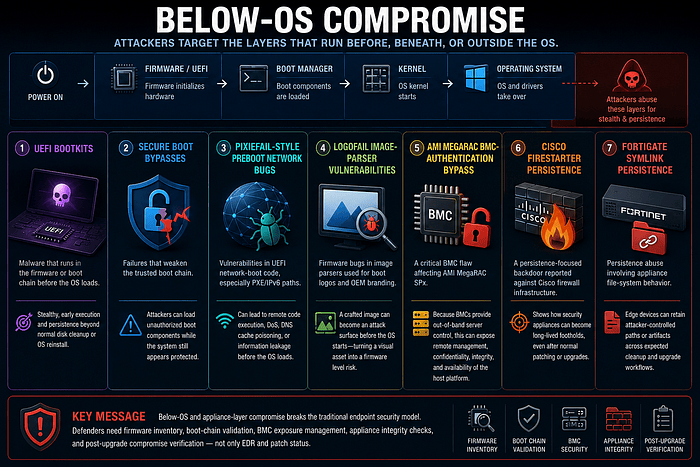
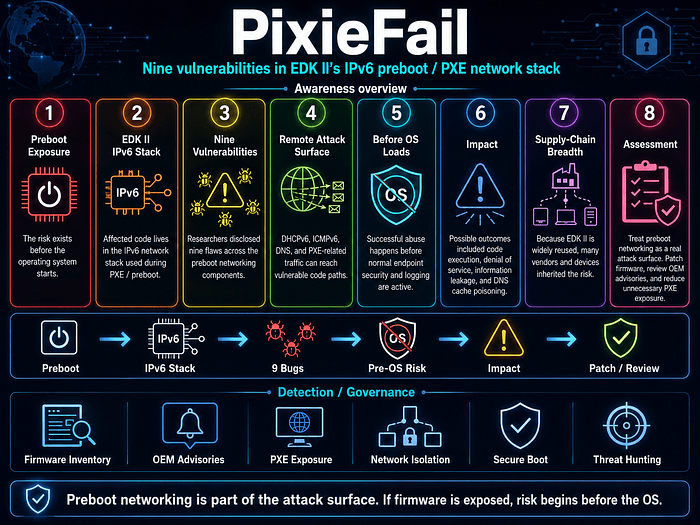
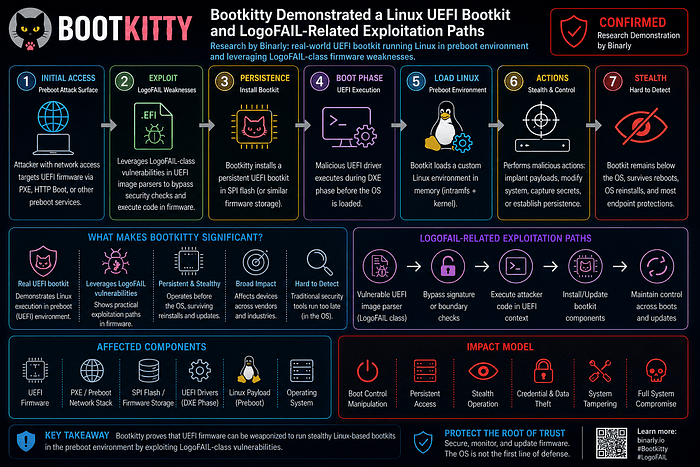
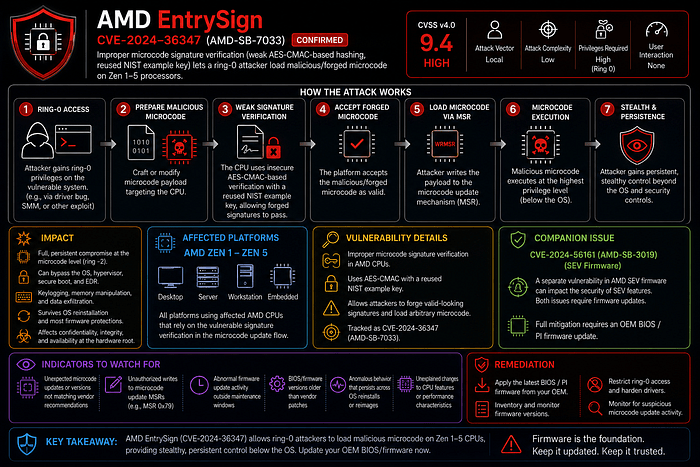
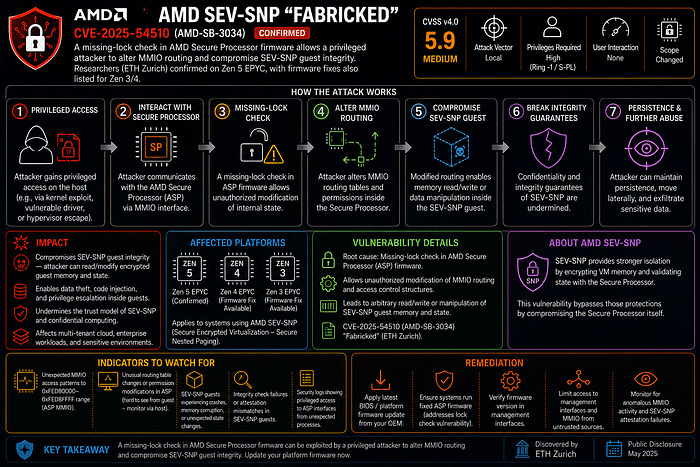
3. BMC, UEFI, silicon, and GPU risks change the trust boundary
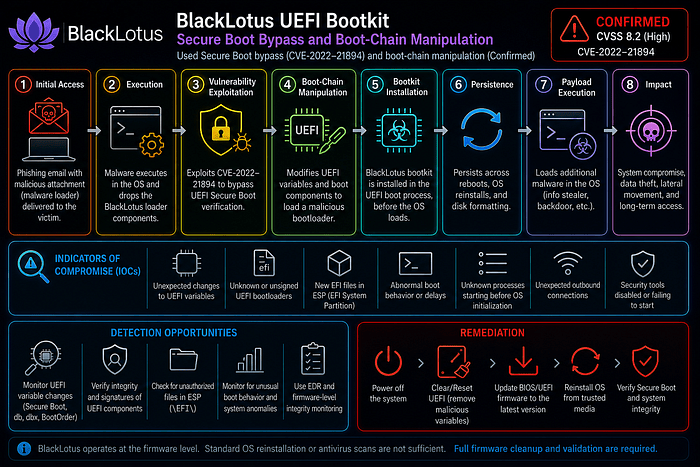
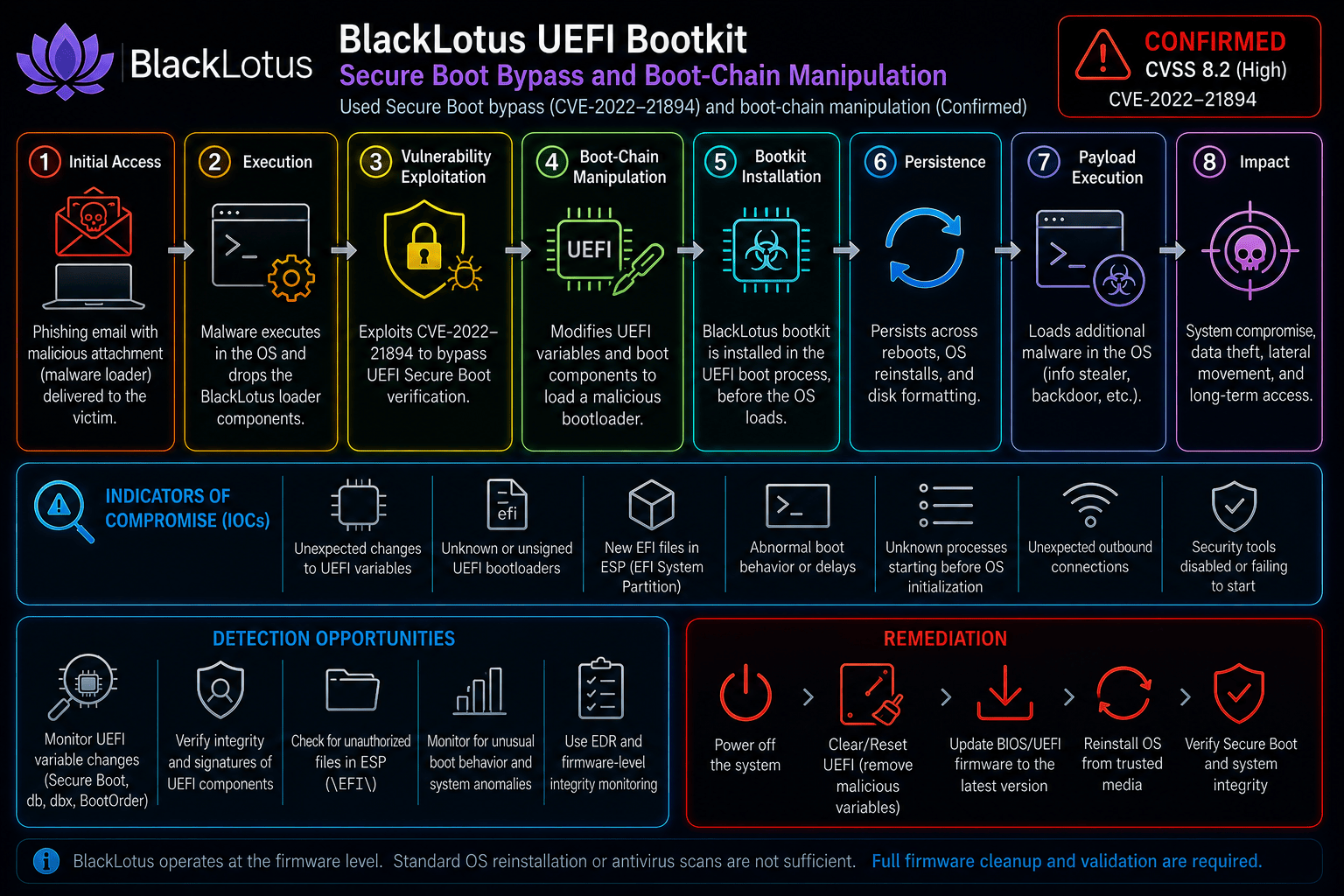
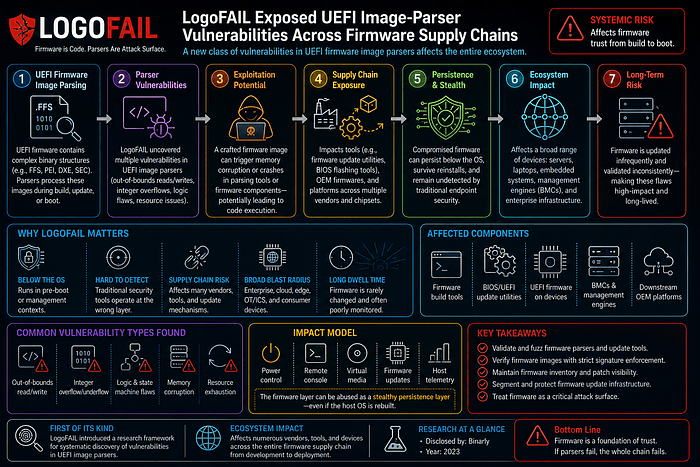
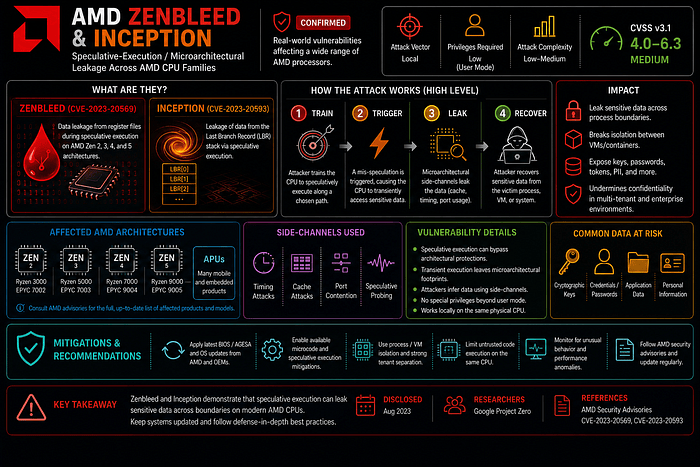
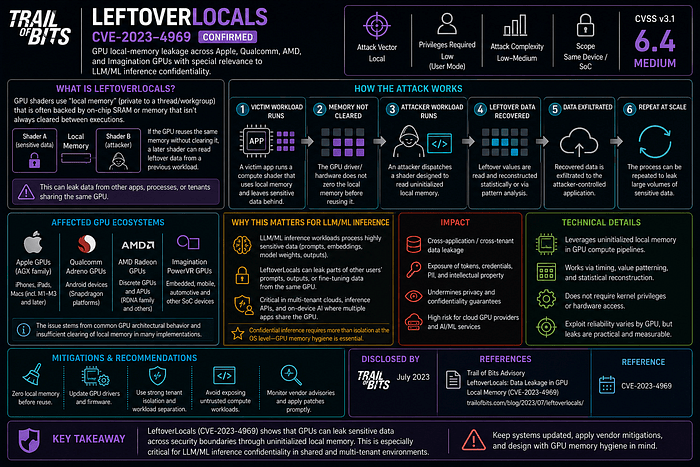
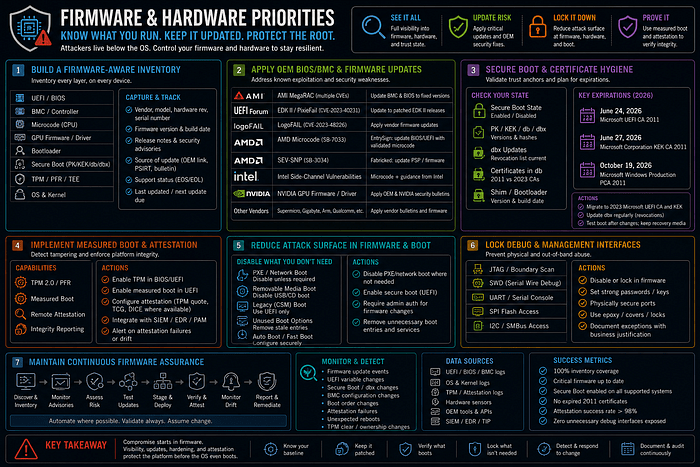
BMC and boot trust failures can undermine the server below the operating system. Microcode, confidential-computing, and GPU local-memory issues show that the trust boundary also includes hardware-assisted isolation layers. This is where AdversaryGraph needs CVE context, asset inventory, vendor PSIRT status, and architecture-specific exposure.
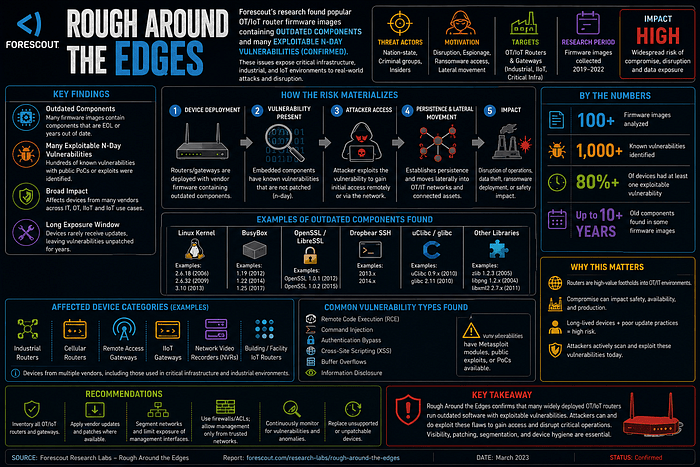
4. SOHO, IoT, and OT firmware risk are lifecycle problems
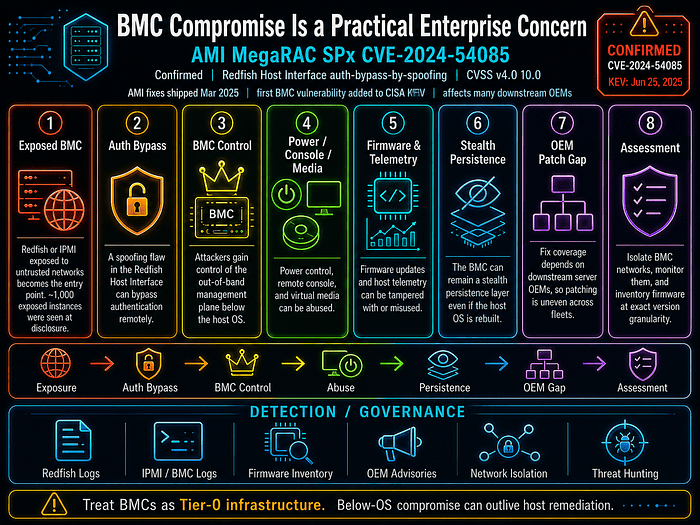
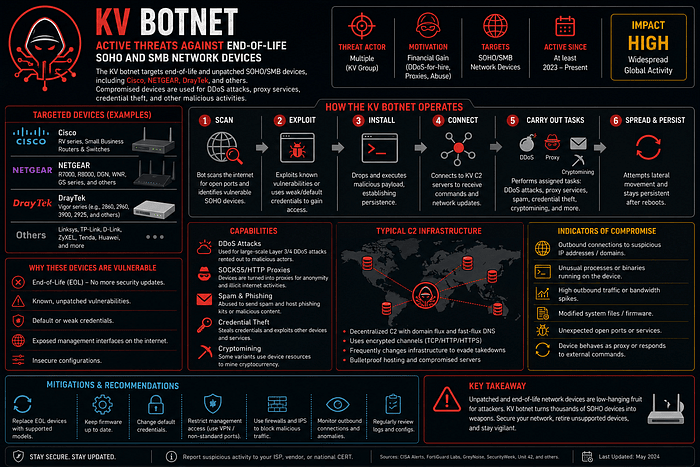
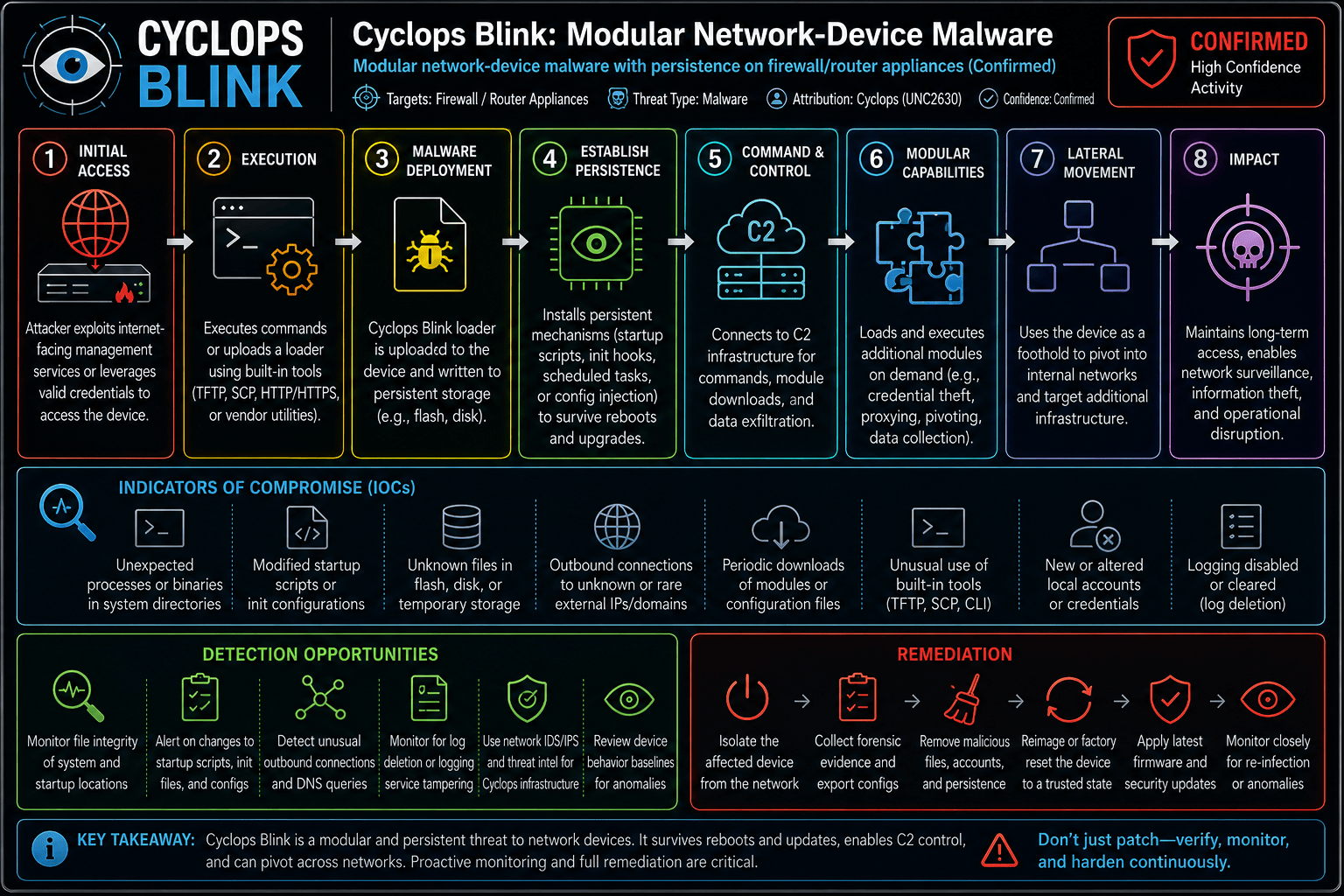
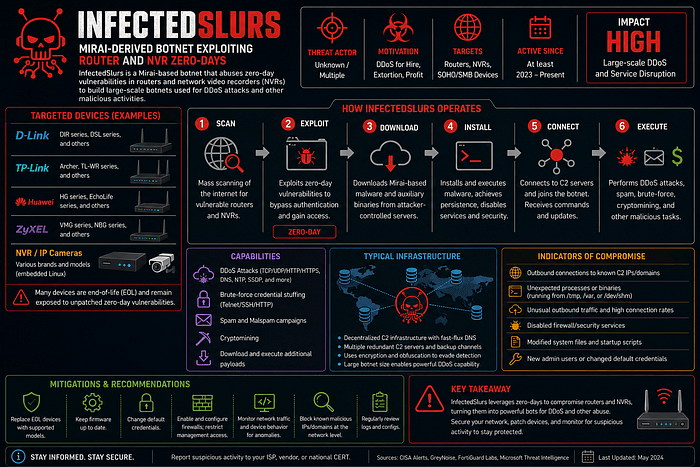
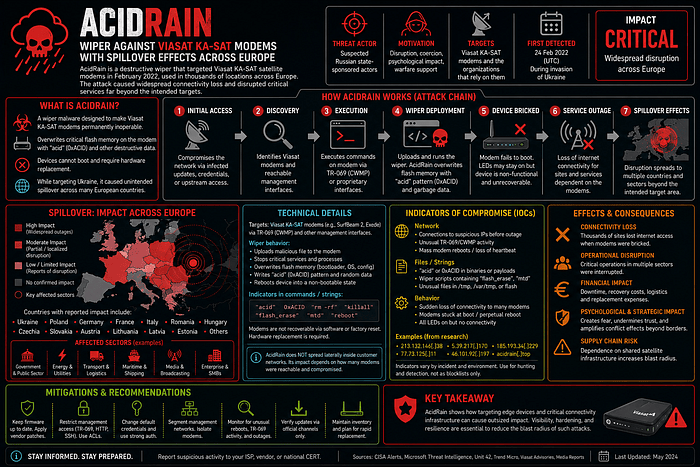
Volt Typhoon, KV Botnet, Cyclops Blink, AcidRain, Mirai-derived activity, and OT/IoT firmware research show why home-office routers, ISP devices, unmanaged remote-access paths, and cyber-physical assets must be included in operational CTI. This aligns with Operation Desert Hydra methodology: intelligence is useful only when it creates a concrete hunt, inventory, or validation action.
Vendor and Ecosystem Risk Matrix
The vendor matrix converts the article’s source base into a prioritization model for defenders: exposed edge first, durable compromise second, firmware and hardware trust third, then sector-specific OT/IoT constraints. Use this with AdversaryGraph analytics and CVE Library to compare CVE pressure, ATT&CK technique pressure, asset tags, sector tags, and telemetry readiness.
Campaign and Case-Study Intelligence
The case studies below are evidence anchors for the report. Each should be transformed into AdversaryGraph entities: actor/group, campaign, CVE, IOC, affected product, technique candidates, and telemetry requirements. Use Threat Matrix for public ATT&CK exploration and the self-hosted platform for stored investigations.
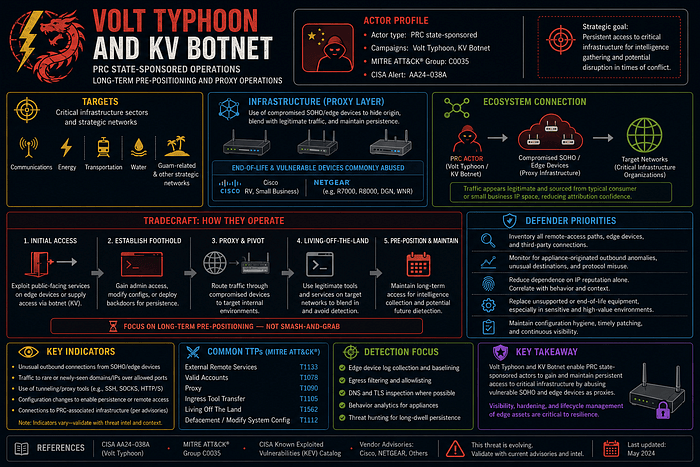
Volt Typhoon and KV Botnet
SOHO router compromise used to conceal infrastructure and support critical-infrastructure targeting. Map to proxy infrastructure, valid accounts, and operational relay behavior.
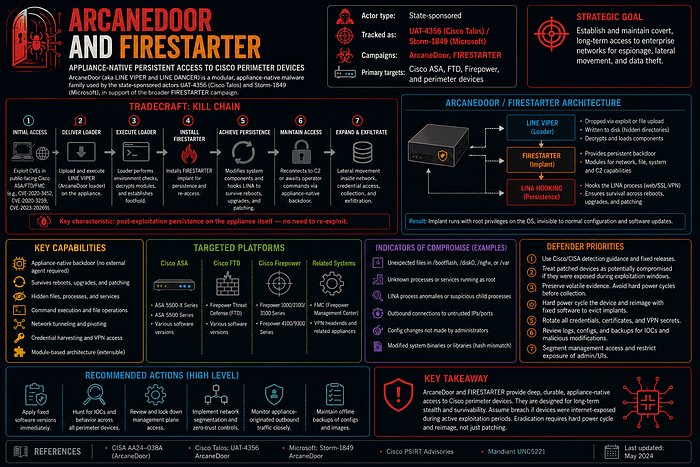
ArcaneDoor and FIRESTARTER
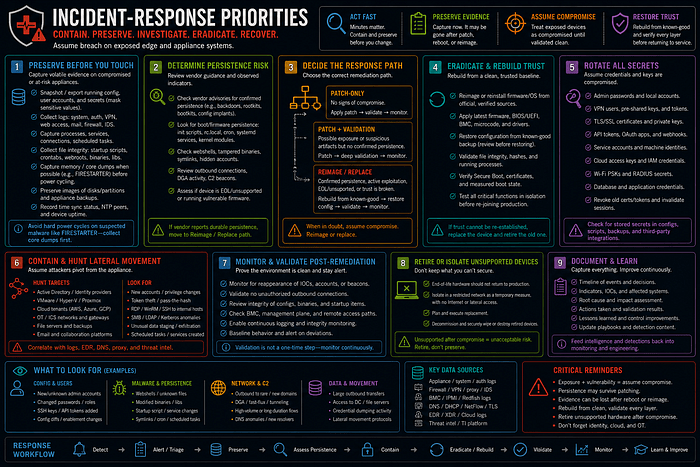
Cisco ASA/FTD exploitation, LINE VIPER loader activity, and FIRESTARTER persistence show why edge compromise needs hard power cycle, reimage, and log validation.
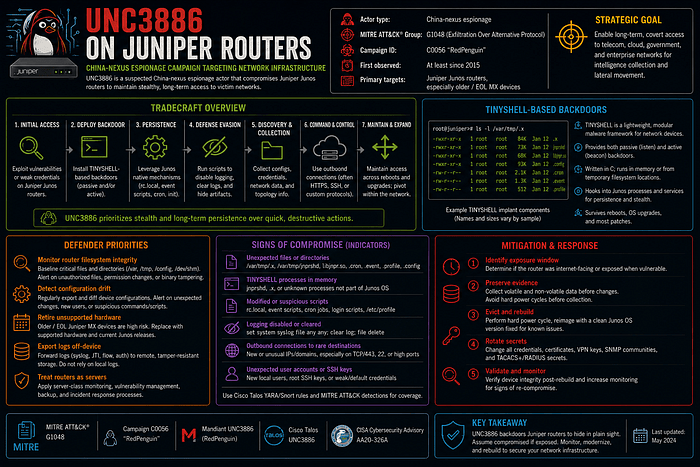
UNC3886 on Juniper routers
TINYSHELL-based backdoors and logging disruption on routers highlight the value of off-device logs and management-plane review.
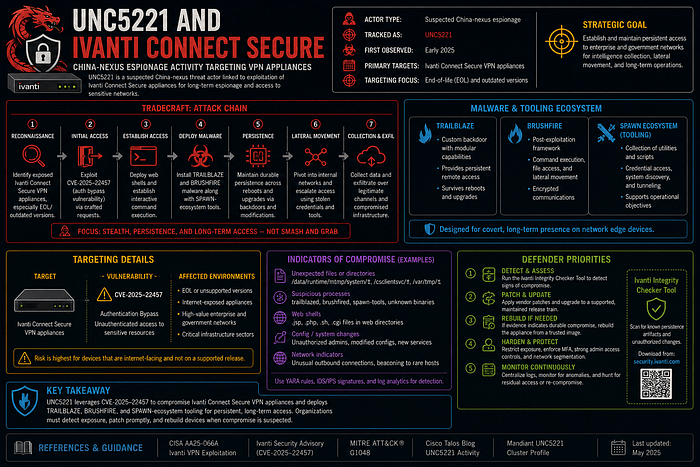
UNC5221 and Ivanti Connect Secure
Ivanti exploitation chains require integrity checking, train/version validation, and rebuild decisions when durable compromise is plausible.
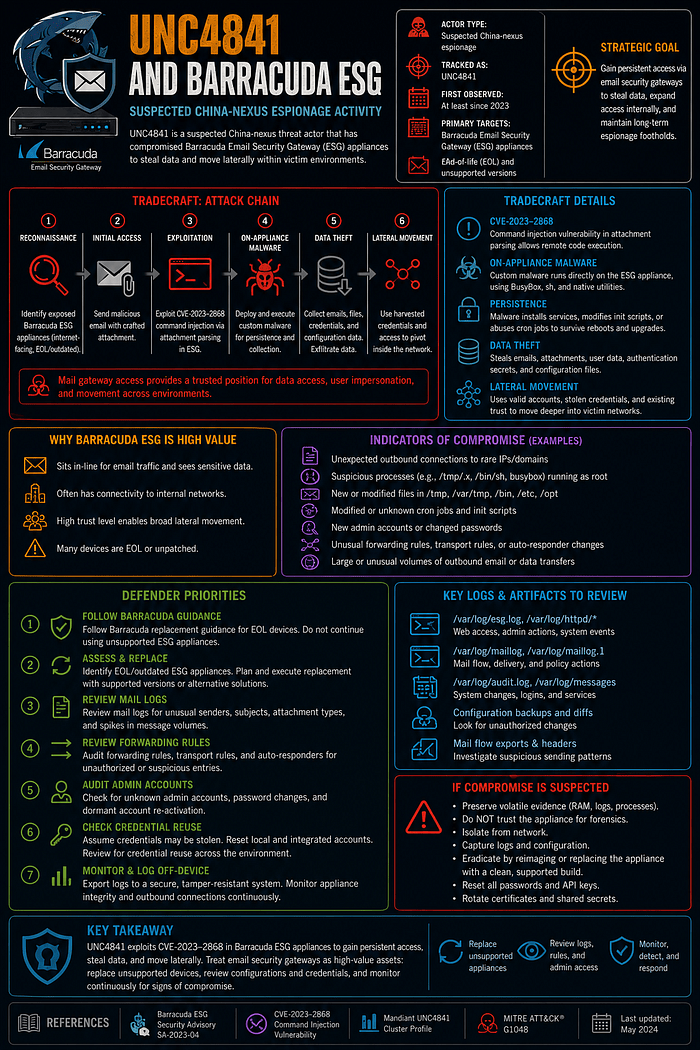
UNC4841 and Barracuda ESG
Mail-gateway compromise became a data-theft and lateral-movement problem, not only an attachment-parsing vulnerability.
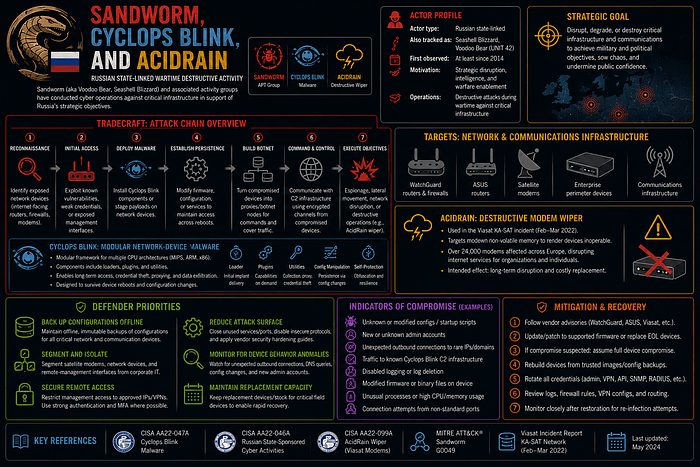
Sandworm, Cyclops Blink, and AcidRain
Router malware and modem-wiper activity demonstrate destructive and prepositioning risks across embedded network infrastructure.
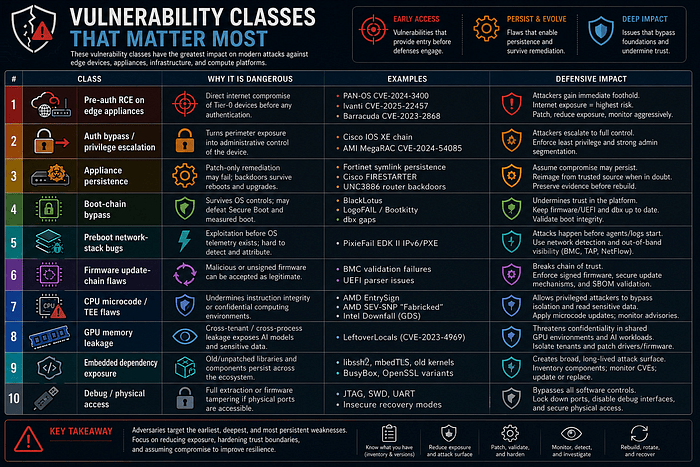
Vulnerability Classes That Matter Most
The highest-value classes are authentication bypass, command injection, path traversal, buffer overflow, weak update or signature verification, exposed management interfaces, hard-coded credentials, insecure boot/rollback behavior, and inherited vulnerable components. In AdversaryGraph, each class should become a CVE tag, affected-asset tag, risk tag, and detection/telemetry requirement.
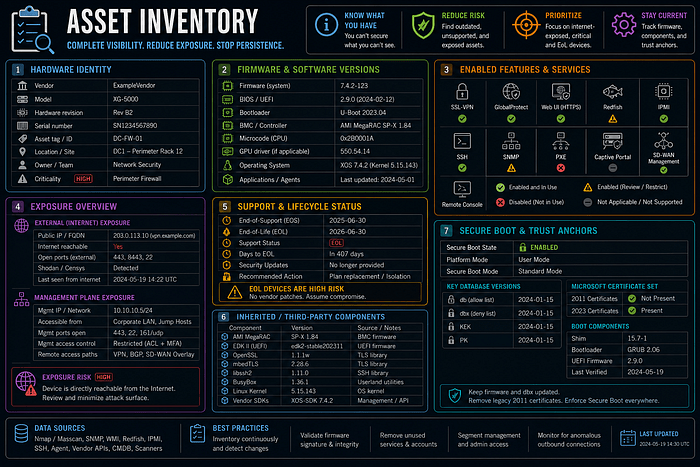
Priority Collection Requirements
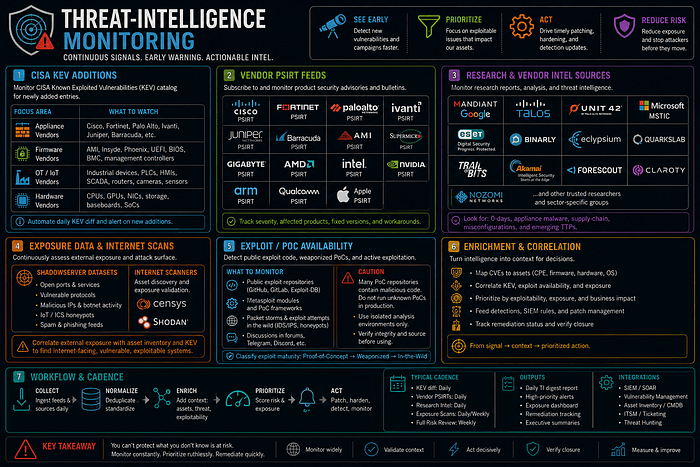
Collection should start with asset inventory and exposed management surface, then add vendor PSIRT, CISA KEV, NVD, product lifecycle state, firmware version, management protocol, remote-access path, and off-device telemetry status. Use Asset Surface to normalize inventories and CVE Library to connect CVEs to actor, technique, sector, and asset context.
Defensive Operating Model
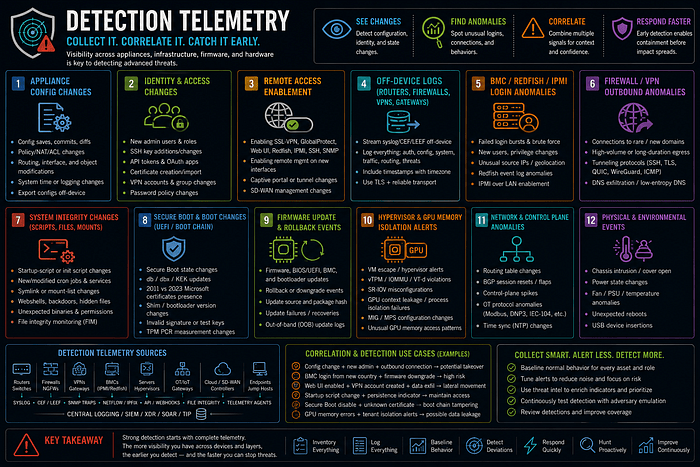
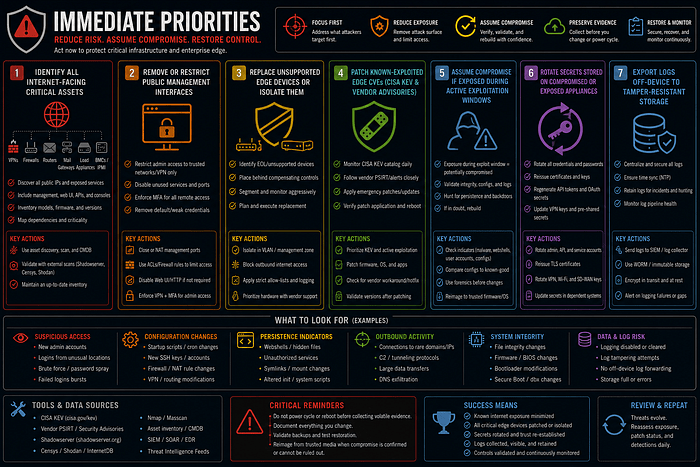
Mature defense starts with feature-aware edge inventory, firmware-aware asset inventory, KEV/PSIRT-driven patching, end-of-support retirement, isolated management networks, off-device logs, measured boot, BMC isolation, Secure Boot migration tracking, and reimage/replace playbooks. The workflow belongs in the same ecosystem as Attack Simulation and Observability: if you cannot validate telemetry, you cannot claim detection coverage.
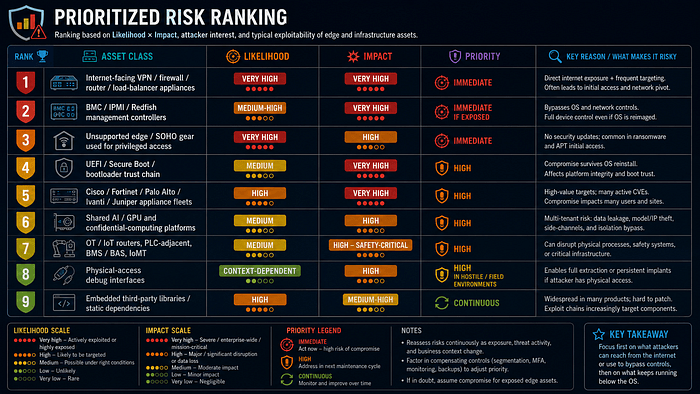
Prioritized Risk Ranking
The highest-priority operational risks are exposed edge appliances, durable appliance persistence, unsupported edge devices, BMC exposure, UEFI/boot trust drift, firmware supply-chain inheritance, SOHO router proxy infrastructure, and OT/IoT patch constraints. This ranking can be converted into an AdversaryGraph validation backlog and used with external validation evidence.
Source Base and Ecosystem Links
The published article was source-verified on July 2, 2026. Primary source families include CISA KEV and BOD 26-02, Cisco/Talos FIRESTARTER and ArcaneDoor reporting, Fortinet SSL-VPN persistence guidance, Palo Alto Operation MidnightEclipse, Ivanti and Barracuda advisories, Google/Mandiant reports on UNC3886/UNC5221/UNC4841, ESET BlackLotus analysis, AMD and Intel security bulletins, Trail of Bits GPU research, Forescout, Claroty, Nozomi, and CISA ICS advisories.
- Original Medium publication
- 1200km CTI research index
- AdversaryGraph project hub
- AdversaryGraph documentation
- Asset Attack Surface Mapping
- CVE Library and CVE-to-TTP correlation
- Attack Simulation and SIEM validation
- Live ATT&CK Threat Matrix
- CTI Analyst Field Manual
- Operation Desert Hydra
- CTI as a Code
- Israel Government Threat Actors CTI