Parent-Child Execution
Atlas home · Research path · Operational families · Anomaly models · Visual index
Consolidated 27 September 2026 from the revised publication. Source-reported incidents, proposed models, functional tests, and synthetic results remain separate evidence classes. Provenance and review scope.
An unusual direct process relationship or explicitly defined ancestry path.
Telemetry contract: Stable process identifiers, parent identifiers, command lines, user and asset role.
Candidate method [unvalidated until tested]: Specify direct child versus ancestor matching and test process-ID reuse and incomplete ancestry.
Benign alternatives and limits: Application automation can launch shells; in-process activity can evade child-process rules.
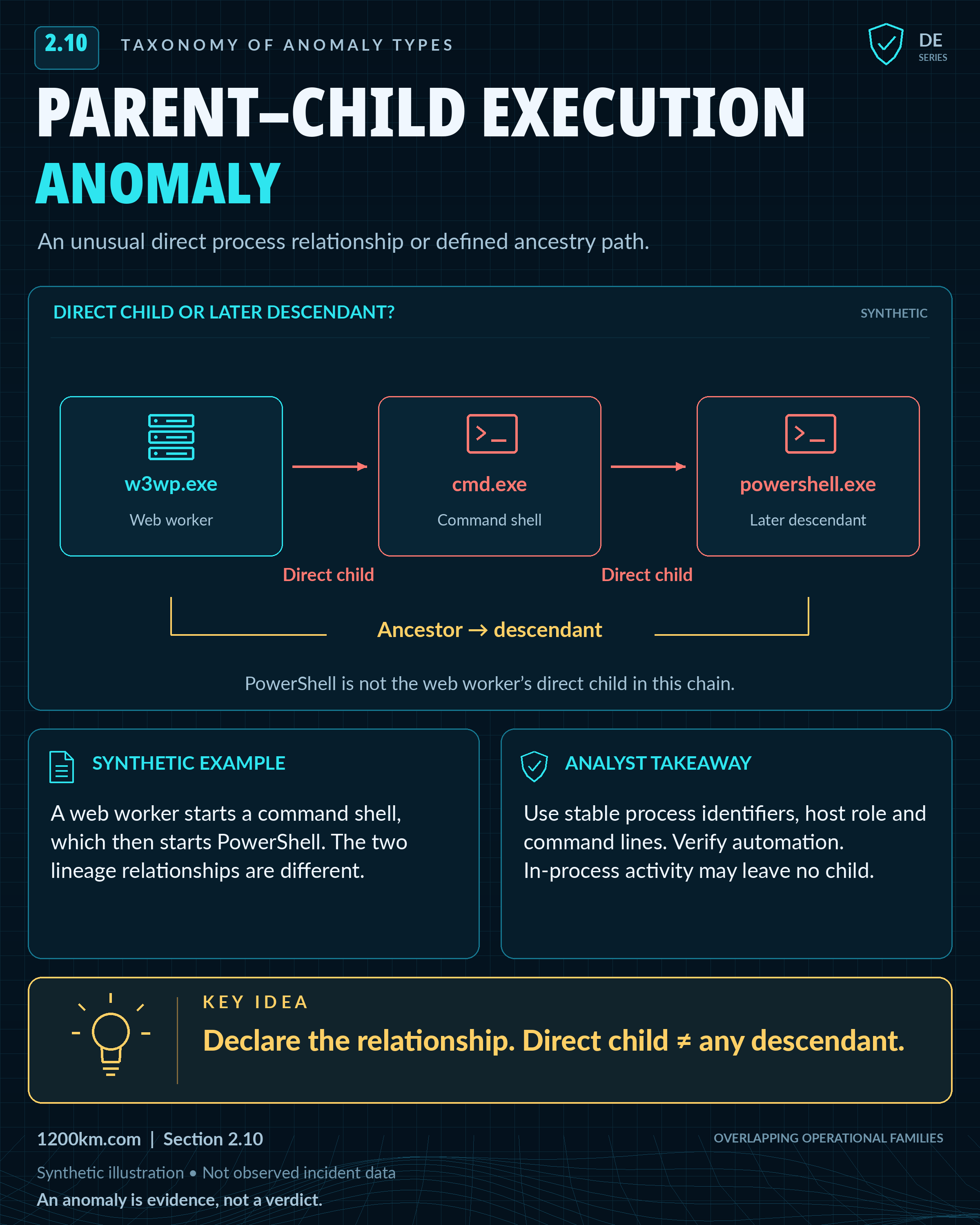
Text equivalent and full-size diagram
PID reuse, missing ancestry and in-process execution limit coverage.
Direct relationship 1: w3wp.exe starts cmd.exe. Direct relationship 2: cmd.exe starts powershell.exe.
Relative to w3wp.exe, PowerShell is a descendant, not a direct child.
Use stable process identifiers, host role and command lines. Verify legitimate automation; in-process activity may create no child process.
Evidence tags: Endpoint telemetry. Statistical forms: contextual, collective.
Browse articles and guides: Parent-Child Execution.
Reported incidents and detection interpretations
Lemon Duck exploitation of Exchange servers
Period: March 2021 reporting. Evidence: campaign reported by the cited source.
Observed [source-reported]: Microsoft associated Exchange IIS-worker spawning of PowerShell with observed Lemon Duck activity and supplied a corresponding hunting query. Microsoft: Analyzing attacks taking advantage of the Exchange Server vulnerabilities.
Anomaly interpretation [inferred]: Investigate w3wp.exe to powershell.exe lineage in the Exchange context, then inspect the command, deployment history and network activity.
Telemetry to validate: MDE DeviceProcessEvents or equivalent parent/child process events with command lines.
Boundary / competing explanation: Microsoft's query is a hunting starting point, not proof that every matching parent-child pair is malicious.
ATT&CK [author-mapped behavior, not actor attribution]: T1059.001 — Command and Scripting Interpreter: PowerShell
DoejoCrypt activity after Exchange exploitation
Period: March 2021 reporting. Evidence: campaign reported by the cited source.
Observed [source-reported]: Microsoft described DoejoCrypt-associated batch-script credential theft and published lineage-oriented queries for post-exploitation activity. Microsoft: Analyzing attacks taking advantage of the Exchange Server vulnerabilities.
Anomaly interpretation [inferred]: Follow the web-server, command-shell and credential-access chain instead of alerting on cmd.exe globally. Corroborate with script content and resulting files.
Telemetry to validate: Process ancestry, batch command lines, sensitive-registry access and file creation.
Boundary / competing explanation: The report covers several exploiting actors; do not attribute every Exchange child process to HAFNIUM or DoejoCrypt.
ATT&CK [author-mapped behavior, not actor attribution]: T1059.003 — Command and Scripting Interpreter: Windows Command Shell
Crosslinks: Rare Process / Service · Sequence. Statistical foundation in the Anomaly Detection Atlas. Related research: Newest Detection Engineering Techniques: From Rules to Validated Security Telemetry.
Illustrative scenarios (not additional incidents):
-
winword.exespawnspowershell.exe, even though Office applications on that workstation normally never launch script interpreters. -
w3wp.exe(IIS worker process) startscmd.exe, an uncommon parent-child relationship that can indicate web shell activity. -
excel.exelaunchesrundll32.exeand then a network connection follows, which is not part of normal spreadsheet usage. -
An SSH session has
curlorwgetin its descendant process tree, although such downloads are unusual for the host role. A shell may be the direct parent; record actual ancestry instead of assumingsshdis the direct parent. -
A business application service suddenly spawns
7z.exeorrar.exe, an unusual child process for that parent and host role.
Apply this analytical view
These are curated conceptual links, not claims that a specific model detected the cited incidents.
Models: PowerShell script, encoded content, or remote command execution · Trusted system binary launches unexpected content · Public-facing application exploitation · User opens delivered content followed by execution.
Collection references: Process Creation · Script Execution. These describe data components, not equivalent connectors or guaranteed fields.
Technique workspaces
Follow the exact technique ID to source rules, associated tools, collection references, and documented lab candidates. A navigation association is not live validation.