Detection Engineering Patterns and Logic Examples
Atlas home · Research path · Operational families · Anomaly models · Visual index
Consolidated 27 September 2026 from the revised publication. Source-reported incidents, proposed models, functional tests, and synthetic results remain separate evidence classes. Provenance and review scope.
Four Core Design Patterns
Rarity in role: compare equivalent entities and tasks rather than the entire estate. Role membership itself must be trustworthy and updated after legitimate changes.
Rate plus shape: combine count, distinct targets, distinct sources and ordering. A fixed time bin has boundary effects; longer or overlapping windows introduce additional cost and deduplication requirements.
State change: inspect a new permission, identity relationship or configuration state against policy and approved change. A deterministic condition is not the same as a deterministic malicious verdict.
Corroboration: combine independent evidence while measuring what each extra gate removes. If a gate intersects a candidate set, it can remove true positives as well as false positives. Do not promise improved precision without a recall trade-off.
Text equivalent and full-size diagram
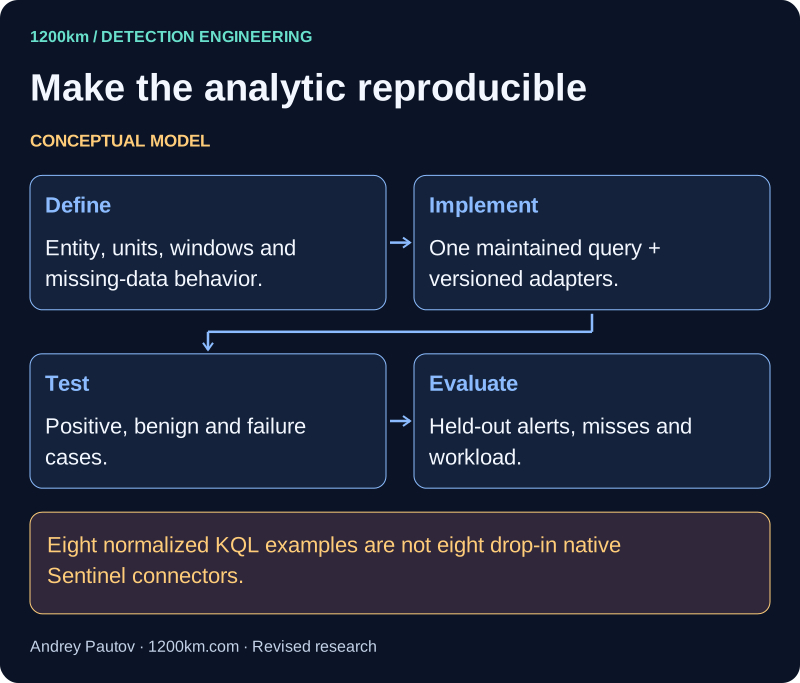
Eight normalized KQL examples are not eight drop-in native Sentinel connectors.
- Define. Entity, units, windows and missing-data behavior.
- Implement. One maintained query + versioned adapters.
- Test. Positive, benign and failure cases.
- Evaluate. Held-out alerts, misses and workload.
Detection Logic Examples
The canonical implementations are eight KQL files under research/anomaly-validation/queries/ in the pinned research source repository. This section is generated from those files; edits belong in the files, not in duplicated snippets. The old broken SPL/KQL exports remain in an explicitly historical download, not as deployment recipes.
Contract: these queries use the named normalized tables in the telemetry contract. They are not drop-in queries for an unspecified Sentinel connector. Fixture execution establishes syntax and selected logic behavior; live ingestion, identity enrichment, scheduling, production thresholds and analyst outcomes require separate validation. No Splunk execution is claimed by converting an SPL example to KQL.
Distributed Password Spray — Rate and Shape
The example selects result 50126 as one invalid-credential class, not every nonzero status. It joins only attempted identities within the same tenant, requires success after that identity's last failure, and uses a bounded follow-up period. 50140 is an interaction interruption, not generic completed success. Microsoft error-code reference, Kusto time-window joins.
The numeric thresholds are fixture parameters. Shared proxies and identity outages can create similar patterns; success afterward does not prove compromise. This analytic deliberately requires a burst and subsequent success, so failure-only spraying, unresolved identities and sufficiently low-volume activity fall outside its scope. Its fixed-bin boundary blind spot is an explicit regression test, not hidden by reporting only positive cases.
Download this KQL example · Normalized table contracts.
// Normalized SigninEvents; illustrative parameters, not calibrated production settings.
let Window = 15m;
let Followup = 30m;
let MinFailures = 6;
let MinAccounts = 3;
let MinSources = 2;
let Events = SigninEvents
    | where isnotempty(TenantId) and isnotempty(UserId) and isnotempty(EventId)
    | summarize arg_max(TimeGenerated, *) by TenantId, EventId;
let Failures = Events
    | where ResultType == "50126" and isnotempty(IPAddress)
    | extend WindowStart = bin(TimeGenerated, Window);
let Bursts = Failures
    | summarize Failures=count(), Accounts=count_distinct(UserId), Sources=count_distinct(IPAddress)
        by TenantId, WindowStart
    | where Failures >= MinFailures and Accounts >= MinAccounts and Sources >= MinSources;
let Attempted = Failures
    | summarize FirstFailure=min(TimeGenerated), LastFailure=max(TimeGenerated)
        by TenantId, UserId, WindowStart
    | join kind=inner Bursts on TenantId, WindowStart;
Attempted
| join kind=inner (Events | where ResultType == "0"
    | project TenantId, UserId, SuccessTime=TimeGenerated, SuccessEventId=EventId, SuccessIP=IPAddress)
    on TenantId, UserId
| where SuccessTime > LastFailure and SuccessTime <= LastFailure + Followup
| project TenantId, UserId, WindowStart, FirstFailure, LastFailure,
    SuccessTime, SuccessEventId, SuccessIP, Failures, Accounts, Sources
| order by TenantId asc, UserId asc, SuccessTime asc
Kerberoasting — Service-Request Breadth
This version reports encryption types and includes AES instead of asserting that RC4 alone covers Kerberoasting. It excludes krbtgt from this service-breadth view without excluding all computer principals. The threshold of five distinct service identifiers is illustrative. The public single-ticket recording is deliberately not modified or repeated to make this rule fire: a volume detector can miss a real low-volume technique example.
Download this KQL example · Normalized table contracts.
// WindowsEvents normalized as documented in contracts.json. Five is a test parameter.
WindowsEvents
| where EventID == 4769 and ResultCode == "0"
| where isnotempty(Principal) and isnotempty(ServiceName)
| extend ServiceName=tolower(ServiceName)
| where ServiceName !~ "krbtgt" and not(ServiceName startswith "krbtgt/")
| summarize arg_max(TimeGenerated, *) by Computer, EvidenceId
| extend WindowStart=bin(TimeGenerated, 15m)
| summarize Requests=count(), DistinctServices=count_distinct(ServiceName),
    Services=make_set(ServiceName, 100), EncryptionTypes=make_set(EncryptionType, 10)
    by Principal, SourceIP, WindowStart
| where DistinctServices >= 5
| order by Principal asc, WindowStart asc
DCSync — Replication-Right Access
Return each candidate access, including computer principals and separate-right events. Source enrichment is a bounded same-DC/logon-ID join; unresolved and ambiguous addresses remain visible. An approved-source review belongs after this evidence-preserving stage. The 24-hour correlation bound is a test configuration, not proof that logon IDs cannot be reused. Validate session uniqueness and stale-address handling in the actual environment.
Download this KQL example · Normalized table contracts.
// Candidate replication-right access, NOT proof of successful credential extraction.
let Candidates = WindowsEvents
    | where EventID == 4662
    | where binary_and(AccessMask, 256) != 0
    | where ObjectType =~ "domainDNS" or ObjectType contains "19195a5b-6da0-11d0-afd3-00c04fd930c9"
    | where Properties contains "1131f6aa-9c07-11d1-f79f-00c04fc2dcd2"
        or Properties contains "1131f6ad-9c07-11d1-f79f-00c04fc2dcd2"
        or Properties contains "89e95b76-444d-4c62-991a-0facbeda640c"
    | summarize arg_max(TimeGenerated, *) by Computer, EvidenceId
    | project Computer, EvidenceId, ReplicationTime=TimeGenerated, Principal, LogonId, Properties;
let Correlation = Candidates
    | where isnotempty(LogonId)
    | join kind=inner (WindowsEvents | where EventID == 4624 and isnotempty(LogonId)
        | project Computer, LogonId, LogonTime=TimeGenerated, CorrelatedIP=SourceIP) on Computer, LogonId
    | where LogonTime <= ReplicationTime and LogonTime >= ReplicationTime - 24h
    | where isnotempty(CorrelatedIP) and CorrelatedIP != "-"
    | summarize CandidateIPs=make_set(CorrelatedIP, 100) by Computer, EvidenceId
    | extend SourceIP=iff(array_length(CandidateIPs) == 1, tostring(CandidateIPs[0]), ""),
        SourceStatus=iff(array_length(CandidateIPs) == 1, "correlated", "ambiguous");
Candidates
| join kind=leftouter Correlation on Computer, EvidenceId
| extend SourceStatus=iff(isempty(SourceStatus), "unresolved", SourceStatus)
| project Computer, EvidenceId, ReplicationTime, Principal, LogonId, Properties, SourceIP, SourceStatus
| order by Computer asc, EvidenceId asc
Pass-the-Hash — Authentication Hunting Views
These are broad hunting outputs: source-side alternate-credential context and target-side NTLM network authentication. They intentionally include legitimate activity and do not assign a malicious verdict. Correlate them with process and identity evidence; missing one view does not exclude PtH.
Download this KQL example · Normalized table contracts.
// Two hunting views, not an authentication-attack classifier.
WindowsEvents
| where EventID == 4624
| extend EvidenceClass=case(
    LogonType == 9 and LogonProcess =~ "seclogo", "source-new-credentials",
    LogonType == 3 and AuthenticationPackage =~ "NTLM", "target-ntlm-network",
    "outside-scope")
| where EvidenceClass != "outside-scope"
| summarize arg_max(TimeGenerated, *) by Computer, EvidenceId
| project TimeGenerated, Computer, EvidenceId, Principal, SourceIP, LogonId, EvidenceClass
| order by EvidenceId asc
LSASS Credential Access — Sysmon Event 10
The query identifies VM-read access to LSASS. It does not equate every matching process with a credential dumper or every nonmatching access mode with safety. Familiar paths are deliberately retained for review rather than silently allowlisted.
Download this KQL example · Normalized table contracts.
// PROCESS_VM_READ candidates. No trusted-path or process-name auto-exclusion.
EndpointEvents
| where Provider == "Microsoft-Windows-Sysmon" and EventID == 10
| where TargetImage endswith "\\lsass.exe"
| where binary_and(GrantedAccess, 16) != 0
| summarize arg_max(TimeGenerated, *) by Computer, EvidenceId
| project TimeGenerated, Computer, EvidenceId, Image, TargetImage, GrantedAccess, CallTrace
| order by EvidenceId asc
Web-Server Process Spawning Shell Interpreter
This tests a direct parent-child relationship on inventory-confirmed web servers. It does not detect every webshell, indirect descendant, module or in-process action. A legitimate application can match. Do not substitute an ancestor for a direct parent without changing and testing the analytic.
Download this KQL example · Normalized table contracts.
// Direct child relation only; HostRole is inventory enrichment, not guessed from a filename.
EndpointEvents
| where Provider == "Microsoft-Windows-Sysmon" and EventID == 1 and HostRole == "web-server"
| where ParentImage endswith "\\w3wp.exe" or ParentImage endswith "\\UMWorkerProcess.exe"
| where Image endswith "\\cmd.exe" or Image endswith "\\powershell.exe" or Image endswith "\\pwsh.exe"
| summarize arg_max(TimeGenerated, *) by Computer, EvidenceId
| project TimeGenerated, Computer, EvidenceId, Image, ParentImage, CommandLine, HostRole
| order by EvidenceId asc
DNS Tunneling — Shannon Entropy on Subdomain
The implementation extracts entropy from a specified ASCII label; it does not classify tunneling. Keep the raw QNAME and extraction provenance upstream. Short labels, valid encoded services, alphabet choices and internationalized names need deliberate handling. A high score on abcdefghijklmnop demonstrates why character entropy is not the same as unpredictable or malicious content.
Download this KQL example · Normalized table contracts.
// Feature extraction, NOT a malicious-domain verdict. One normalized ASCII label per row.
let Labels = DnsLabels
    | where isnotempty(EvidenceId) and isnotempty(Label)
    | extend Label=tolower(Label)
    | where Label matches regex "^[a-z0-9_-]{1,63}$"
    | summarize arg_max(TimeGenerated, *) by Sensor, EvidenceId
    | extend LabelLength=strlen(Label);
Labels
| mv-expand CharacterIndex=range(0, LabelLength - 1, 1) to typeof(long)
| extend Character=substring(Label, toint(CharacterIndex), 1)
| summarize Occurrences=count() by Sensor, EvidenceId, Label, LabelLength, Character
| extend P=todouble(Occurrences) / todouble(LabelLength)
| summarize Entropy=-sum(P * log2(P)) by Sensor, EvidenceId, Label, LabelLength
| extend LengthBound=log2(todouble(LabelLength))
| order by EvidenceId asc
SaaS Bulk Download Anomaly (M365 SharePoint / OneDrive)
DailyDownloads contains one row per tenant, immutable user and complete UTC calendar day. Independent collection health determines Complete. Missing collection must not become an invented zero. Count deduplicated audit events; do not label the result bytes or unique files. Reject duplicate entity/day rows before scoring.
The caller supplies EvaluationDay; training excludes that day and the future. The example exposes cold starts and incomplete data instead of silently losing users in an inner join. The zero-MAD fallback and minimum excess are explicit policy parameters, not a universal improvement over z-scores. A seasonal or role-specific model may be more appropriate.
Download this KQL example · Normalized table contracts.
// Complete UTC calendar days; Counts are audit events, not bytes or unique documents.
// EvaluationDay is supplied explicitly by the caller. Do not tune on the scored day.
let HistoryDays=28d;
let MinimumObservedDays=14;
let MinimumExcess=20.0;
let MadMultiplier=6.0;
let History = DailyDownloads
    | where Day >= EvaluationDay - HistoryDays and Day < EvaluationDay
    | where Complete and isnotnull(Count) and Count >= 0;
let Medians = History | summarize Median=percentile(Count, 50), ObservedDays=count() by TenantId, UserId;
let Baselines = History
    | join kind=inner Medians on TenantId, UserId
    | extend Deviation=abs(todouble(Count) - Median)
    | summarize MAD=percentile(Deviation, 50), Median=take_any(Median), ObservedDays=take_any(ObservedDays)
        by TenantId, UserId;
DailyDownloads
| where Day == EvaluationDay
| join kind=leftouter Baselines on TenantId, UserId
| extend ObservedDays=coalesce(ObservedDays, tolong(0))
| extend Threshold=Median + max_of(MinimumExcess, MadMultiplier * MAD)
| extend Status=case(
    not(Complete) or isnull(Count) or Count < 0, "missing-telemetry",
    ObservedDays < MinimumObservedDays, "insufficient-history",
    todouble(Count) > Threshold, "above-baseline",
    "within-baseline")
| project TenantId, UserId, Day, Count, ObservedDays, Median, MAD, Threshold, Status
| order by TenantId asc, UserId asc
Reproduction and evidence levels
Run these commands from the root of the pinned research repository, following its reproduction README. Run the offline checks with Python 3.13 or a compatible Python 3 standard library. Public inputs are small XML log recordings, not executable samples. The downloader pins the repository commit, verifies Git LFS SHA-256 digests and file sizes, and does not execute recorded commands.
python3 research/anomaly-validation/run_validation.py
python3 research/anomaly-validation/run_validation.py --download
For real query-language execution, start the pinned local engine using the instructions in the research README, then run:
python3 research/anomaly-validation/run_validation.py \
  --endpoint http://127.0.0.1:18921 --public-recordings
The Kusto emulator is used only for development and functional tests, not throughput/latency comparisons or product benchmarking. It is not a production Sentinel environment and has no production authentication or ingestion pipeline. Microsoft emulator limitations.
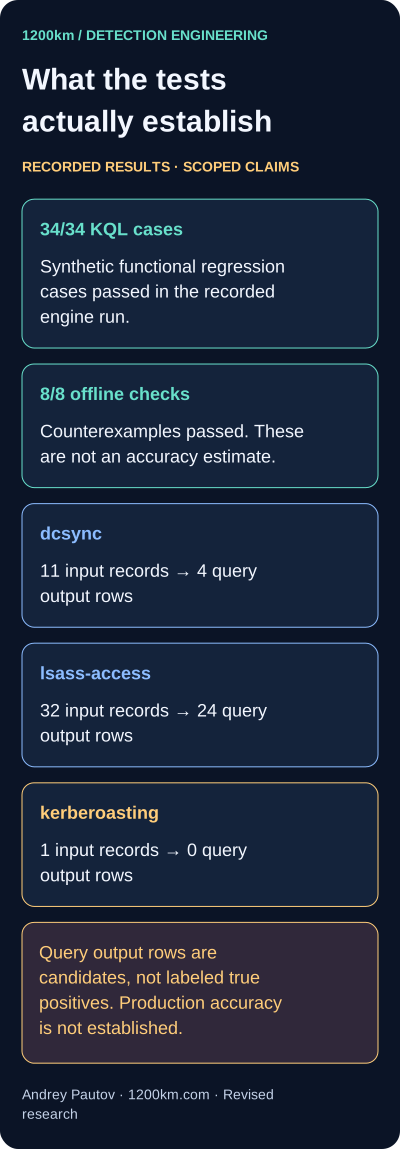
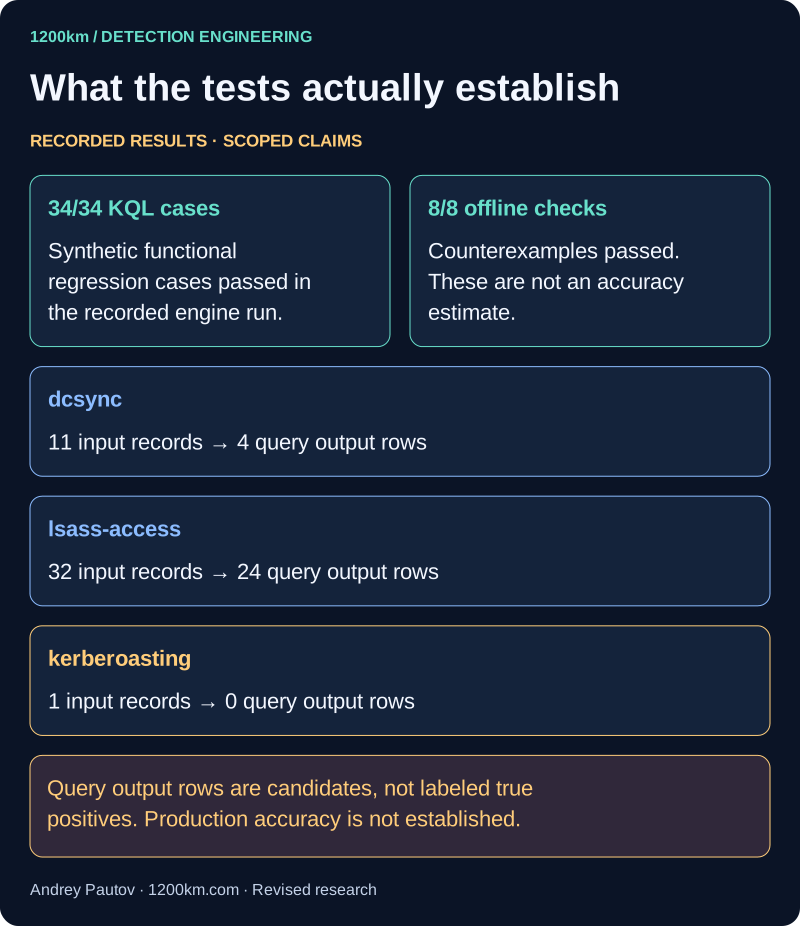
Measured functional result: 34/34 synthetic KQL regression cases and 8/8 offline checks passed. This is test-suite completion, not a detection-accuracy percentage.
| Public lab recording | Input records | Query output rows | Interpretation |
|---|---|---|---|
| dcsync | 11 | 4 | Candidate observations, not individually labeled true positives. |
| lsass-access | 32 | 24 | Candidate observations, not individually labeled true positives. |
| kerberoasting | 1 | 0 | Low-volume case falls below the breadth threshold; known blind spot. |
Full outputs, input-record hashes, query hashes, engine identity and limits are in the functional report.
The public recordings are provided by Splunk's Attack Data repository under Apache-2.0, pinned in datasets.json. They are lab activity, not a representative mix of labeled enterprise events. Query output rows are not a true-positive denominator. A recording can contain legitimate background behavior. Zero matches may expose an analytic's scope limitation rather than an ingestion or execution failure. Dataset repository.
Text equivalent and full-size diagram
Query output rows are candidates, not labeled true positives. Production accuracy is not established.
{
  "kqlPassed": 34,
  "kqlTotal": 34,
  "offlinePassed": 8,
  "offlineTotal": 8,
  "replay": [
    {
      "id": "dcsync",
      "input": 11,
      "output": 4
    },
    {
      "id": "lsass-access",
      "input": 32,
      "output": 24
    },
    {
      "id": "kerberoasting",
      "input": 1,
      "output": 0
    }
  ]
}