Privileged Account Management focuses on implementing policies, controls, and tools to securely manage privileged accounts (e.g., SYSTEM, root, or administrative accounts). This includes restricting access, limiting the scope of permissions, monitoring privileged account usage, and ensuring accountability through logging and auditing.This mitigation can be implemented through the following measures: Account Permissions and Roles: - Implement RBAC and least privilege principles to allocate permissions securely. - Use tools like Active Directory Group Policies to enforce access restrictions. Credential Security: - Deploy password vaulting tools like CyberArk, HashiCorp Vault, or KeePass for secure storage and rotation of credentials. - Enforce password policies for complexity, uniqueness, and expiration using tools like Microsoft Group Policy Objects (GPO). Multi-Factor Authentication (MF…
MITRE mitigation sourceAdversaryGraph public intelligence page
This page is part of Threat Matrix, the public browser workspace for the main AdversaryGraph platform. Use it for ATT&CK pivots, actor and technique context, similarity leads, detection coverage review, and analyst-ready investigation paths.
Validation disclaimer: TTP overlap, actor similarity, generated summaries, and coverage findings are investigation leads, not attribution proof or operational validation without analyst review.
Main AdversaryGraph project Documentation Malware Analysis GitHub
Windows Management Instrumentation
Adversaries may abuse Windows Management Instrumentation (WMI) to execute malicious commands and payloads. WMI is designed for programmers and is the infrastructure for management data and operations on Windows systems.(Citation: WMI 1-3) WMI is an administration feature that provides a uniform environment to access Windows system components. The WMI service enables both local and remote access, though the latter is facilitated by [Remote Services](https://attack.mitre.org/techniques/T1021) such as [Distributed Component Object Model](https://attack.mitre.org/techniques/T1021/003) and [Windows Remote Management](https://attack.mitre.org/techniques/T1021/006).(Citation: WMI 1-3) Remote WMI over DCOM operates using port 135, whereas WMI over WinRM operates over port 5985 when using HTTP and 5986 for HTTPS.(Citation: WMI 1-3) (Citation: Mandiant WMI) An adversary can use WMI to interact with local and remote systems and use it as a means to execute various behaviors, such as gathering information for [Discovery](https://attack.mitre.org/tactics/TA0007) as well as [Execution](https://attack.mitre.org/tactics/TA0002) of commands and payloads.(Citation: Mandiant WMI) For example, `wmic.exe` can be abused by an adversary to delete shadow copies with the command `wmic.exe Shadowcopy Delete` (i.e., [Inhibit System Recovery](https://attack.mitre.org/techniques/T1490)).(Citation: WMI 6) **Note:** `wmic.exe` is deprecated as of January of 2024, with the WMIC feature being “disabled by default” on Windows 11+. WMIC will be removed from subsequent Windows releases and replaced by [Power…
Open detection, hunting, mitigation, and evidence workspace
Detection logic
Monitor network traffic for WMI connections; the use of WMI in environments that do not typically use WMI may be suspect. Perform process monitoring to capture command-line arguments of "wmic" and detect commands that are used to perform remote behavior.
Observed actors
G0009APT29
G0016Naikon
G0019Threat Group-3390
G0027Lotus Blossom
G0030Lazarus Group
G0032Sandworm Team
G0034FIN6
G0037Stealth Falcon
G0038menuPass
G0045FIN7
G0046Gamaredon Group
G0047OilRig
G0049APT32
G0050Magic Hound
G0059FIN8
G0061Leviathan
G0065MuddyWater
G0069GALLIUM
G0093APT41
G0096APT-C-36
G0099Wizard Spider
G0102Blue Mockingbird
G0108Windshift
G0112Chimera
G0114Indrik Spider
G0119Mustang Panda
G0129Aquatic Panda
G0143Ember Bear
G1003Earth Lusca
G1006FIN13
G1016Volt Typhoon
G1017TA2541
G1018Cinnamon Tempest
G1021ToddyCat
G1022INC Ransom
G1032BlackByte
G1043APT42
G1044Velvet Ant
G1047Medusa Group
G1051MirrorFace
G1054VOID MANTICORE
G1055NIMBUS MANTICORE
G1059
Correlated CTI and IR reports
1200km CTI repository · explicit report mentionATT&CK as a Working Tool: Theory and Hands-On Practical Usage
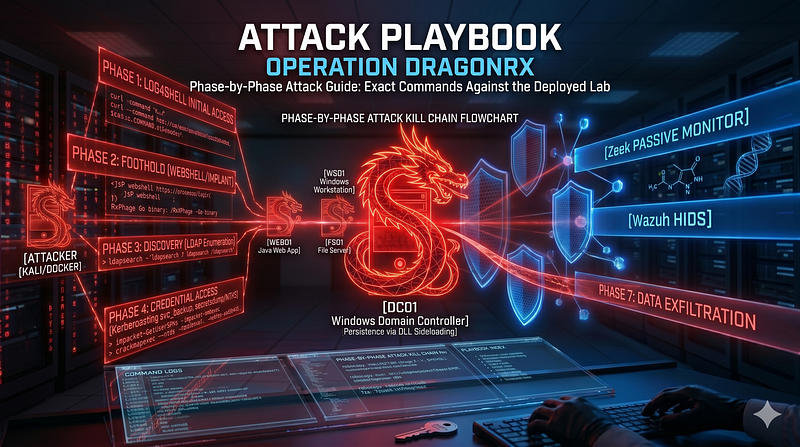
1200km CTI repository · explicit report mentionAttack Playbook — Operation DragonRx
1200km CTI repository · explicit report mentionOperation DragonRx — APT41 Full Attack Simulation
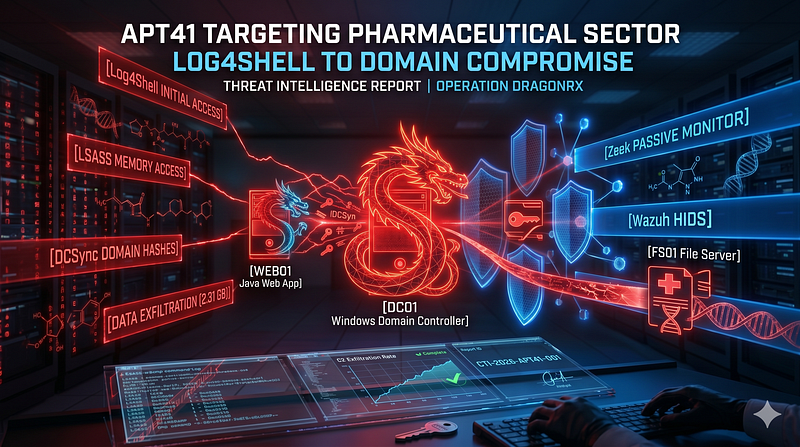
1200km CTI repository · explicit report mentionOperation DragonRx: Simulating an APT41 Attack End-to-End — From Log4Shell to DFIR and Malware Analysis
1200km CTI repository · explicit report mentionAPT41 Targeting Pharmaceutical Sector Log4Shell to Domain Compromise
1200km Medium · authored report mentionATT CK as a Working Tool Theory and Hands On Practical Usage
1200km Medium · authored report mentionAttack Playbook Operation DragonRx
1200km Medium · authored report mentionOperation DragonRx Simulating an APT41 Attack End to End From Log4Shell to DFIR and Malware
1200km Medium · authored report mention
Cyber Knowledge context
Use these routes to move from the ATT&CK behavior into explanation, implementation, evidence handling, validation, and defensive operations. Relevance is generated from explicit identifiers/names and governed topic mappings; it is not attribution evidence.
Blue Team & Defensive Security · Governed topic match · 42/100Module 5 — Cloud, containers, and Kubernetes
Red Team & Offensive Security · Tactic learning route · 24/100Static triage: strings, imports, resources, and capabilities
Malware Analysis & Reverse Engineering · Tactic learning route · 24/100Module 4 — Detection engineering and detection as code
Blue Team & Defensive Security · Tactic learning route · 24/100
MITRE mitigations
Behavior Prevention on Endpoint refers to the use of technologies and strategies to detect and block potentially malicious activities by analyzing the behavior of processes, files, API calls, and other endpoint events. Rather than relying solely on known signatures, this approach leverages heuristics, machine learning, and real-time monitoring to identify anomalous patterns indicative of an attack. This mitigation can be implemented through the following measures: Suspicious Process Behavior: - Implementation: Use Endpoint Detection and Response (EDR) tools to monitor and block processes exhibiting unusual behavior, such as privilege escalation attempts. - Use Case: An attacker uses a known vulnerability to spawn a privileged process from a user-level application. The endpoint tool detects the abnormal parent-child process relationship and blocks the action. Unauthorized File Access: -…
MITRE mitigation sourceUser Account Management involves implementing and enforcing policies for the lifecycle of user accounts, including creation, modification, and deactivation. Proper account management reduces the attack surface by limiting unauthorized access, managing account privileges, and ensuring accounts are used according to organizational policies. This mitigation can be implemented through the following measures: Enforcing the Principle of Least Privilege - Implementation: Assign users only the minimum permissions required to perform their job functions. Regularly audit accounts to ensure no excess permissions are granted. - Use Case: Reduces the risk of privilege escalation by ensuring accounts cannot perform unauthorized actions. Implementing Strong Password Policies - Implementation: Enforce password complexity requirements (e.g., length, character types). Require password expiration every 90…
MITRE mitigation sourcePrevent the execution of unauthorized or malicious code on systems by implementing application control, script blocking, and other execution prevention mechanisms. This ensures that only trusted and authorized code is executed, reducing the risk of malware and unauthorized actions. This mitigation can be implemented through the following measures: Application Control: - Use Case: Use tools like AppLocker or Windows Defender Application Control (WDAC) to create whitelists of authorized applications and block unauthorized ones. On Linux, use tools like SELinux or AppArmor to define mandatory access control policies for application execution. - Implementation: Allow only digitally signed or pre-approved applications to execute on servers and endpoints. (e.g., `New-AppLockerPolicy -PolicyType Enforced -FilePath "C:\Policies\AppLocker.xml"`) Script Blocking: - Use Case: Use script control me…
MITRE mitigation sourceMITRE detection strategies and analytics
- AN1031 · Analytic 1031 — Detects adversarial abuse of WMI to execute local or remote commands via WMIC, PowerShell, or COM API through a multi-event chain: process creation, command execution, and corresponding network connection if remote.
Related sector research
Editorial reading routes, not additional MITRE relationships or proof of an actor's involvement in a particular incident.
- Cyberattacks on Big Pharma and Its Ecosystem — MITRE NotPetya WMI behavior; enterprise propagation context. Evidence cutoff: 2026-09-25.
Continue the investigation
Attack tools, simulations and detection rules
Follow explicit source relationships into the reference modules. Linked procedures and detectors are not claims of live validation or actor attribution.
- T1047 Windows Management Instrumentation simulation — Exact active technique ID
- T1047 detection rules — Exact active technique ID; not actor-specific detector coverage