Security Log Source Library
Plan collection and inspect field-level evidence.
Independent course review · Detection Engineering
How attack simulations, endpoint telemetry, and clear investigation workflows turn detection engineering into a practical discipline.
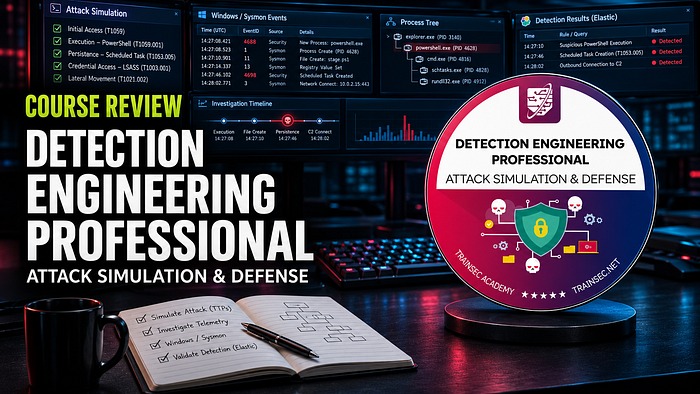
This is my independent personal assessment, originally published on Medium. Course enrollment links marked affiliate use my TrainSec referral URL. I may earn a commission if you enroll through them. The access basis is not disclosed. Publication does not establish a certification or formal completion date.
The strongest connection is between attacker behavior and defensive evidence: explain the technique, simulate it, inspect telemetry, and develop a detection. Windows Event Logs, Sysmon configuration, and Elastic investigations provide a concrete platform for that reasoning.
The 367-page presentation and 19-page workbook support six independent investigation scenarios. The workbook asks for timelines, affected entities, assessment, detection logic, tuning, and possible bypasses. It provides no answer key.
Foundations lead into Windows logs, Sysmon, Elastic Agent and Defend, lateral movement, discovery, persistence, credential access, and process injection. The value is in following each behavior through investigation to detection.
I would improve the independent labs with an optional self-check rubric and make a consistency pass across the written material. Elastic KQL, EQL, and Microsoft Kusto syntax require explicit distinctions. Query examples need schema checks, tuning, and local validation. Simulations require an isolated, authorized lab.
Plan collection and inspect field-level evidence.
Connect behaviors to techniques without treating a label as proof.
Choose simulation references for an isolated, authorized lab.
Compare expected observations with available telemetry.
Review candidate logic and its assumptions before local validation.
Develop scoped questions and preserve investigation evidence.
Connect detection to response decisions and verified recovery.
AdversaryGraph and its documentation support intelligence investigation; Threat Matrix and Anomaly Detection Atlas add context and investigation questions. These independent resources supplement the course; a saved query or library entry is not proof of operational coverage.
Recommended for practitioners with a security foundation who want to reproduce attacker behavior, understand endpoint telemetry, and test detection logic. Budget time for investigation and tuning beyond video playback.