
Use intrusion detection signatures to block traffic at network boundaries.
MITRE mitigation sourceAdversaryGraph public intelligence page
This page is part of Threat Matrix, the public browser workspace for the main AdversaryGraph platform. Use it for ATT&CK pivots, actor and technique context, similarity leads, detection coverage review, and analyst-ready investigation paths.
Validation disclaimer: TTP overlap, actor similarity, generated summaries, and coverage findings are investigation leads, not attribution proof or operational validation without analyst review.
Main AdversaryGraph project Documentation Malware Analysis GitHub
Application Layer Protocol
Adversaries may communicate using OSI application layer protocols to avoid detection/network filtering by blending in with existing traffic. Commands to the remote system, and often the results of those commands, will be embedded within the protocol traffic between the client and server. Adversaries may utilize many different protocols, including those used for web browsing, transferring files, electronic mail, DNS, or publishing/subscribing. For connections that occur internally within an enclave (such as those between a proxy or pivot node and other nodes), commonly used protocols are SMB, SSH, or RDP.(Citation: Mandiant APT29 Eye Spy Email Nov 22)
Open detection, hunting, mitigation, and evidence workspace
Detection logic
Analyze network data for uncommon data flows (e.g., a client sending significantly more data than it receives from a server). Processes utilizing the network that do not normally have network communication or have never been seen before are suspicious. Analyze packet contents to detect application layer protocols that do not follow the expected protocol standards regarding syntax, structure, or any other variable adversaries could leverage to conceal data.
Observed actors
Correlated CTI and IR reports
1. Executive Summary
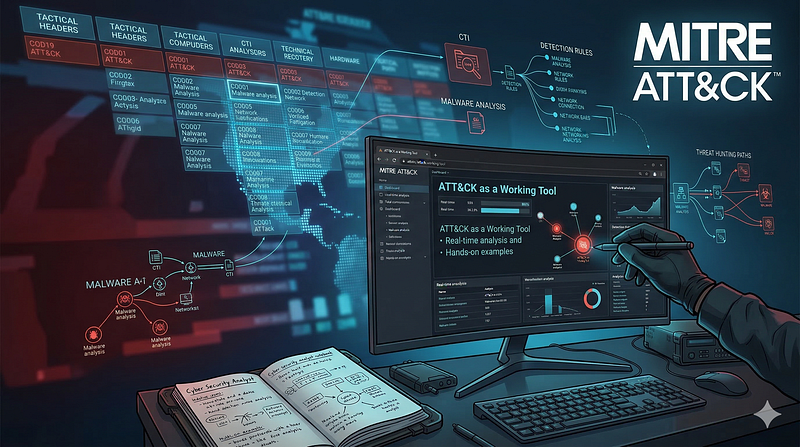
Israel Threat Actors CTI · explicit report mentionATT&CK as a Working Tool: Theory and Hands-On Practical Usage
1200km CTI repository · explicit report mentionCTI Research: LLM/AI/MCP Usage in the Cyber Kill Chain
1200km CTI repository · explicit report mentionCTI Research: LLM/AI/MCP Usage in the Cyber Kill Chain
1200km CTI repository · explicit report mentionExecutive Summary
Israel Threat Actors CTI · explicit report mentionATT CK as a Working Tool Theory and Hands On Practical Usage
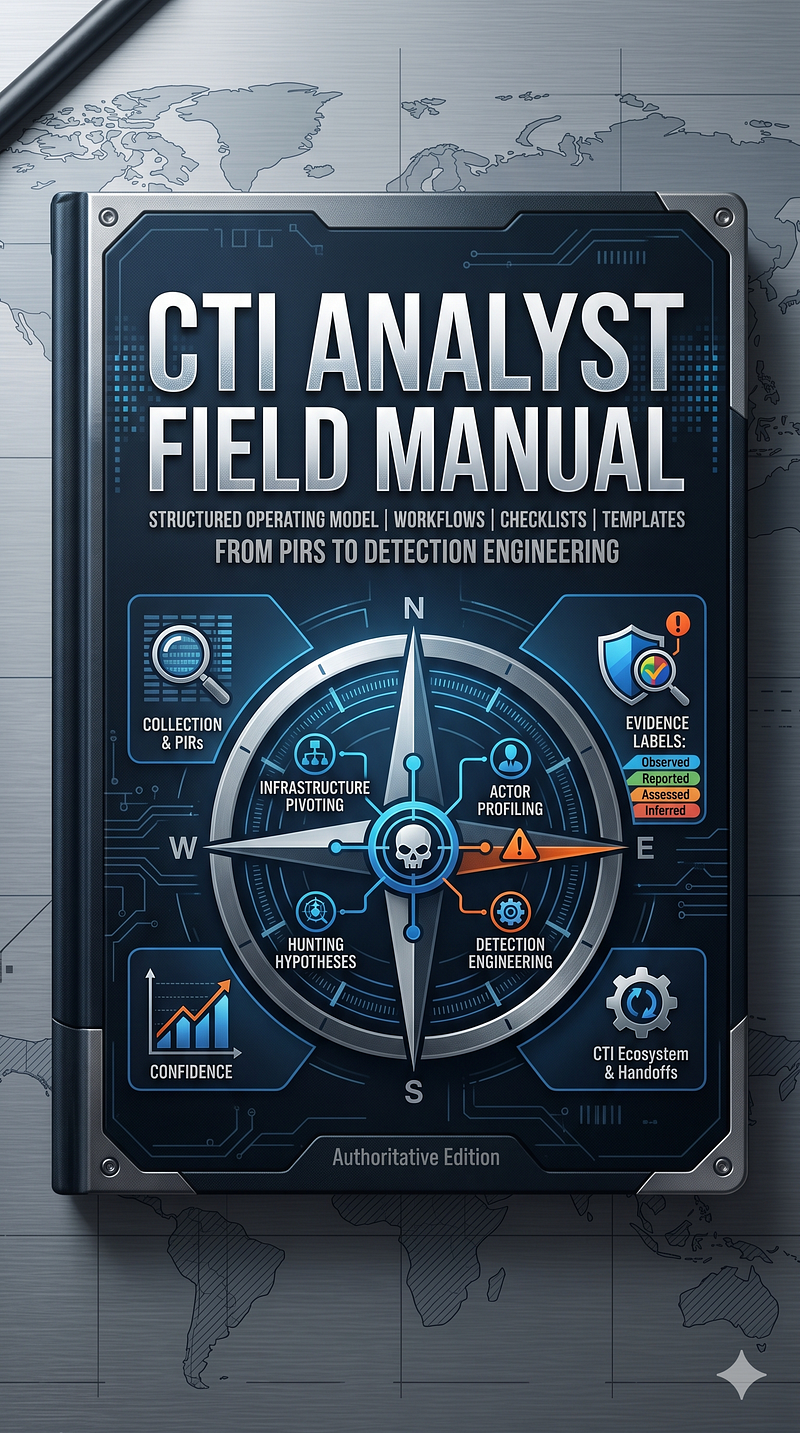
1200km Medium · authored report mentionCTI Analyst Field Manual Complete Reference
1200km Medium · authored report mentionCyberattacks on 4G LTE Telecom Networks Threat Mapping and Defense
1200km Medium · authored report mention
Israel Threat Actors CTI · explicit report mentionATT&CK as a Working Tool: Theory and Hands-On Practical Usage
1200km CTI repository · explicit report mentionCTI Research: LLM/AI/MCP Usage in the Cyber Kill Chain
1200km CTI repository · explicit report mentionCTI Research: LLM/AI/MCP Usage in the Cyber Kill Chain
1200km CTI repository · explicit report mentionExecutive Summary
Israel Threat Actors CTI · explicit report mentionATT CK as a Working Tool Theory and Hands On Practical Usage
1200km Medium · authored report mentionCTI Analyst Field Manual Complete Reference
1200km Medium · authored report mentionCyberattacks on 4G LTE Telecom Networks Threat Mapping and Defense
1200km Medium · authored report mention
Cyber Knowledge context
Use these routes to move from the ATT&CK behavior into explanation, implementation, evidence handling, validation, and defensive operations. Relevance is generated from explicit identifiers/names and governed topic mappings; it is not attribution evidence.
Module 8 — Network defense, protocol analysis, and NDR
Blue Team & Defensive Security · Governed topic match · 42/100Module 6 — The Threat Actor Landscape
Cyber Threat Intelligence (CTI) · Tactic learning route · 24/100Disassembly, decompilation, and code-led analysis
Malware Analysis & Reverse Engineering · Tactic learning route · 24/100Module 5 — Threat hunting
Blue Team & Defensive Security · Tactic learning route · 24/100
Blue Team & Defensive Security · Governed topic match · 42/100Module 6 — The Threat Actor Landscape
Cyber Threat Intelligence (CTI) · Tactic learning route · 24/100Disassembly, decompilation, and code-led analysis
Malware Analysis & Reverse Engineering · Tactic learning route · 24/100Module 5 — Threat hunting
Blue Team & Defensive Security · Tactic learning route · 24/100
MITRE mitigations
Employ network appliances and endpoint software to filter ingress, egress, and lateral network traffic. This includes protocol-based filtering, enforcing firewall rules, and blocking or restricting traffic based on predefined conditions to limit adversary movement and data exfiltration. This mitigation can be implemented through the following measures: Ingress Traffic Filtering: - Use Case: Configure network firewalls to allow traffic only from authorized IP addresses to public-facing servers. - Implementation: Limit SSH (port 22) and RDP (port 3389) traffic to specific IP ranges. Egress Traffic Filtering: - Use Case: Use firewalls or endpoint security software to block unauthorized outbound traffic to prevent data exfiltration and command-and-control (C2) communications. - Implementation: Block outbound traffic to known malicious IPs or regions where communication is unexpected. Protoc…
MITRE mitigation sourceMITRE detection strategies and analytics
- AN1225 · Analytic 1225 — Detects suspicious usage of common application-layer protocols (e.g., HTTP, HTTPS, DNS, SMB) by abnormal processes, with high outbound byte counts or irregular ports, possibly indicating command and control or data exfiltration.
- AN1226 · Analytic 1226 — Detects suspicious curl, wget, or custom socket traffic that leverages DNS, HTTPS, or IRC-style protocols with unbalanced traffic or beacon-like intervals.
- AN1227 · Analytic 1227 — Detects applications using abnormal protocols or high volume traffic not previously associated with the process image, such as Automator or AppleScript invoking curl or python sockets.
- AN1228 · Analytic 1228 — Detects application-layer tunneling or unauthorized app protocols like DNS-over-HTTPS, embedded C2 in TLS/HTTP headers, or misused SMB traffic crossing VLANs.
Continue the investigation
Attack tools, simulations and detection rules
Follow explicit source relationships into the reference modules. Linked procedures and detectors are not claims of live validation or actor attribution.
- T1071 Application Layer Protocol simulation — Exact active technique ID
- T1071 detection rules — Exact active technique ID; not actor-specific detector coverage