Behavior Prevention on Endpoint refers to the use of technologies and strategies to detect and block potentially malicious activities by analyzing the behavior of processes, files, API calls, and other endpoint events. Rather than relying solely on known signatures, this approach leverages heuristics, machine learning, and real-time monitoring to identify anomalous patterns indicative of an attack. This mitigation can be implemented through the following measures: Suspicious Process Behavior: - Implementation: Use Endpoint Detection and Response (EDR) tools to monitor and block processes exhibiting unusual behavior, such as privilege escalation attempts. - Use Case: An attacker uses a known vulnerability to spawn a privileged process from a user-level application. The endpoint tool detects the abnormal parent-child process relationship and blocks the action. Unauthorized File Access: -…
MITRE mitigation sourceAdversaryGraph public intelligence page
This page is part of Threat Matrix, the public browser workspace for the main AdversaryGraph platform. Use it for ATT&CK pivots, actor and technique context, similarity leads, detection coverage review, and analyst-ready investigation paths.
Validation disclaimer: TTP overlap, actor similarity, generated summaries, and coverage findings are investigation leads, not attribution proof or operational validation without analyst review.
Main AdversaryGraph project Documentation Malware Analysis GitHub
Command Obfuscation
Adversaries may obfuscate content during command execution to impede detection. Command-line obfuscation is a method of making strings and patterns within commands and scripts more difficult to signature and analyze. This type of obfuscation can be included within commands executed by delivered payloads (e.g., [Phishing](https://attack.mitre.org/techniques/T1566) and [Drive-by Compromise](https://attack.mitre.org/techniques/T1189)) or interactively via [Command and Scripting Interpreter](https://attack.mitre.org/techniques/T1059).(Citation: Akamai JS)(Citation: Malware Monday VBE) For example, adversaries may abuse syntax that utilizes various symbols and escape characters (such as spacing, `^`, `+`. `$`, and `%`) to make commands difficult to analyze while maintaining the same intended functionality.(Citation: RC PowerShell) Many languages support built-in obfuscation in the form of base64 or URL encoding.(Citation: Microsoft PowerShellB64) Adversaries may also manually implement command obfuscation via string splitting (`“Wor”+“d.Application”`), order and casing of characters (`rev <<<'dwssap/cte/ tac'`), globing (`mkdir -p '/tmp/:&$NiA'`), as well as various tricks involving passing strings through tokens/environment variables/input streams.(Citation: Bashfuscator Command Obfuscators)(Citation: FireEye Obfuscation June 2017) Adversaries may also use tricks such as directory traversals to obfuscate references to the binary being invoked by a command (`C:\voi\pcw\..\..\Windows\tei\qs\k\..\..\..\system32\erool\..\wbem\wg\je\..\..\wmic.exe shadowcopy delete`).(Citation: Twi…
Open detection, hunting, mitigation, and evidence workspace
Detection logic
Use behavior-focused telemetry and validate findings against surrounding activity.
Observed actors
G0010Sandworm Team
G0034FIN6
G0037Patchwork
G0040FIN7
G0046Gamaredon Group
G0047APT32
G0050Magic Hound
G0059FIN8
G0061MuddyWater
G0069APT19
G0073Leafminer
G0077Cobalt Group
G0080APT38
G0082WIRTE
G0090Silence
G0091TA505
G0092Kimsuky
G0094Wizard Spider
G0102Chimera
G0114GOLD SOUTHFIELD
G0115Fox Kitten
G0117Sidewinder
G0121TA551
G0127LazyScripter
G0140Aquatic Panda
G0143HEXANE
G1001Play
G1040Salt Typhoon
G1045Medusa Group
G1051Contagious Interview
G1052
Correlated CTI and IR reports
1200km CTI repository · explicit report mentionCyber Threat Intelligence Dossier: Iranian and Hamas-Aligned Operations Targeting Israeli and Allied Ecosystems (2023-2026)
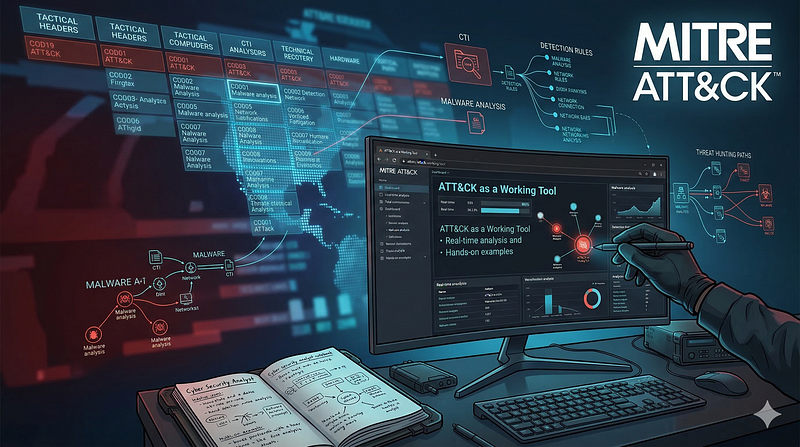
Israel Threat Actors CTI · explicit report mentionATT CK as a Working Tool Theory and Hands On Practical Usage
1200km Medium · authored report mention
Cyber Knowledge context
Use these routes to move from the ATT&CK behavior into explanation, implementation, evidence handling, validation, and defensive operations. Relevance is generated from explicit identifiers/names and governed topic mappings; it is not attribution evidence.
Malware Analysis & Reverse Engineering · Governed topic match · 39/100Controlled dynamic behavior and differential observation
Malware Analysis & Reverse Engineering · Tactic learning route · 24/100Module 4 — Detection engineering and detection as code
Blue Team & Defensive Security · Tactic learning route · 24/100Disk, file-system, and persistence forensics
Digital Forensics & Incident Response (DFIR) · Tactic learning route · 24/100
MITRE mitigations
Antivirus/Antimalware solutions utilize signatures, heuristics, and behavioral analysis to detect, block, and remediate malicious software, including viruses, trojans, ransomware, and spyware. These solutions continuously monitor endpoints and systems for known malicious patterns and suspicious behaviors that indicate compromise. Antivirus/Antimalware software should be deployed across all devices, with automated updates to ensure protection against the latest threats. This mitigation can be implemented through the following measures: Signature-Based Detection: - Implementation: Use predefined signatures to identify known malware based on unique patterns such as file hashes, byte sequences, or command-line arguments. This method is effective against known threats. - Use Case: When malware like "Emotet" is detected, its signature (such as a specific file hash) matches a known database of…
MITRE mitigation sourceMITRE detection strategies and analytics
- AN1394 · Analytic 1394 — Detection of command-line activity exhibiting syntactic obfuscation patterns, such as excessive escape characters, base64 encoding, command concatenation, or outlier command length and entropy.
- AN1395 · Analytic 1395 — Detection of shell commands that leverage encoded execution, command chaining, excessive piping, or unusual token patterns indicative of obfuscation.
- AN1396 · Analytic 1396 — Detection of obfuscated commands via shell, osascript, or AppleScript interpreters using unusual tokens, encoding, variable substitution, or runtime string reconstruction.
Continue the investigation
Attack tools, simulations and detection rules
Follow explicit source relationships into the reference modules. Linked procedures and detectors are not claims of live validation or actor attribution.
- T1027.010 Command Obfuscation simulation — Exact active technique ID
- T1027.010 detection rules — Exact active technique ID; not actor-specific detector coverage