Chapter status: Complete. Originally published on 8 August 2026 and finalized on 30 August 2026, this canonical course version closes the evidence review, preserves all visuals locally, and includes the assessed analyst exercise. The Medium article remains the original companion publication.
This chapter explains neural-network computation, optimization, reproducibility, attacker access, adversarial claims, and defensible evidence for security practitioners without a calculus prerequisite.

Learning objectives
After completing this chapter, you will be able to:
- distinguish architecture, parameters, activations, gradients, artifacts, configuration, and inference evidence;
- trace the forward pass and training loop without confusing a model score with a policy decision or authorization;
- state attacker access, perturbation, and query-budget assumptions for an adversarial-machine-learning claim;
- evaluate evasion, robustness, poisoning, backdoor, extraction, membership-inference, and inversion claims against reproducible evidence;
- map the chapter's security mechanisms to version-pinned MITRE ATLAS techniques and case studies; and
- complete an evidence-preserving analyst exercise that separates observed, reproduced, demonstrated, inferred, and unknown claims.
Table of contents
- 1. Why the mechanism matters to security
- 2. Neural-network security objects
- 3. The forward pass
- 4. Loss functions and objectives
- 5. Gradients and backpropagation
- 6. Optimization in practice
- 7. Generalization, regularization, and drift
- 8. Reproducibility and the nondeterminism problem
- 9. Attacker access and the threat-model taxonomy
- 10. Adversarial examples and evasion
- 11. Evaluating robustness claims
- 12. Poisoning and backdoors
- 13. What inference reveals about training
- 14. CTI case study: evading a malware classifier
- 15. Controls, ATLAS mapping, and analyst exercise
- 16. Key takeaways
- 17. References
- 18. What comes next
1. Why the mechanism matters to security
Security teams do not need calculus, but they do need a causal model of changed predictions. A neural network is a parameterized computation, not the complete AI system; data, preprocessing, features, configuration, dependencies, serving, policy, and downstream action also matter.
During incident response, a changed output may result from a modified input, parser, tokenizer, checkpoint, adapter, threshold, random seed, library, or serving route. A score is evidence for a policy decision, never the policy or an authorization. Ask which observable component changed and what evidence connects it to the outcome.
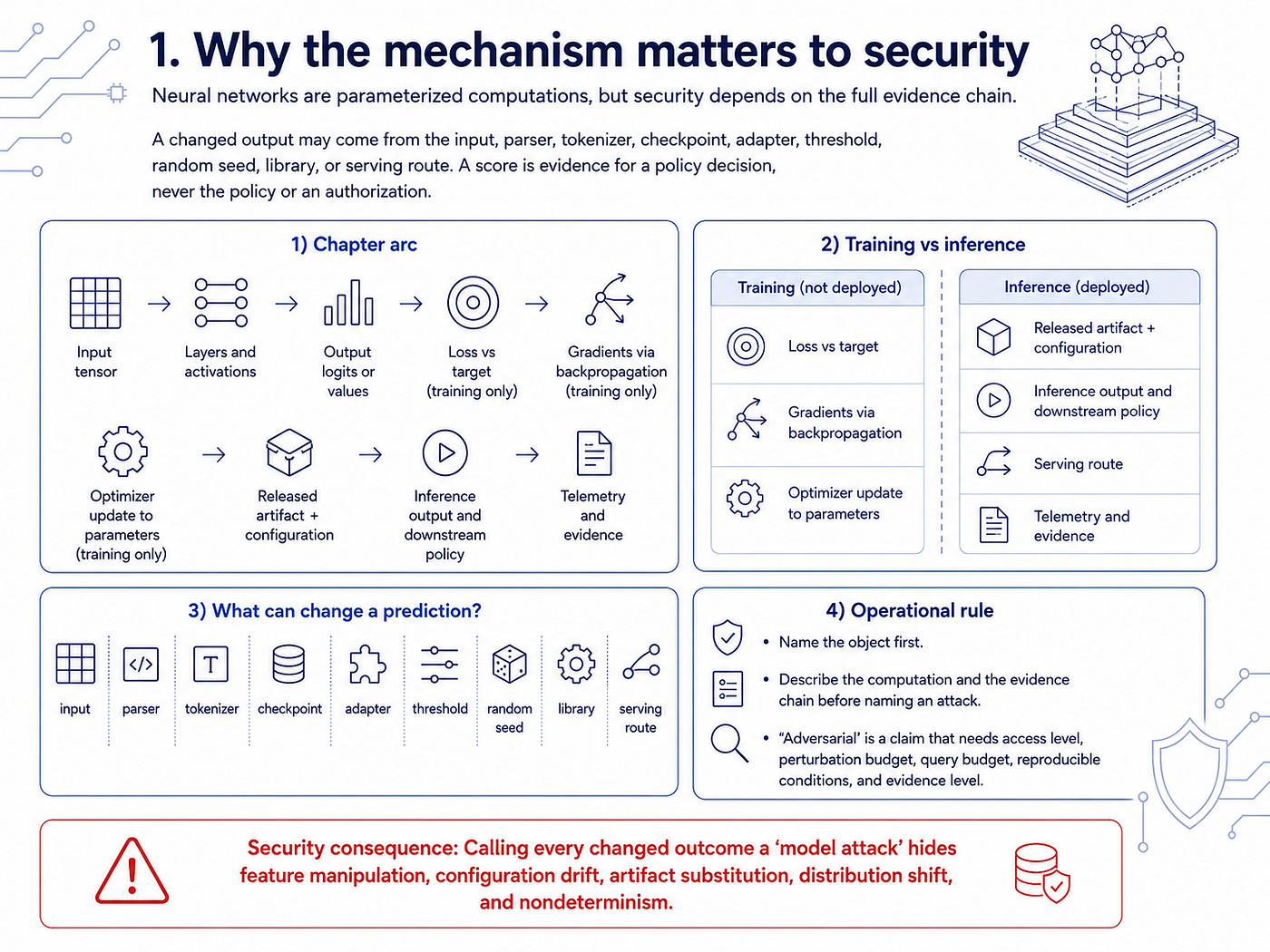
input tensor
  → layers and activations
  → output logits or values
  → loss against a target (training only)
  → gradients through backpropagation (training only)
  → optimizer update to parameters (training only)
  → released artifact + configuration
  → inference output and downstream policy
  → telemetry and evidence
Training and inference are different paths. Loss, gradients, and updates normally belong to training; a released artifact turns an input into a score, classification, generation, or embedding that may influence deterministic policy. Preserve the boundary in diagrams and logs.
Security consequence: Calling every changed outcome a “model attack” hides feature manipulation, configuration drift, artifact substitution, distribution shift, and nondeterminism. Name the object first.
Course rule: Describe the computation and the evidence chain before naming an attack. “Adversarial” is a claim that needs an access level, a perturbation budget, a query budget where applicable, reproducible conditions, and an evidence level.
2. Neural-network security objects
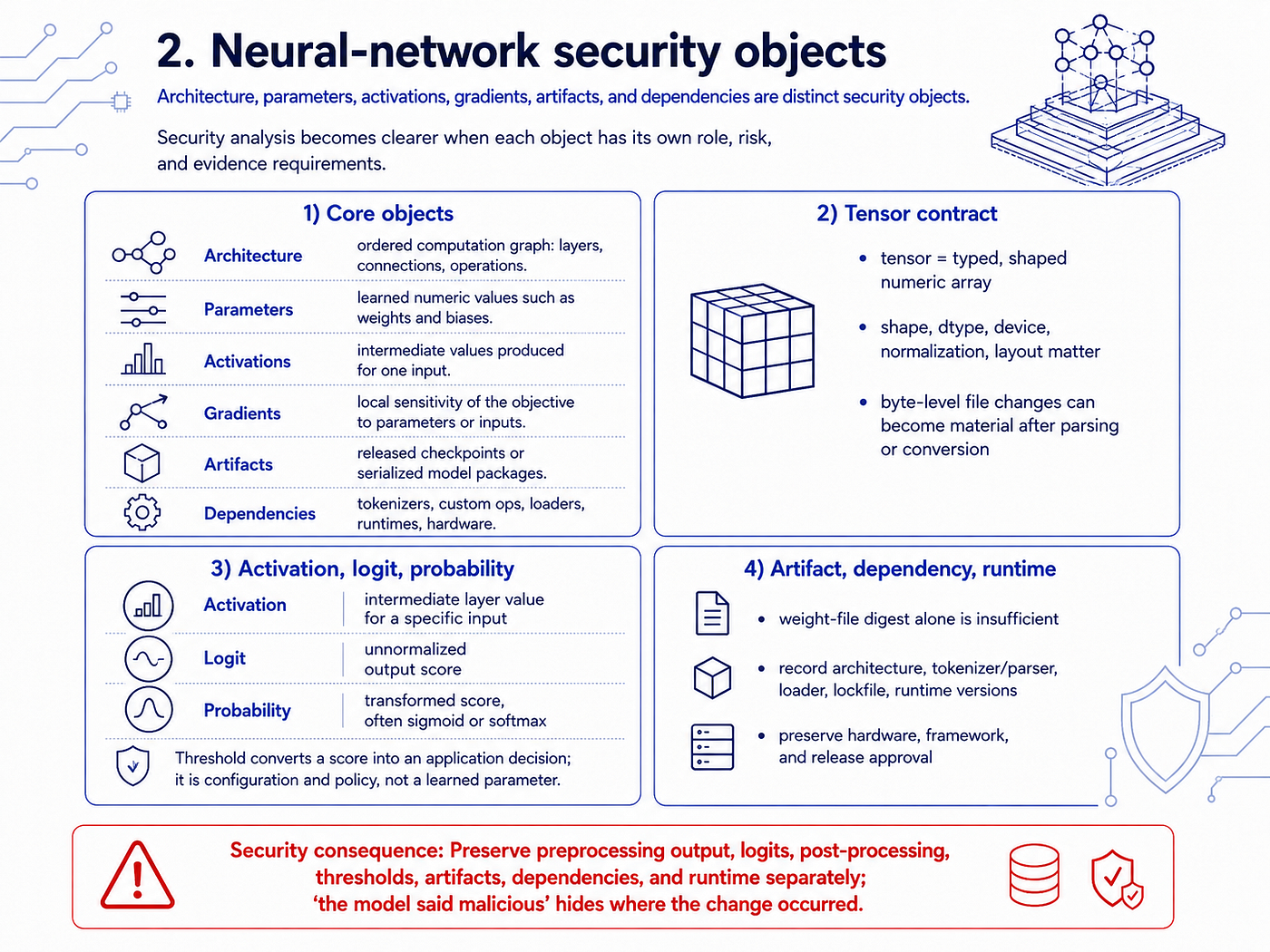
An architecture is the ordered computation graph specifying layers, connections, and operations. Parameters are learned numeric values, such as weights and biases. Activations are intermediate values for one input. Gradients describe how an objective changes when a parameter or input changes.
Tensor
A tensor is a typed, shaped array of numbers. Shape, data type, device, normalization, and layout form part of the model interface. A byte-level change in a file can be harmless to a human reviewer but material after parsing, padding, or conversion into a tensor.
Security consequence: Record the tensor contract and representative preprocessing output. A changed channel order, dtype, truncation rule, or missing-value policy can change a score without changing the checkpoint.
Activation, logit, and probability
An activation is the value produced by an intermediate layer for a particular input. A logit is an unnormalized output score. A probability is a transformed score, such as a sigmoid or softmax value, that may be easier to communicate but is not automatically calibrated. A threshold converts a score into an application decision; it is configuration and policy, not a learned parameter.
Security consequence: Preserve preprocessing output, logits, post-processing, threshold, and final action separately. “The model said malicious” hides where the change occurred.
Artifact, dependency, and runtime
A model artifact is a released representation of an architecture and learned parameters, such as a checkpoint or serialized package. A dependency is a library, tokenizer, custom operator, loader, or runtime component needed to execute it. Hardware, drivers, framework, and serving configuration determine how the artifact is interpreted.
Security consequence: A weight-file digest is insufficient. Record the architecture, tokenizer or parser, loader, lockfile, runtime versions, and release approval.
Chapter 2 covers data, features, labels, artifacts, configuration, and split methodology; cross-link rather than repeat it here.
3. The forward pass
The forward pass applies an architecture and its parameters to an input to produce intermediate activations and an output. In a simple layer, the computation combines an input with weights, adds a bias, and applies an activation function:
z = W · x + b
a = activation(z)
Convolutional networks apply local filters, recurrent networks carry state through a sequence, and Transformer blocks combine attention with feed-forward transformations. Whatever the architecture, ask which input, operations, parameters, and post-processing produced the output.
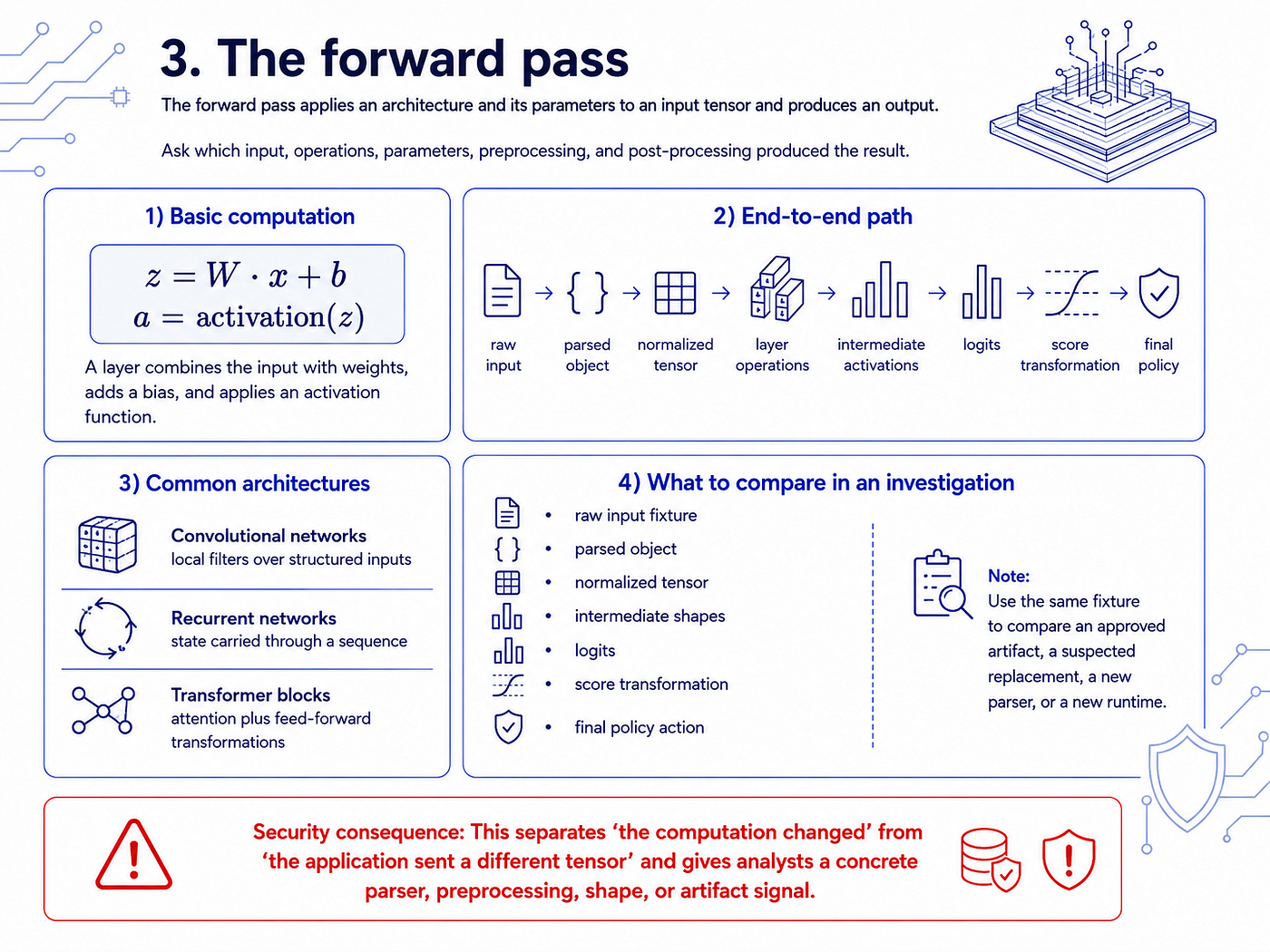
Capture a minimal request fixture and run it against the approved artifact. Compare the raw input, parsed object, normalized tensor, intermediate shapes, logits, score transformation, and final policy. Use the same fixture to compare a suspected replacement, a new parser, or a new runtime.
Security consequence: This separates “the computation changed” from “the application sent a different tensor” and gives detection engineering a concrete parser, preprocessing, shape, or artifact signal.
4. Loss functions and objectives
A loss function turns a prediction and a target into a number that training tries to minimize. Cross-entropy is common for classification, mean-squared error is common for regression, and ranking or contrastive objectives are common for retrieval and representation learning. The objective is selected by people and code; it is not a neutral description of risk.
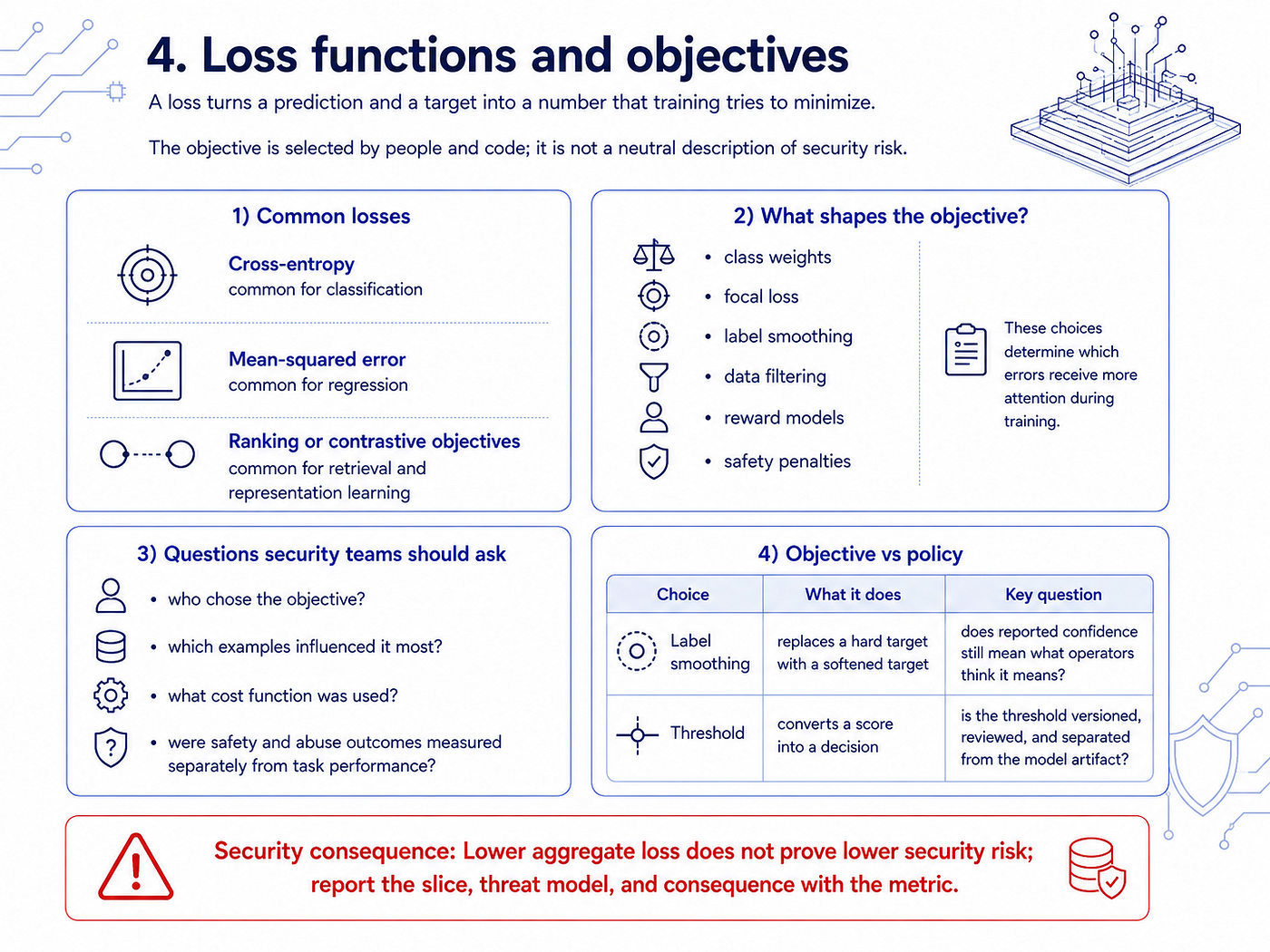
Class weights, focal loss, label smoothing, data filtering, reward models, and safety penalties change which errors receive attention. A security team should ask who chose the objective, which examples had the greatest influence, what cost function was used, and whether safety and abuse outcomes were measured separately from task performance.
Security consequence: A lower aggregate loss does not prove lower security risk. A model can improve its average score while becoming less calibrated, more vulnerable to a rare trigger, or worse for a high-cost minority class. Report the slice, threat model, and consequence with the metric.
| Objective or setting | Mechanism | Security question |
|---|---|---|
| Label smoothing | Replaces a hard target with a softened target | Does the reported confidence still mean what operators think it means? |
| Threshold | Converts a score into a decision | Is the threshold versioned, reviewed, and separated from the model artifact? |
5. Gradients and backpropagation
Backpropagation is the procedure that sends the loss signal backward through the computation graph to compute gradients for the parameters. A gradient is information about local sensitivity, not an attacker by itself. During training, the optimizer uses these values to decide how to update parameters; during an authorized white-box evaluation, an analyst may use input gradients to search for an evasion condition.
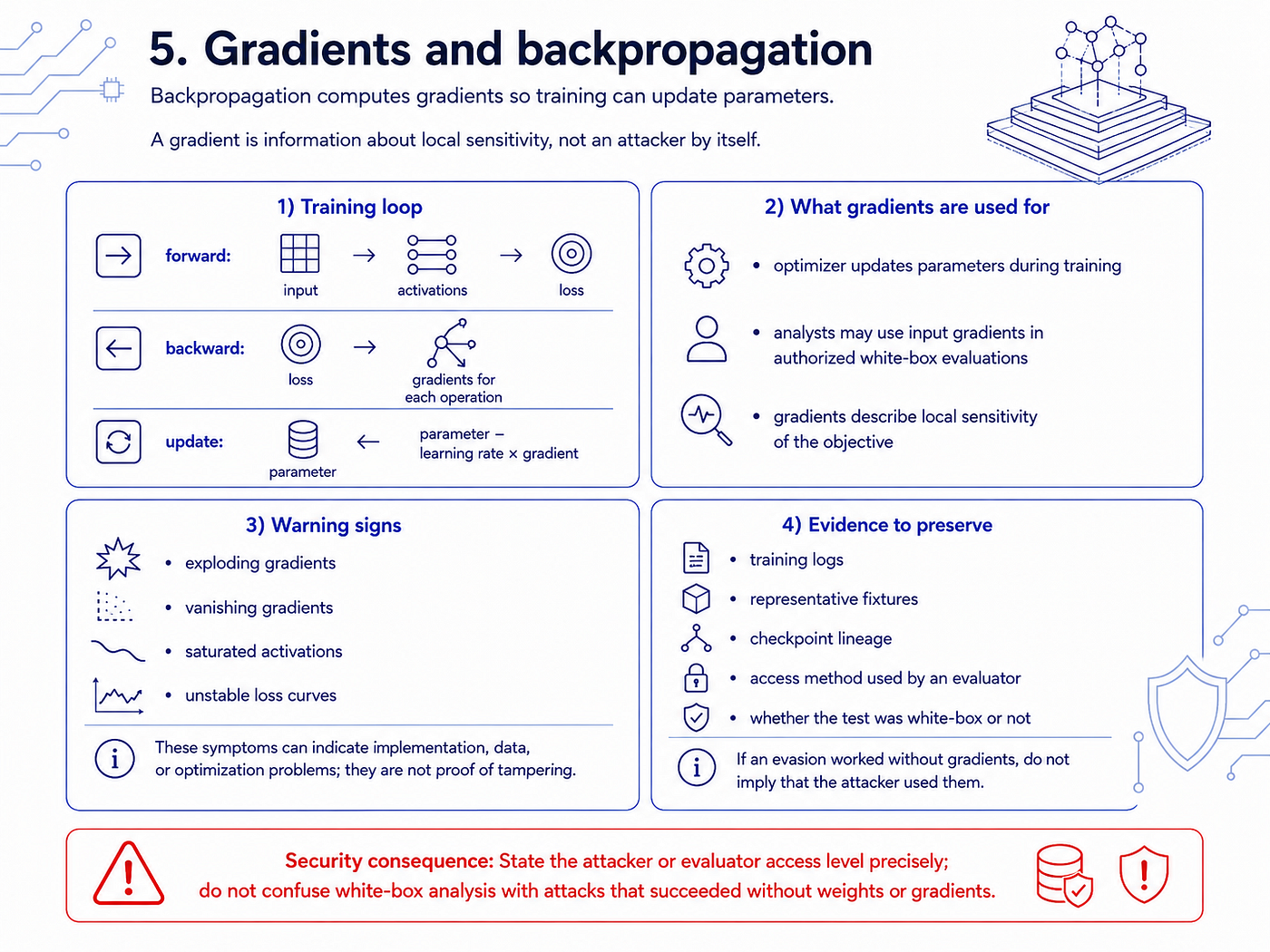
forward:  input → activations → loss
backward: loss → gradients for each operation
update:   parameter ← parameter − learning rate × gradient
Exploding gradients, vanishing gradients, saturated activations, or unstable loss curves can indicate an implementation, data, or optimization problem. The symptoms are not proof of tampering. Preserve training logs, representative fixtures, and checkpoint lineage so an investigator can reproduce the condition and compare it with a clean reference.
Security consequence: The attacker access question is concrete. If an evaluator had gradients, state that as white-box access and record how it was obtained. If an evasion worked without gradients, do not imply that the attacker used them. The Cylance/Skylight case in Section 14 is important precisely because the researchers manipulated feature extraction and scoring without touching weights or gradients.
6. Optimization in practice
An optimizer is an update rule that uses gradients to change parameters. Stochastic gradient descent (SGD) estimates an update from a batch; momentum smooths updates; Adam adapts step sizes. A learning rate is the scale of an update. Batch size, epochs, schedule, weight decay, initialization, and seed can change the artifact.
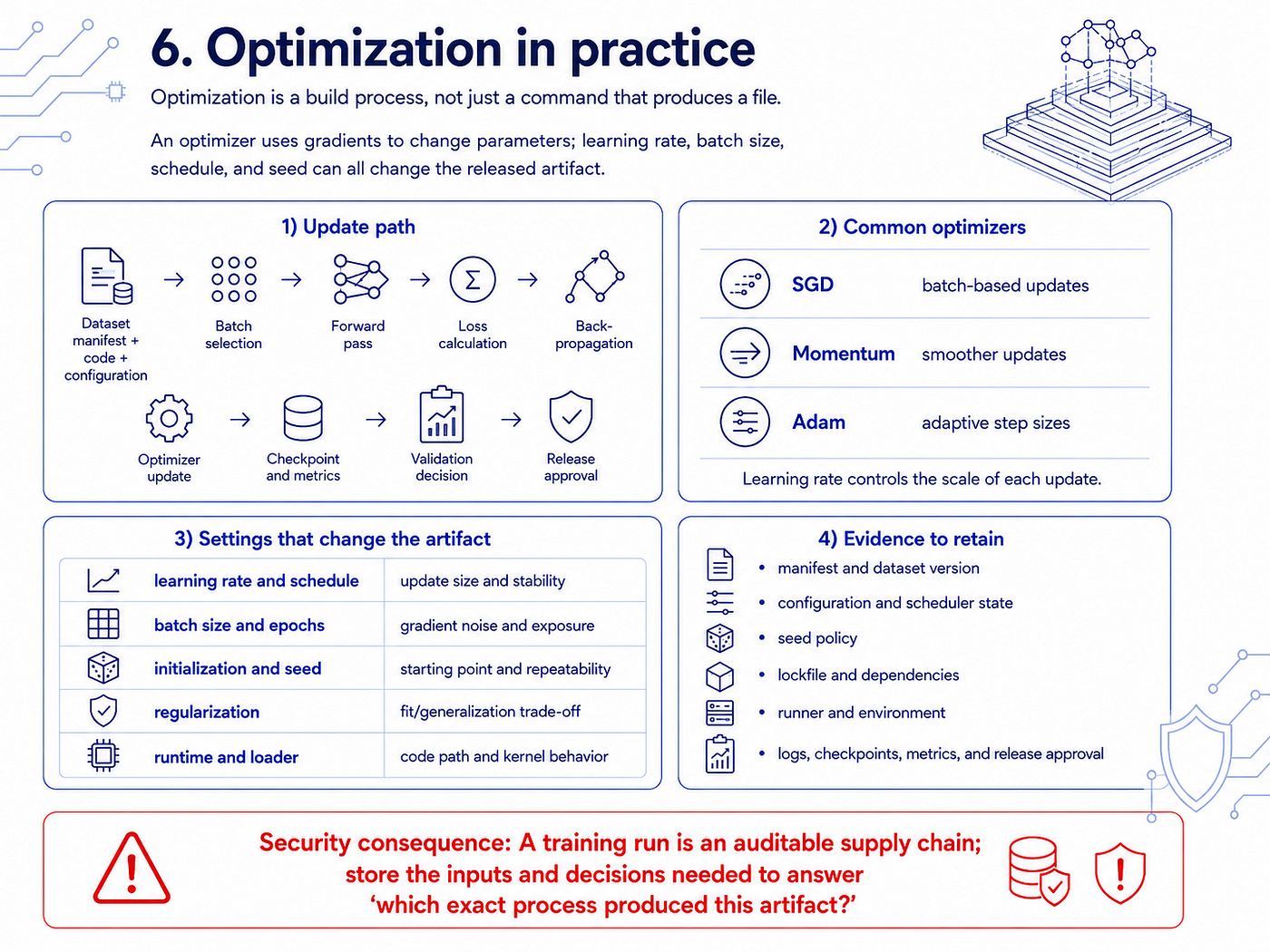
dataset manifest + code + configuration
  → batch selection
  → forward pass
  → loss calculation
  → backpropagation
  → optimizer update
  → checkpoint and metrics
  → validation decision and release approval
Optimization is a build process. Treat the runner, dependencies, manifest, configuration, logs, checkpoint, and release approval as one supply chain. A model digest without build context cannot fully explain behavior.
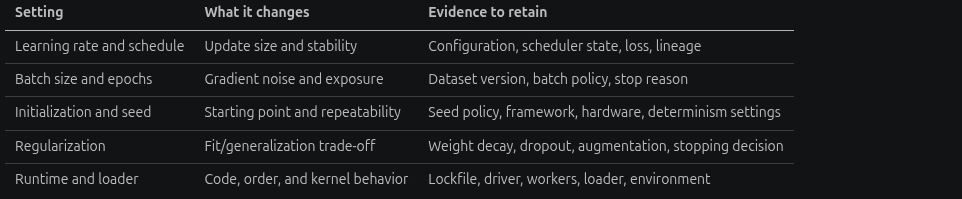
| Setting | What it changes | Evidence to retain |
|---|---|---|
| Learning rate and schedule | Update size and stability | Configuration, scheduler state, loss, lineage |
| Batch size and epochs | Gradient noise and exposure | Dataset version, batch policy, stop reason |
| Initialization and seed | Starting point and repeatability | Seed policy, framework, hardware, determinism settings |
| Regularization | Fit/generalization trade-off | Weight decay, dropout, augmentation, stopping decision |
| Runtime and loader | Code, order, and kernel behavior | Lockfile, driver, workers, loader, environment |
Security consequence: A training run is an auditable build, not just a command that produced a file. Store the inputs and decisions needed to answer “which exact process produced this artifact?” before the artifact is released.
7. Generalization, regularization, and drift
Generalization is performance on conditions not used to fit or repeatedly tune the model. Overfitting occurs when a model learns training-specific patterns that do not transfer. Underfitting occurs when it has not captured enough useful structure. Regularization is a constraint or training choice intended to improve generalization, such as weight decay, dropout, augmentation, label smoothing, or early stopping.
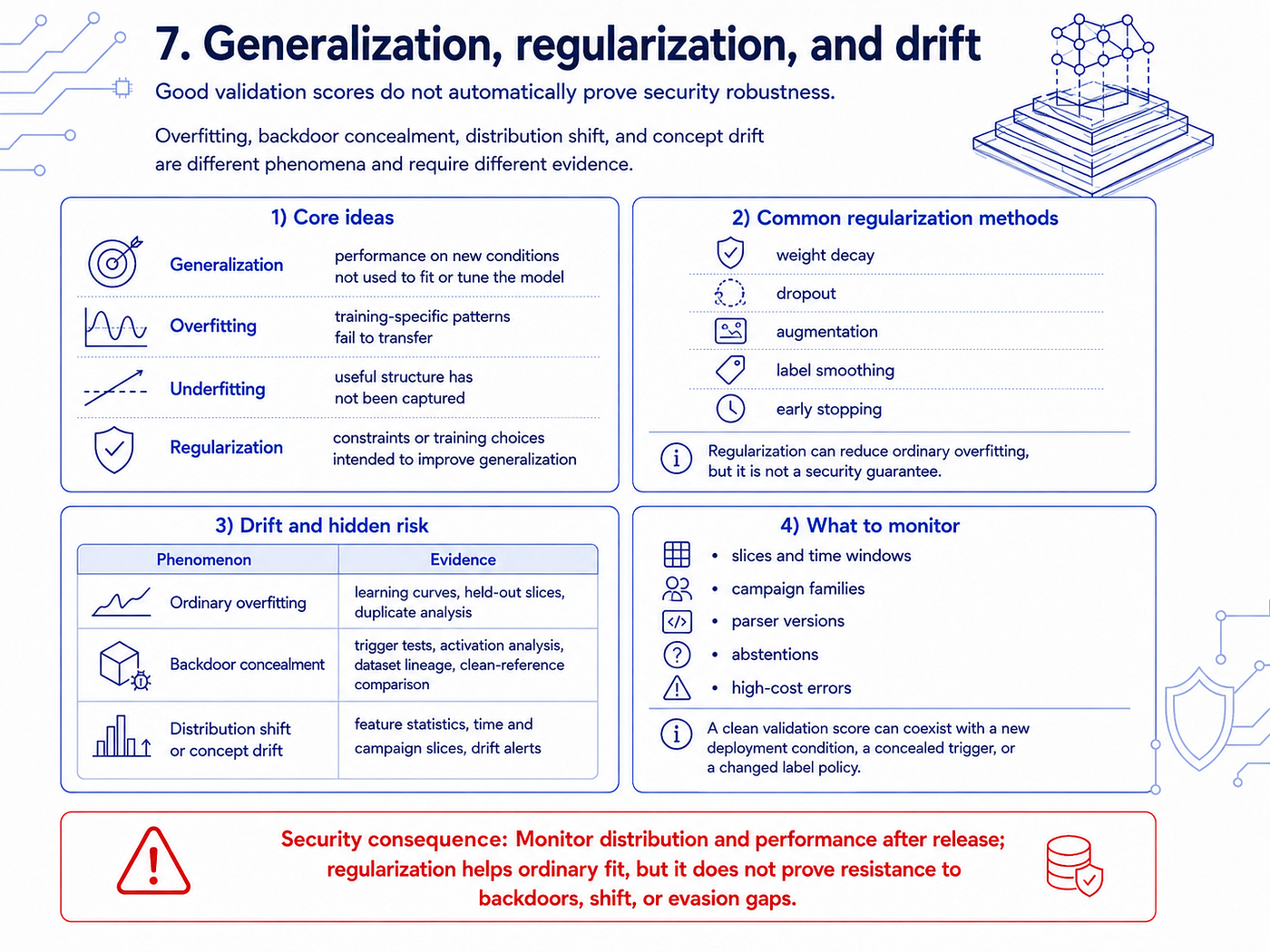
Regularization can reduce ordinary overfitting, but it is not a security guarantee. A backdoor can remain hidden because its trigger-to-target association costs almost nothing in clean-set accuracy; standard validation then has little signal to detect it. That is a property of model capacity and evaluation design, not ordinary overfitting. An evasion gap can likewise arise from a deployment/threat-model mismatch, not simply underfitting.
Distribution shift is already defined in Module 00 and Chapter 2 as a difference between development and deployment conditions. Concept drift is when the relationship between an input and its target changes over time, such as a new malware family using features absent from the training corpus or a changed label policy.
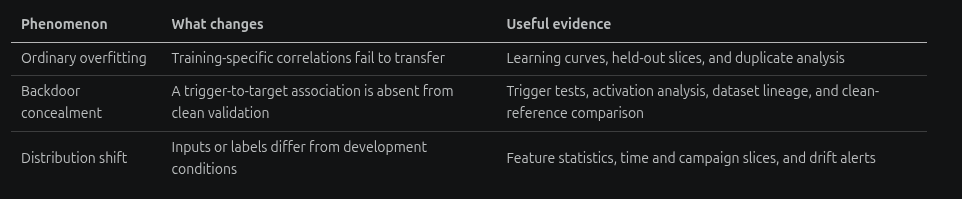
Security consequence: Monitor slices, time windows, campaign families, parser versions, abstentions, and high-cost errors. A clean validation score can coexist with a new deployment condition, a concealed trigger, or a changed label policy.
| Phenomenon | What changes | Useful evidence |
|---|---|---|
| Ordinary overfitting | Training-specific correlations fail to transfer | Learning curves, held-out slices, and duplicate analysis |
| Backdoor concealment | A trigger-to-target association is absent from clean validation | Trigger tests, activation analysis, dataset lineage, and clean-reference comparison |
| Distribution shift | Inputs or labels differ from development conditions | Feature statistics, time and campaign slices, and drift alerts |
8. Reproducibility and the nondeterminism problem
Nondeterminism means that the same nominal program, data, and configuration can produce different execution results because hidden or implementation-dependent choices are not fixed. A second run can therefore produce a different checkpoint without an attacker changing the source code or dataset.
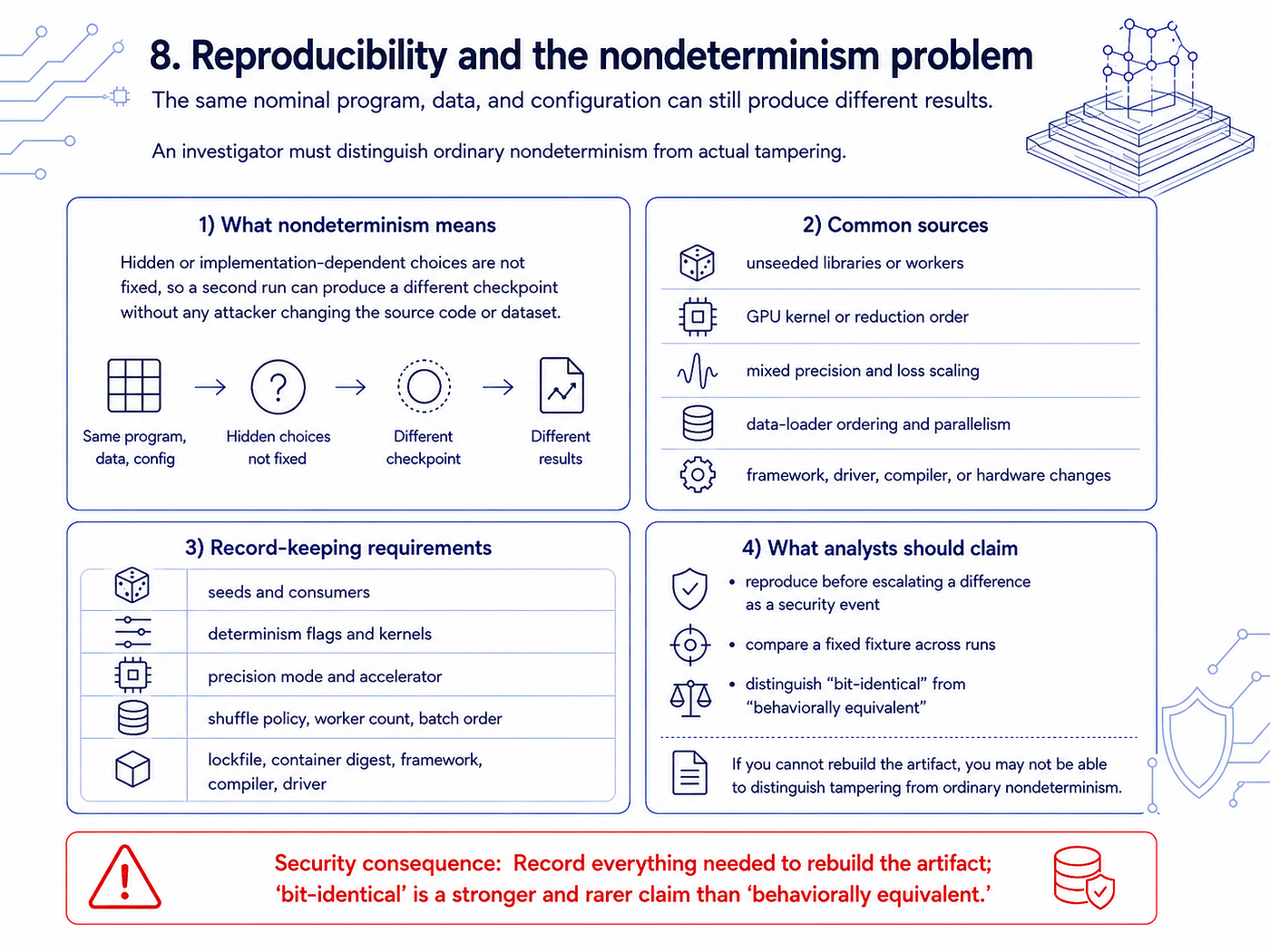
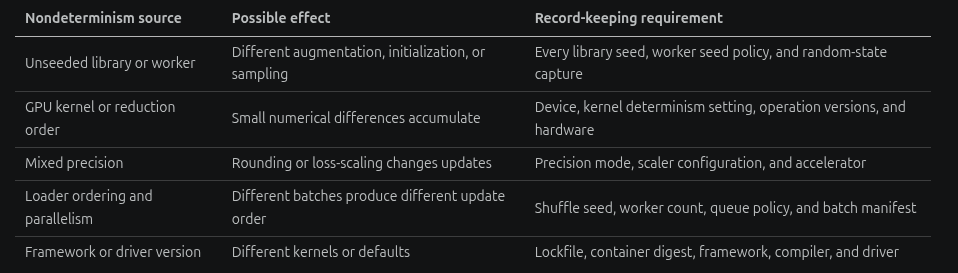
Seed handling is a source. A project may seed one library but not the framework, augmentation library, workers, or device generator. Record every seed and its consumer. GPU kernels can complete parallel reductions in different orders; record determinism flags, kernels, device, and workers.
Mixed-precision arithmetic can round intermediate values differently from full precision, especially near a decision boundary. Record precision mode, loss-scaling settings, and accelerator type. Data-loader ordering and parallelism can change the order in which examples reach an optimizer, even when the dataset bytes are identical. Record shuffle policy, worker count, queue behavior, and batch order for a reproducibility fixture.
Framework, driver, compiler, and hardware versions can change kernels or numerical behavior. Record the lockfile, versions, accelerator, operating-system image, container digest, and a known-input fixture with expected ranges.
| Nondeterminism source | Possible effect | Record-keeping requirement |
|---|---|---|
| Unseeded library or worker | Different augmentation, initialization, or sampling | Every library seed, worker seed policy, and random-state capture |
| GPU kernel or reduction order | Small numerical differences accumulate | Device, kernel determinism setting, operation versions, and hardware |
| Mixed precision | Rounding or loss-scaling changes updates | Precision mode, scaler configuration, and accelerator |
| Loader ordering and parallelism | Different batches produce different update order | Shuffle seed, worker count, queue policy, and batch manifest |
| Framework or driver version | Different kernels or defaults | Lockfile, container digest, framework, compiler, and driver |
Security consequence: An investigator who cannot rebuild an artifact cannot distinguish tampering from ordinary nondeterminism. “Bit-identical” is a stronger and rarer claim than “behaviorally equivalent.” State which claim is supported, preserve the build record, and compare a fixed fixture across runs before escalating a difference as a security event.
9. Attacker access and the threat-model taxonomy
An evasion or extraction result is not meaningful without an access level. White-box access means target weights, architecture, gradients, or equivalent internal detail. Gray-box access means architecture, feature schema, training assumptions, or score semantics without weights. Black-box query access means submitted inputs and returned labels or scores without internals. Transfer from a surrogate means another model is used without direct target access.
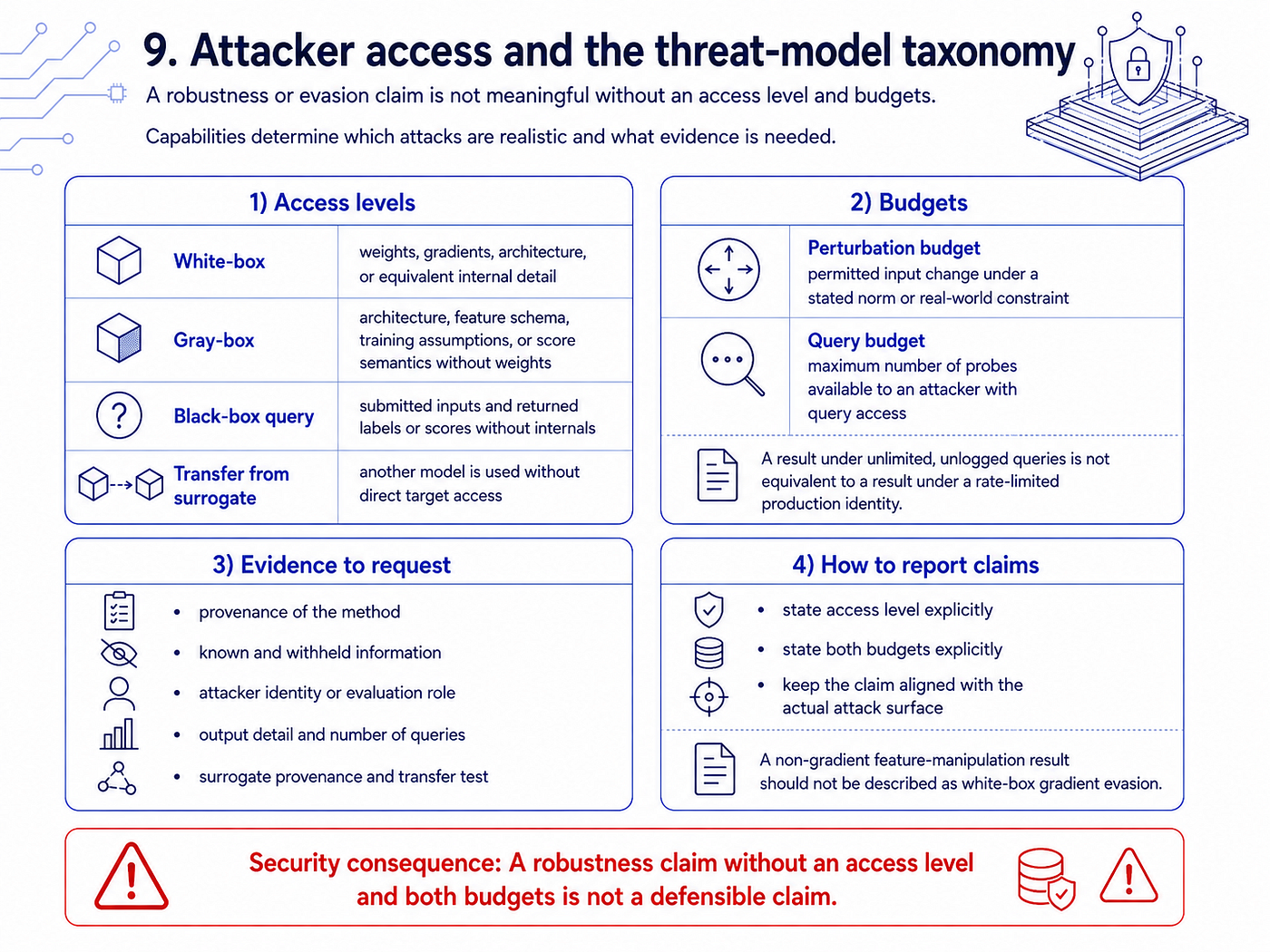
A perturbation budget is the permitted change to an input, expressed by a stated norm or a real-world constraint such as preserving a valid file and its function. A query budget is the maximum number of probes available to an attacker with query access. These budgets make a robustness claim falsifiable: a result under unlimited, unlogged queries is not equivalent to a result under a rate-limited production identity.

| Access level | Attacker knowledge or capability | Evidence to request |
|---|---|---|
| White-box | Weights, gradients, architecture, or equivalent access | Provenance, method, budgets, and reproduction |
| Gray-box | Architecture, features, assumptions, or score semantics | Known and withheld information, tested assumptions |
| Black-box query | Input submission and label or score response | Identity, rate, output detail, count, responses |
| Transfer-from-surrogate | No target access; relies on another model | Surrogate provenance, transfer test, uncertainty |
Security consequence: A robustness claim without both budgets and an access level is not a claim. The Cylance/Skylight case is a non-gradient feature-manipulation result; describing it as white-box gradient evasion would erase the relevant attack surface.
10. Adversarial examples and evasion
An adversarial example is an input intentionally modified to produce an unwanted result under a specified threat model. Evasion occurs at test time, after training, and a capability demonstration is not automatically an intrusion.
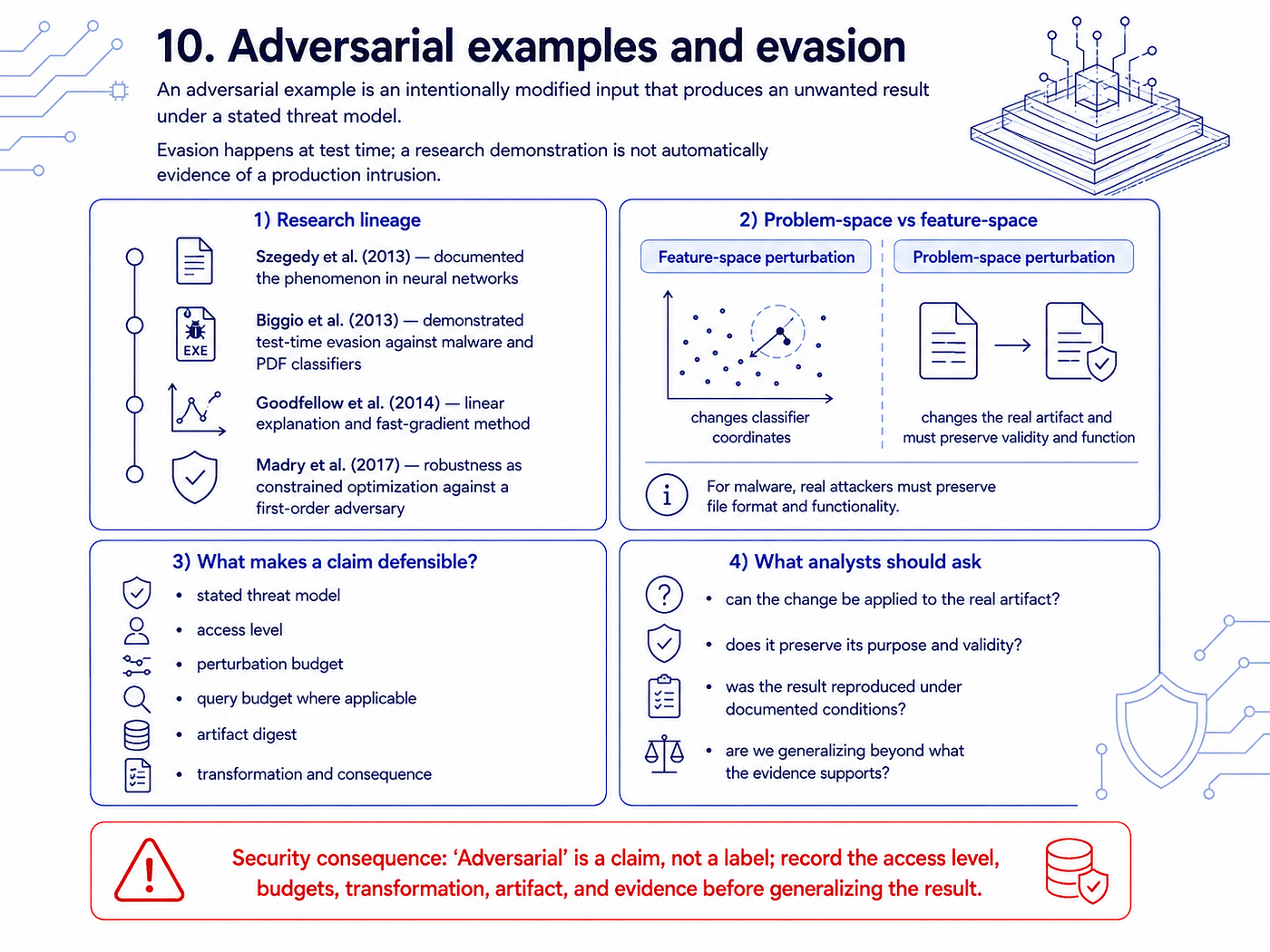
The research lineage matters. Szegedy et al. (2013) first documented the phenomenon in neural networks. Biggio et al. (2013), working in the security literature, independently demonstrated test-time evasion against malware and PDF classifiers. Goodfellow et al. (2014) provided a linear explanation and the fast-gradient method. Madry et al. (2017) framed robustness as constrained optimization against a first-order adversary. Each contribution answers a different question; none by itself proves that a particular production tenant was affected.
The problem-space and feature-space distinction is especially important for malware. A feature-space perturbation changes coordinates consumed by a classifier, while a problem-space perturbation changes the real artifact that must remain valid and functional. A semantically trivial file change—such as appended strings, repacking, or added sections—can move a feature vector substantially, but many mathematically convenient feature changes cannot be realized as a functioning file. A real malware attacker must preserve functionality, respect the file format, and work without arbitrary access to feature coordinates.
Security consequence: Ask whether the change can be applied to the real artifact while preserving its purpose. Record input hash, transformation, access level, both budgets, artifact digest, and consequence; do not generalize an image-space result to malware without problem-space validation.
11. Evaluating robustness claims
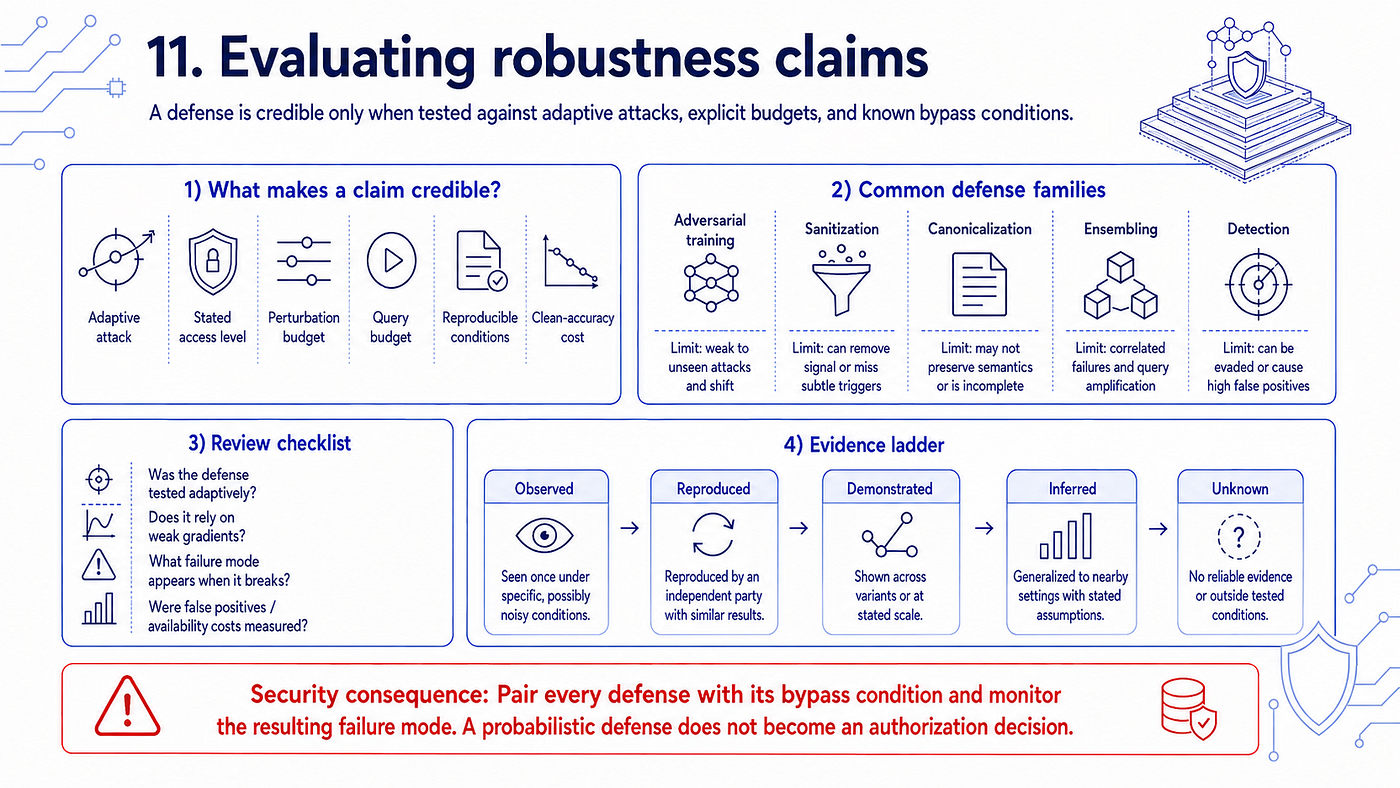
An adaptive attack is an evaluation that uses knowledge of the proposed defense and chooses an attack strategy intended to test that defense, rather than repeating a fixed weak attack. A defense that merely makes gradients uninformative can appear robust under a weak gradient method and collapse under an adaptive method. Athalye, Carlini, and Wagner called this failure mode obfuscated or masked gradients; Carlini and Wagner provided a practical framework for evaluating adversarial robustness.
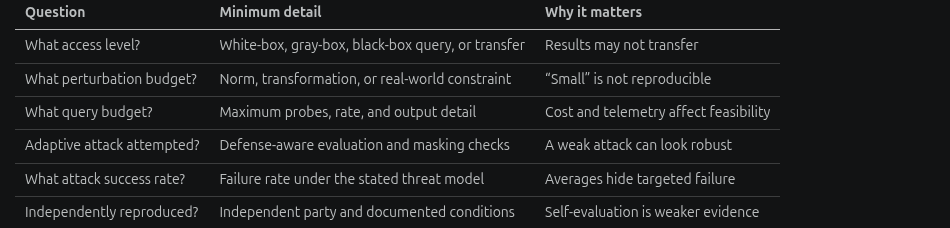
Use this checklist for a vendor datasheet, research paper, or internal report:
| Question | Minimum detail | Why it matters |
|---|---|---|
| What access level? | White-box, gray-box, black-box query, or transfer | Results may not transfer |
| What perturbation budget? | Norm, transformation, or real-world constraint | “Small” is not reproducible |
| What query budget? | Maximum probes, rate, and output detail | Cost and telemetry affect feasibility |
| Adaptive attack attempted? | Defense-aware evaluation and masking checks | A weak attack can look robust |
| What attack success rate? | Failure rate under the stated threat model | Averages hide targeted failure |
| Independently reproduced? | Independent party and documented conditions | Self-evaluation is weaker evidence |
Adversarial training includes transformed examples, but is bounded by its threat model, costs clean accuracy or compute, and degrades outside its perturbation budget. Sanitization can remove useful signal or miss encodings; canonicalization fails when semantics change or parsers disagree; ensembling does not guarantee independent errors; and detection can be adapted to or harm availability through false positives.
Security consequence: Pair every defense with its bypass condition and monitor the resulting failure mode. None of these defenses converts a probabilistic score into an authorization decision. Deterministic authorization, schema validation, transaction limits, and human approval remain policy responsibilities outside the model.
Evidence standard: Use one five-term ladder throughout this chapter: Observed — a production event or provider report. Reproduced — the same failure under documented local conditions. Demonstrated — a research proof-of-concept on a stated model, not necessarily yours. Inferred — a hypothesis linking observations. Unknown — an explicitly recorded gap.
12. Poisoning and backdoors
Poisoning changes training data or the training process so a learned artifact behaves incorrectly. A backdoor is a hidden trigger-to-target association that causes a selected behavior while ordinary inputs appear acceptable. A trigger is the condition that activates the backdoor, such as a pattern, token, or artifact property. The attacker can target collection, labels, augmentation, a dependency, a checkpoint, or a loader.
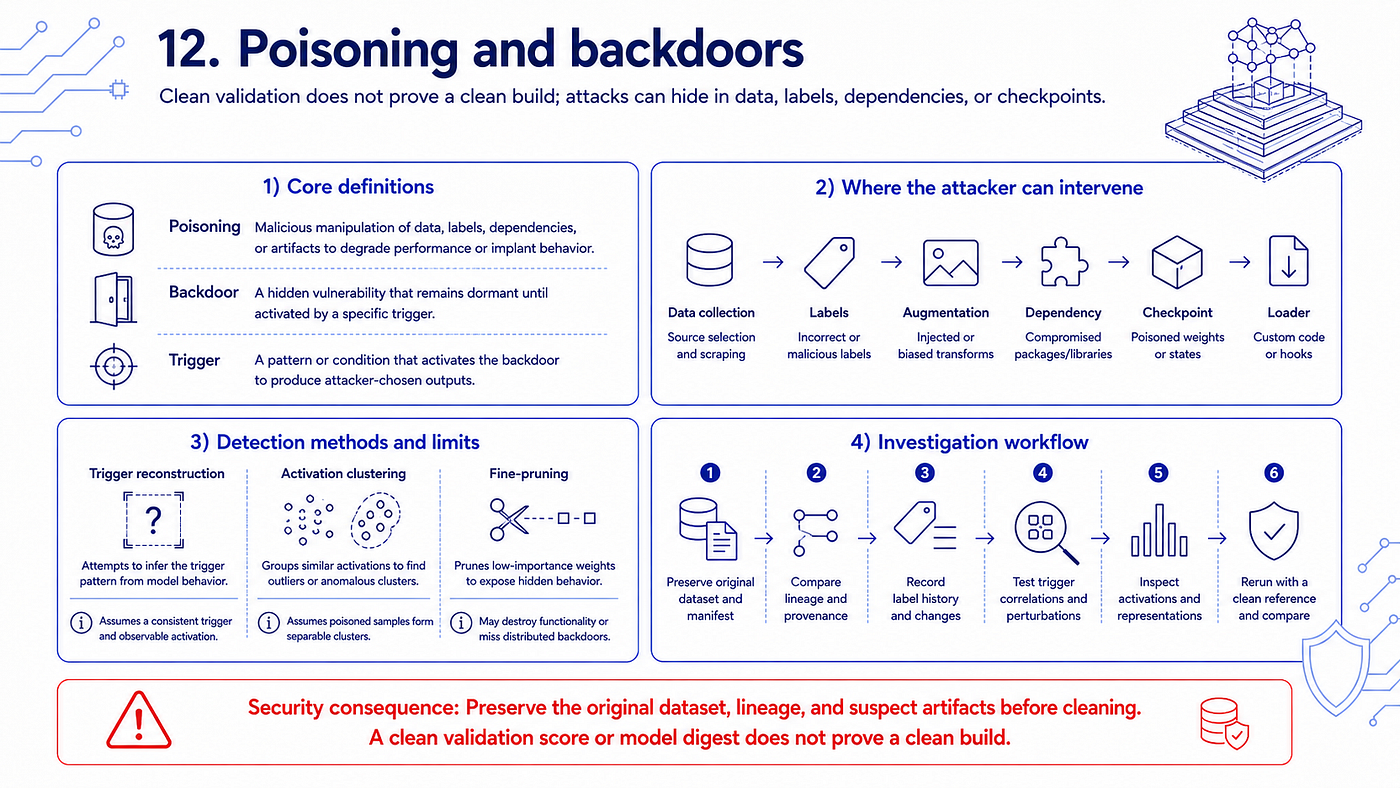
Backdoor detection needs explicit methods and assumptions. Trigger reconstruction searches for a compact input pattern that causes a target output; it assumes the trigger is sufficiently simple and that the search objective exposes it, so distributed or semantic triggers can be missed. Activation clustering groups internal activations to find a suspicious cluster associated with poisoned examples; it assumes poisoned and clean representations separate enough to cluster, so weak or entangled triggers can evade it. Fine-pruning removes neurons that appear dormant on clean data and then evaluates behavior; it assumes backdoor functionality depends on removable dormant capacity, so triggers using ordinary shared features can survive and pruning can damage legitimate behavior. BadNets is the canonical reference for the backdoor threat model.
The MITRE ATLAS AML.CS0002 VirusTotal Poisoning case, reported by McAfee Advanced Threat Research, is a short parallel: adversarial samples were submitted to a shared detection service. Use only that disclosed fact; service, provenance, and downstream effect require the case record and local telemetry.
When investigating a suspected poisoning event, preserve the original dataset and manifest, compare lineage with the approved version, record label history, test for unusual clusters or trigger correlations, and rerun with a clean reference. Do not overwrite the only copy by “cleaning” it in place. Preserve the suspect bytes, access history, and chain of custody before making a derivative dataset.
Security consequence: A clean validation score or model digest does not prove a clean build. Preserve dataset versions, label events, features, activations, checkpoint lineage, loader behavior, and release identity.
13. What inference reveals about training
Inference can reveal information about training even when the attacker cannot read the artifact. A model extraction attack, also called model stealing, uses target-service outputs to build an approximation of its decision function. It needs query access; confidence scores or logits help more than labels alone; and the query budget affects cost and detectability. Ask who queried, at what rate, from which identity, with what output granularity, and whether responses and model-route identifiers were observable.
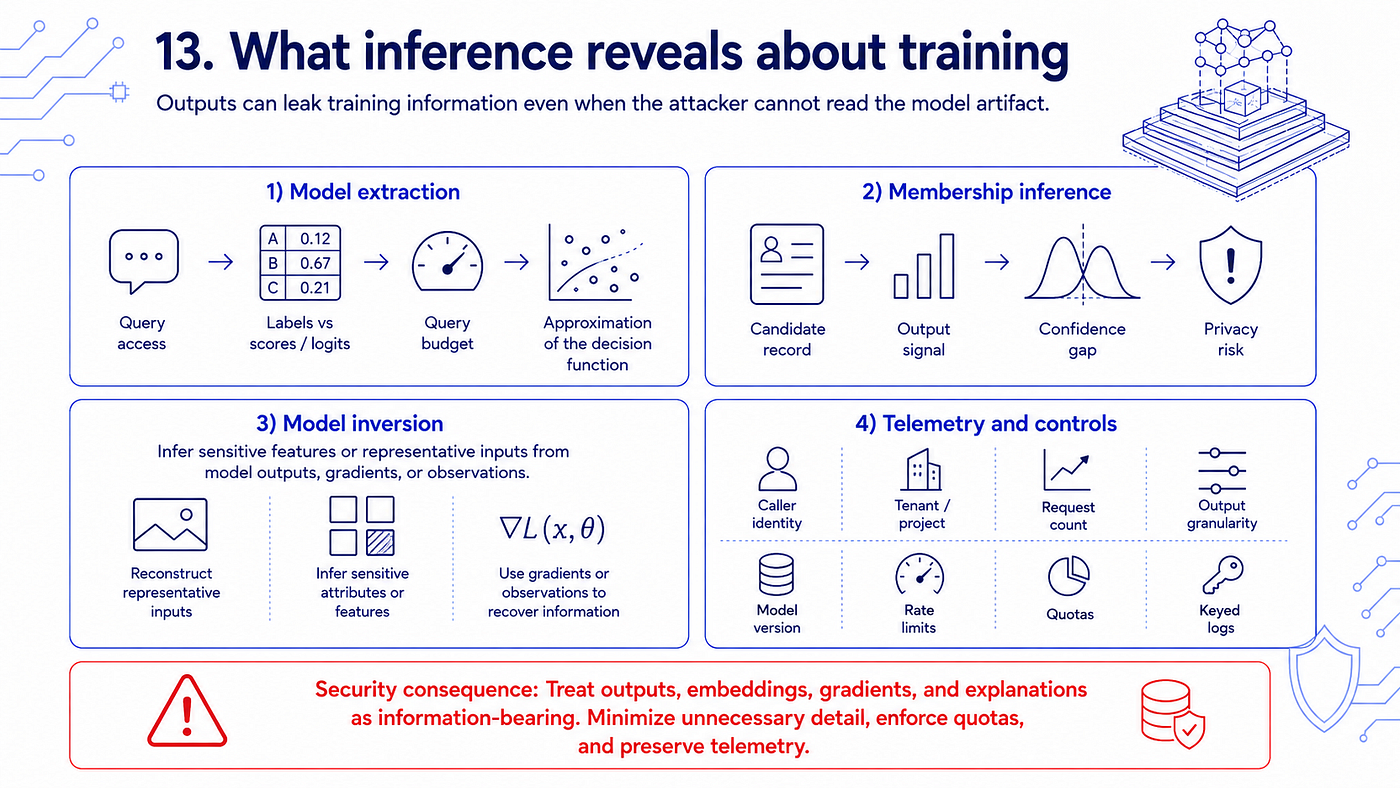
Security consequence: Record caller, tenant, source, request count, timing, output fields, model version, and rate-limit decisions. Coarse outputs and quotas reduce exposure but do not eliminate surrogate transfer.
Membership inference tests whether a particular record was part of training. It needs query access and an output signal, such as confidence or logits, that differs between familiar and unfamiliar examples; query budget and prior knowledge influence the result. Ask which identity tested which candidates, with what output granularity, and whether telemetry captured repeated probes or sensitive slices.
Security consequence: Preserve query fixtures, candidate hashes, response detail, rate, tenant, and data-use authorization. Reduce unnecessary confidence exposure and test privacy on the deployment distribution.
Model inversion, as demonstrated by Fredrikson, Jha, and Ristenpart, attempts to infer sensitive features or representative inputs from outputs, gradients, or other observations. It needs an output interface and, for stronger variants, knowledge about classes, features, or internals. Query budget and output granularity affect what can be inferred. Ask who requested which classes or slices, how many probes were made, what scores or gradients were returned, and whether route and policy were logged.
Security consequence: Treat outputs, embeddings, gradients, and explanations as information-bearing. Minimize granularity, authorize by tenant and purpose, rate-limit probing, and retain keyed telemetry. Map these controls to Section 15.
These mechanisms identify what could be tested; they do not prove that training data was exposed. Keep the claim at the level supported by telemetry.
14. CTI case study: evading a malware classifier
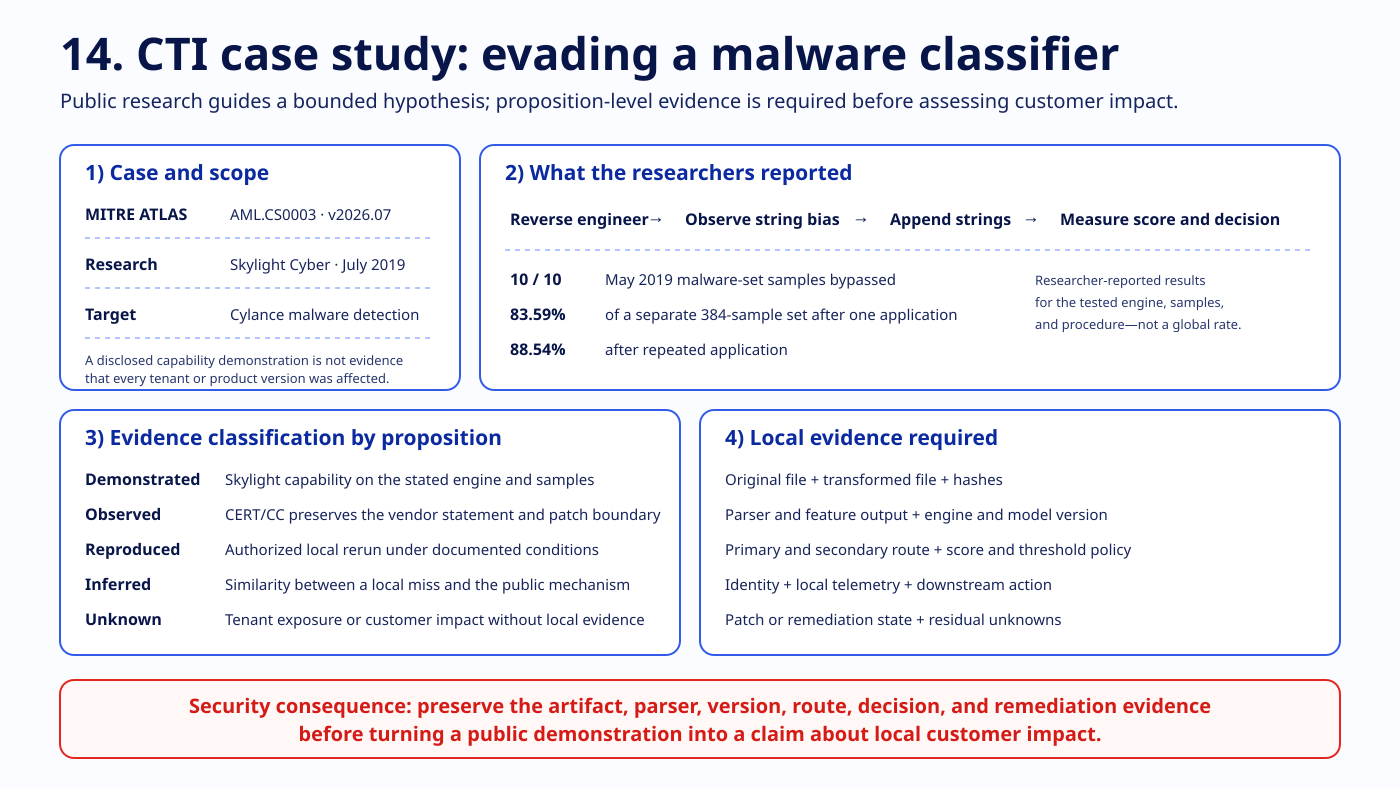
The MITRE ATLAS AML.CS0003 case study, Bypassing Cylance's AI Malware Detection, documents work by Skylight Cyber researchers Adi Ashkenazy and Shahar Zini, published in July 2019. This is a disclosed research case, not evidence that every Cylance customer was compromised.
What the researchers did
The researchers analyzed the CylancePROTECT engine and model using publicly available information and verbose logging. They reverse-engineered which attributes carried positive or negative weight, found that feature extraction relied heavily on strings, and reported a strong bias toward one specific video game. They also discovered a secondary model that could override the primary decision. By appending a selected list of strings to a malicious file, they changed its score enough to avoid detection. Their report states that the method bypassed detection for all ten malware samples in its May 2019 set, 83.59% of a separate 384-sample set after one application, and 88.54% after repeated application. These are researcher-reported results for the tested engine, samples, and procedure—not a global product-detection rate.
Security consequence: The exploitable surface described by the researchers was feature extraction plus a scoring-policy override. The attacker did not need to touch weights or gradients. The relevant local evidence would therefore include the original and modified file hashes, parser output, extracted strings, score, model route, policy decision, and release version.
Why gradients were never needed
The case is not a white-box gradient example. The reported method used public information, verbose logging, feature observations, and score behavior. The change was applied to the problem-space file and evaluated through the released detector. An analyst can therefore test a feature-extraction and policy path without possessing weights or gradients.
The vendor's response and remediation boundary
CERT/CC Vulnerability Note VU#489481 records Cylance's response and identifies products before 21 July 2019 as affected. The vendor disputed the “universal bypass” characterization, describing manipulation of one feature type that in limited circumstances led to an incorrect conclusion. It reported parser anti-tampering controls, model changes to detect disproportionately weighted features, removal of the most susceptible features, and automatic patch deployment. CERT/CC assessed that these changes should stop the disclosed string set but did not establish that every similar forced-misclassification method was eliminated.
Security consequence: The disagreement is useful CTI context but does not resolve every environment. Identify engine version, parser, features, route, and remediation state in scope.
What each party would need to prove
The researchers' claim requires samples, transformation, feature output, score change, sample-set definition, engine version, and reproducible conditions. The vendor's characterization requires feature scope, affected versions, result limits, and remediation evidence. Customer impact additionally requires deployment identity, version, telemetry, sample handling, and action.
Evidence ladder for this case
Use the same five terms: Observed — a production event or provider report. Reproduced — the same failure under documented local conditions. Demonstrated — a research proof-of-concept on a stated model, not necessarily yours. Inferred — a hypothesis linking observations. Unknown — an explicitly recorded gap.
- Observed: CERT/CC preserves the vendor statement and records the affected-version and patch boundary as published facts; this does not independently prove a customer outcome.
- Reproduced: a local rerun against the same engine version and documented conditions would support this level.
- Demonstrated: the published research result is a proof-of-concept on the stated Cylance engine and sample sets, not automatically on every deployment.
- Inferred: a hypothesis that the same feature or policy path explains a missed local sample.
- Unknown: whether a particular tenant used an affected version, received the remediation, or experienced a related event without local artifacts and telemetry.
Do not collapse the dispute into either “the bypass worked everywhere” or “there was no issue.” State the claim, evidence level, access level, budgets, version, and unknowns.
Several competing hypotheses can explain a missed malware sample:
- The sample is outside the development distribution.
- The parser or feature extractor changed.
- The threshold, secondary model, or route changed.
- The sample was modified for evasion in problem space.
- A label, split, or training artifact was corrupted.
research claim and sample provenance
  → original file and transformed file
  → parser and feature output
  → primary and secondary model route
  → score and threshold policy
  → quarantine, delivery, or analyst review
  → local telemetry and remediation state
The CTI publication guides the hypothesis; it does not replace local evidence. Preserve original and derivative samples, hashes, parser output, engine and model identifiers, configuration, request identity, action, and remediation status. This distinguishes an observed local event from an inferred similarity to a public demonstration.
15. Controls, ATLAS mapping, and analyst exercise
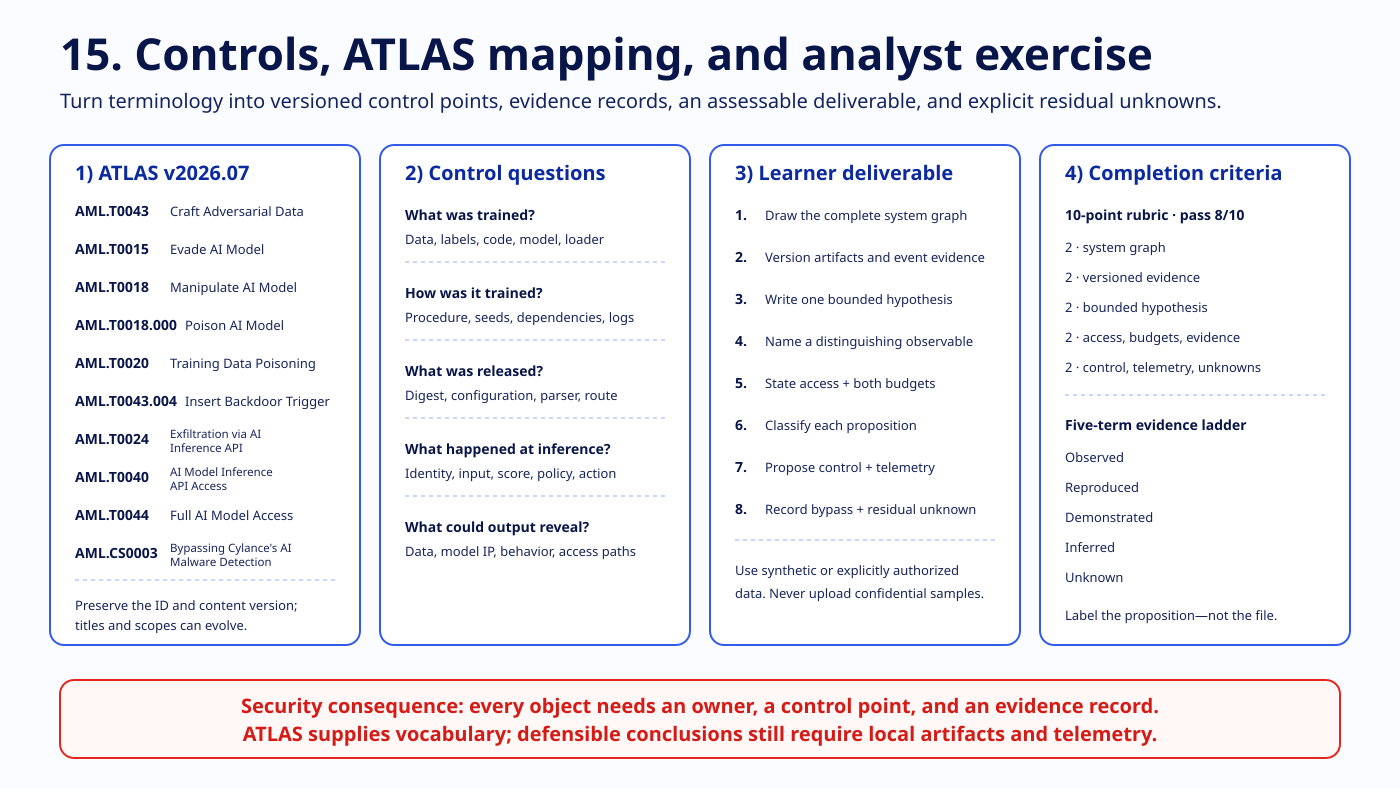
The terminology becomes operational when each object has an owner, a control point, and a record an analyst can collect. MITRE ATLAS supplies vocabulary and mapping; a defensible case still requires local artifacts, configuration, and telemetry. The table below was verified against the version-pinned MITRE ATLAS v2026.07 release. Preserve both the stable ID and the ATLAS content version because technique titles and scopes evolve.
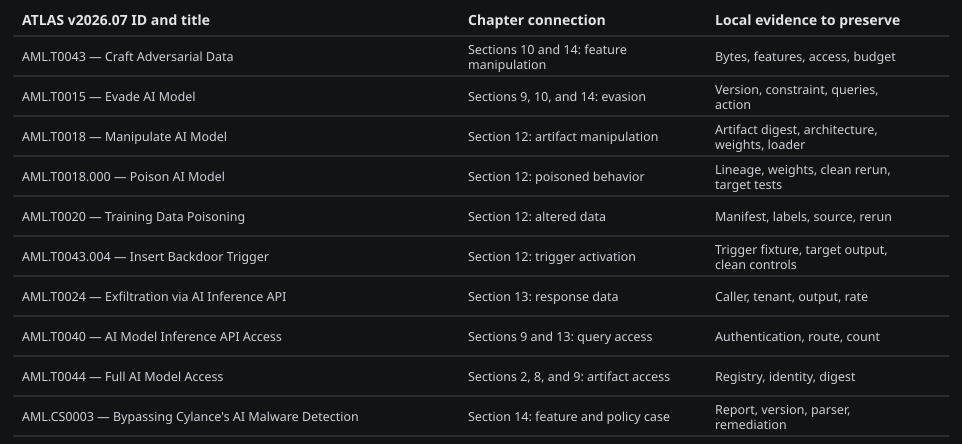
| ATLAS ID and title | Chapter connection | Local evidence to preserve |
|---|---|---|
| AML.T0043 — Craft Adversarial Data | Sections 10 and 14: feature manipulation | Bytes, features, access, budget |
| AML.T0015 — Evade AI Model | Sections 9, 10, and 14: evasion | Version, constraint, queries, action |
| AML.T0018 — Manipulate AI Model | Section 12: artifact manipulation | Artifact digest, architecture, weights, loader |
| AML.T0018.000 — Poison AI Model | Section 12: poisoned model behavior | Lineage, weights, clean rerun, target tests |
| AML.T0020 — Training Data Poisoning | Section 12: altered data | Manifest, labels, source, rerun |
| AML.T0043.004 — Insert Backdoor Trigger | Section 12: trigger activation | Trigger fixture, target output, clean controls |
| AML.T0024 — Exfiltration via AI Inference API | Section 13: response data | Caller, tenant, output, rate |
| AML.T0040 — AI Model Inference API Access | Sections 9 and 13: query access | Authentication, route, count |
| AML.T0044 — Full AI Model Access | Sections 2, 8, and 9: artifact access | Registry, identity, digest |
| AML.CS0003 — Bypassing Cylance's AI Malware Detection | Section 14: feature and policy case | Report, version, parser, remediation |
Control checklist
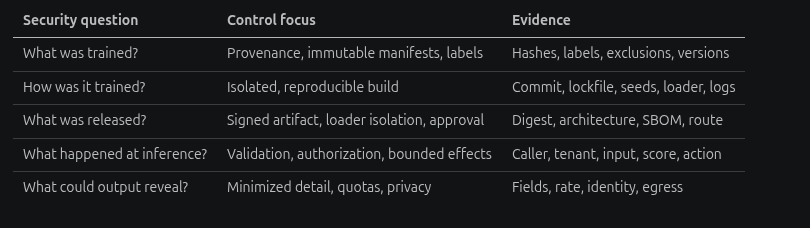
| Security question | Control focus | Evidence |
|---|---|---|
| What was trained? | Provenance, immutable manifests, labels | Hashes, labels, exclusions, versions |
| How was it trained? | Isolated, reproducible build | Commit, lockfile, seeds, loader, logs |
| What was released? | Signed artifact, loader isolation, approval | Digest, architecture, SBOM, route |
| What happened at inference? | Validation, authorization, bounded effects | Caller, tenant, input, score, action |
| What could output reveal? | Minimized detail, quotas, privacy | Fields, rate, identity, egress |
Analyst exercise
Choose a local classifier or course-owned demonstration. Do not upload confidential data or test without authorization. Draw its graph and record one parameter, hyperparameter, feature step, threshold, and inference event.
- Record the input and preprocessing output.
- Record artifact, architecture, dependency, and configuration digests.
- Compare logits or scores before and after the suspected change.
- State which single observable would distinguish evasion from distribution shift, a parser or feature-extraction change, a threshold change, or a swapped artifact.
- Record the access level, perturbation budget, and query budget for any robustness or evasion result.
- Separate Observed — a production event or provider report; Reproduced — the same failure under documented local conditions; Demonstrated — a research proof-of-concept on a stated model, not necessarily yours; Inferred — a hypothesis linking observations; and Unknown — an explicitly recorded gap.
- Propose one deterministic control and one monitoring signal, and document the bypass condition or residual unknown.
Deliverable: Submit a one-page evidence sheet or completed Module 00 workbook containing the system graph, versioned artifacts, one bounded hypothesis, the access and budget statement, the five-term evidence classification, one deterministic control, and one monitoring signal. Use synthetic or explicitly authorized data only.
| Assessment criterion | Points |
|---|---|
| System graph distinguishes model, parser or feature step, configuration, policy, and downstream action | 2 |
| Artifact and event evidence is versioned and sufficient to reproduce the comparison | 2 |
| Hypothesis names the competing explanations and one observable that distinguishes them | 2 |
| Access level, perturbation budget, query budget, and evidence-ladder labels are explicit | 2 |
| Control, telemetry, bypass condition, and residual unknown are documented | 2 |
Pass standard: 8/10, with full credit on the access-and-evidence criterion. Revise any submission that treats a score as authorization, labels a research demonstration as a local incident, or omits the affected artifact or route version.
You have completed this chapter when the deliverable meets that pass standard and, for a misclassification, you can name an observable distinguishing evasion, distribution shift, parser or feature change, threshold change, and swapped artifact; state the access level and both budgets; apply the five-term ladder; and identify control and telemetry needed to test it.
16. Key takeaways
- A neural network is a parameterized computation, not an isolated AI system. The parser, features, configuration, dependencies, runtime, policy, and downstream action also matter.
- A forward pass produces outputs; loss, gradients, and optimizer updates belong to training. Preserve those boundaries in the evidence graph.
- Learning rate, seed, data order, preprocessing, dependencies, and hardware can change behavior as decisively as weights.
- A robustness claim is falsifiable only when it states the access level, perturbation budget, and query budget.
- Problem-space malware changes must preserve functionality and file validity; feature-space coordinates are not automatically realizable artifacts.
- Adversarial training, sanitization, canonicalization, ensembles, and detection all have bypass conditions. None turns a probabilistic score into authorization.
- Backdoor and poisoning investigations require named methods, immutable evidence, and preservation of the suspect dataset.
- Model extraction, membership inference, and model inversion make inference telemetry a CTI and privacy control point.
- Research demonstrations establish capability; use the five-term evidence ladder consistently and record unknowns rather than filling them with assumptions.
17. References
- Rumelhart, Hinton, and Williams — Learning representations by back-propagating errors
- Goodfellow, Shlens, and Szegedy — Explaining and Harnessing Adversarial Examples
- Madry et al. — Towards Deep Learning Models Resistant to Adversarial Attacks
- Kingma and Ba — Adam: A Method for Stochastic Optimization
- NIST AI 100-2 E2025 — Adversarial Machine Learning: A Taxonomy and Terminology of Attacks and Mitigations
- MITRE ATLAS — Adversarial Threat Landscape for Artificial-Intelligence Systems
- MITRE ATLAS data release v2026.07
- Google Machine Learning Crash Course — Neural networks
- Szegedy et al. — Intriguing Properties of Neural Networks
- Biggio et al. — Evasion Attacks against Machine Learning at Test Time
- Carlini and Wagner — On Evaluating Adversarial Robustness
- Athalye, Carlini, and Wagner — Obfuscated Gradients Give a False Sense of Security
- Gu, Dolan-Gavitt, and Garg — BadNets
- Pierazzi et al. — Intriguing Properties of Adversarial ML Attacks in the Problem Space
- Tramèr et al. — Stealing Machine Learning Models via Prediction APIs
- Shokri et al. — Membership Inference Attacks Against Machine Learning Models
- Fredrikson, Jha, and Ristenpart — Model Inversion Attacks that Exploit Confidence Information and Basic Countermeasures
- Carlini et al. — Poisoning Web-Scale Training Datasets Is Practical
- Liu, Dolan-Gavitt, and Garg — Fine-Pruning
- Chen et al. — Detecting Backdoor Attacks through Activation Clustering
- Wang et al. — Neural Cleanse: Identifying and Mitigating Backdoor Attacks in Neural Networks (IEEE S&P 2019)
- MITRE ATLAS AML.CS0003 — Bypassing Cylance's AI Malware Detection (v2026.07)
- MITRE ATLAS AML.CS0002 — VirusTotal Poisoning (v2026.07)
- Skylight Cyber — Cylance, I Kill You!
- CERT/CC VU#489481 — Cylance Antivirus Products Susceptible to Concatenation Bypass
18. What comes next
Chapter 4 — Transformers and LLM Generation connects this mechanism to tokenization, chat templates, embeddings, attention, decoding, prompt injection, application controls, and reproducible CTI evidence.
Chapter 3 status: complete. Finalized 30 August 2026 as a learner-ready chapter with version-pinned ATLAS mappings, a reviewed evidence boundary, and an assessed analyst exercise. The wider AI Security Engineering course remains under construction.