Pre-compromise mitigations involve proactive measures and defenses implemented to prevent adversaries from successfully identifying and exploiting weaknesses during the Reconnaissance and Resource Development phases of an attack. These activities focus on reducing an organization's attack surface, identify adversarial preparation efforts, and increase the difficulty for attackers to conduct successful operations. This mitigation can be implemented through the following measures: Limit Information Exposure: - Regularly audit and sanitize publicly available data, including job posts, websites, and social media. - Use tools like OSINT monitoring platforms (e.g., SpiderFoot, Recon-ng) to identify leaked information. Protect Domain and DNS Infrastructure: - Enable DNSSEC and use WHOIS privacy protection. - Monitor for domain hijacking or lookalike domains using services like RiskIQ or Domain…
MITRE mitigation sourceAdversaryGraph public intelligence page
This page is part of Threat Matrix, the public browser workspace for the main AdversaryGraph platform. Use it for ATT&CK pivots, actor and technique context, similarity leads, detection coverage review, and analyst-ready investigation paths.
Validation disclaimer: TTP overlap, actor similarity, generated summaries, and coverage findings are investigation leads, not attribution proof or operational validation without analyst review.
Main AdversaryGraph project Documentation Malware Analysis GitHub
Vulnerability Scanning
Adversaries may scan victims for vulnerabilities that can be used during targeting. Vulnerability scans typically check if the configuration of a target host/application (ex: software and version) potentially aligns with the target of a specific exploit the adversary may seek to use. These scans may also include more broad attempts to [Gather Victim Host Information](https://attack.mitre.org/techniques/T1592) that can be used to identify more commonly known, exploitable vulnerabilities. Vulnerability scans typically harvest running software and version numbers via server banners, listening ports, or other network artifacts.(Citation: OWASP Vuln Scanning) Information from these scans may reveal opportunities for other forms of reconnaissance (ex: [Search Open Websites/Domains](https://attack.mitre.org/techniques/T1593) or [Search Open Technical Databases](https://attack.mitre.org/techniques/T1596)), establishing operational resources (ex: [Develop Capabilities](https://attack.mitre.org/techniques/T1587) or [Obtain Capabilities](https://attack.mitre.org/techniques/T1588)), and/or initial access (ex: [Exploit Public-Facing Application](https://attack.mitre.org/techniques/T1190)).
Open detection, hunting, mitigation, and evidence workspace
Detection logic
Monitor for suspicious network traffic that could be indicative of scanning, such as large quantities originating from a single source (especially if the source is known to be associated with an adversary/botnet). Analyzing web metadata may also reveal artifacts that can be attributed to potentially malicious activity, such as referer or user-agent string HTTP/S fields. Much of this activity may have a very high occurrence and associated false positive rate, as well as potentially taking place outside the visibility of the target organization, making detection difficult for defenders. Detection efforts may be focused on related stages of the adversary lifecycle, such as during Initial Access.
Observed actors
Correlated CTI and IR reports
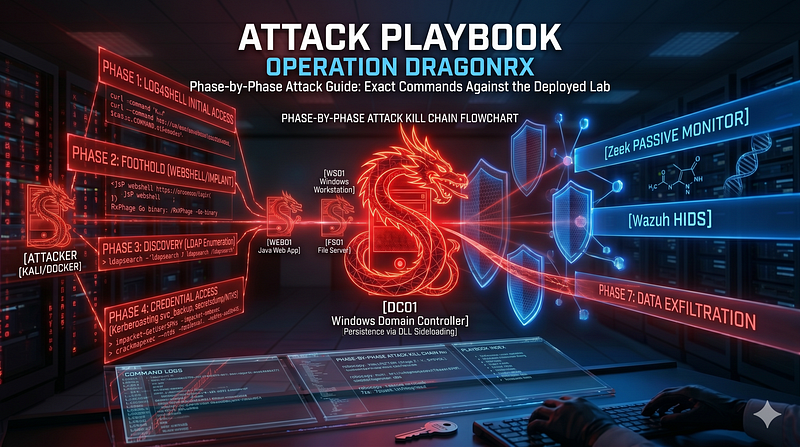
1200km CTI repository · explicit report mentionAttack Playbook — Operation DragonRx
1200km CTI repository · explicit report mentionOperation DragonRx — APT41 Full Attack Simulation
1200km CTI repository · explicit report mentionOperation DragonRx: Simulating an APT41 Attack End-to-End — From Log4Shell to DFIR and Malware Analysis
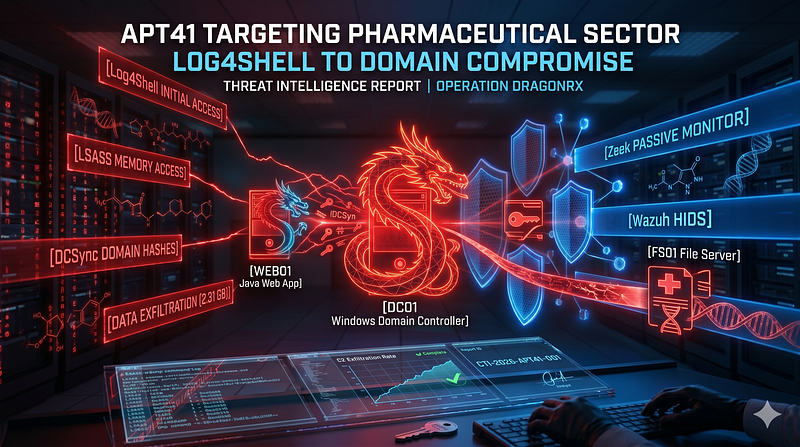
1200km CTI repository · explicit report mentionAPT41 Targeting Pharmaceutical Sector Log4Shell to Domain Compromise
1200km Medium · authored report mentionAttack Playbook Operation DragonRx
1200km Medium · authored report mentionOperation DragonRx Simulating an APT41 Attack End to End From Log4Shell to DFIR and Malware
1200km Medium · authored report mention
Cyber Knowledge context
Use these routes to move from the ATT&CK behavior into explanation, implementation, evidence handling, validation, and defensive operations. Relevance is generated from explicit identifiers/names and governed topic mappings; it is not attribution evidence.
OSINT & Reconnaissance · Governed topic match · 78/100Weakness taxonomy and vulnerability identity
Vulnerability Research & Exploit Development · Governed topic match · 57/100Memory-safety and low-level weakness classes
Vulnerability Research & Exploit Development · Governed topic match · 57/100Exploitability validation and laboratory exploit engineering
Vulnerability Research & Exploit Development · Governed topic match · 48/100AI-assisted vulnerability research, RAG, agents, and MCP
Vulnerability Research & Exploit Development · Governed topic match · 48/100Coordinated disclosure, PSIRT, scoring, remediation, and regression
Vulnerability Research & Exploit Development · Governed topic match · 48/100Authority, ethics, privacy, safety, and operational security
OSINT & Reconnaissance · Tactic learning route · 24/100Module 4 — Collection Sources
Cyber Threat Intelligence (CTI) · Tactic learning route · 24/100
MITRE mitigations
MITRE detection strategies and analytics
- AN1999 · Analytic 1999 — Monitor and analyze traffic patterns and packet inspection associated to protocol(s) that do not follow the expected protocol standards and traffic flows (e.g extraneous packets that do not belong to established flows, gratuitous or anomalous traffic patterns, anomalous syntax, or structure). Consider correlation with process monitoring and command line to detect anomalous processes execution and command line arguments associated to traffic patterns (e.g. monitor anomalies in use of files that do not normally initiate connections for respective protocol(s)). Monitor network data for uncommon data flows. Processes utilizing the network that do not normally have network communication or have never been seen before are suspicious.
Continue the investigation
Attack tools, simulations and detection rules
Follow explicit source relationships into the reference modules. Linked procedures and detectors are not claims of live validation or actor attribution.
- T1595.002 Vulnerability Scanning simulation — Exact active technique ID
- T1595.002 detection rules — Exact active technique ID; not actor-specific detector coverage