Pre-compromise mitigations involve proactive measures and defenses implemented to prevent adversaries from successfully identifying and exploiting weaknesses during the Reconnaissance and Resource Development phases of an attack. These activities focus on reducing an organization's attack surface, identify adversarial preparation efforts, and increase the difficulty for attackers to conduct successful operations. This mitigation can be implemented through the following measures: Limit Information Exposure: - Regularly audit and sanitize publicly available data, including job posts, websites, and social media. - Use tools like OSINT monitoring platforms (e.g., SpiderFoot, Recon-ng) to identify leaked information. Protect Domain and DNS Infrastructure: - Enable DNSSEC and use WHOIS privacy protection. - Monitor for domain hijacking or lookalike domains using services like RiskIQ or Domain…
MITRE mitigation sourceAdversaryGraph public intelligence page
This page is part of Threat Matrix, the public browser workspace for the main AdversaryGraph platform. Use it for ATT&CK pivots, actor and technique context, similarity leads, detection coverage review, and analyst-ready investigation paths.
Validation disclaimer: TTP overlap, actor similarity, generated summaries, and coverage findings are investigation leads, not attribution proof or operational validation without analyst review.
Main AdversaryGraph project Documentation Malware Analysis GitHub
Email Addresses
Adversaries may gather email addresses that can be used during targeting. Even if internal instances exist, organizations may have public-facing email infrastructure and addresses for employees. Adversaries may easily gather email addresses, since they may be readily available and exposed via online or other accessible data sets (ex: [Social Media](https://attack.mitre.org/techniques/T1593/001) or [Search Victim-Owned Websites](https://attack.mitre.org/techniques/T1594)).(Citation: HackersArise Email)(Citation: CNET Leaks) Email addresses could also be enumerated via more active means (i.e. [Active Scanning](https://attack.mitre.org/techniques/T1595)), such as probing and analyzing responses from authentication services that may reveal valid usernames in a system.(Citation: GrimBlog UsernameEnum) For example, adversaries may be able to enumerate email addresses in Office 365 environments by querying a variety of publicly available API endpoints, such as autodiscover and GetCredentialType.(Citation: GitHub Office 365 User Enumeration)(Citation: Azure Active Directory Reconnaisance) Gathering this information may reveal opportunities for other forms of reconnaissance (ex: [Search Open Websites/Domains](https://attack.mitre.org/techniques/T1593) or [Phishing for Information](https://attack.mitre.org/techniques/T1598)), establishing operational resources (ex: [Email Accounts](https://attack.mitre.org/techniques/T1586/002)), and/or initial access (ex: [Phishing](https://attack.mitre.org/techniques/T1566) or [Brute Force](https://attack.mitre.org/techniques/T1110) via [External…
Open detection, hunting, mitigation, and evidence workspace
Detection logic
Monitor for suspicious network traffic that could be indicative of probing for email addresses and/or usernames, such as large/iterative quantities of authentication requests originating from a single source (especially if the source is known to be associated with an adversary/botnet). Analyzing web metadata may also reveal artifacts that can be attributed to potentially malicious activity, such as referer or user-agent string HTTP/S fields. Much of this activity may have a very high occurrence and associated false positive rate, as well as potentially taking place outside the visibility of the target organization, making detection difficult for defenders. Detection efforts may be focused on related stages of the adversary lifecycle, such as during Initial Access.
Observed actors
Correlated CTI and IR reports
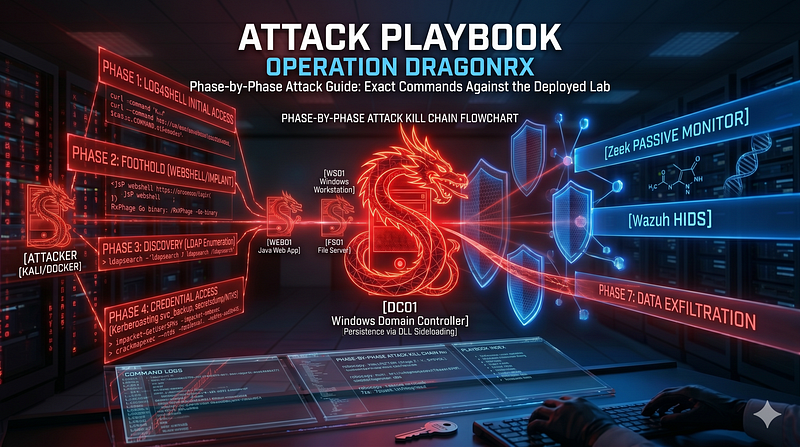
1200km CTI repository · explicit report mentionAttack Playbook — Operation DragonRx
1200km CTI repository · explicit report mentionOperation DragonRx — APT41 Full Attack Simulation
1200km CTI repository · explicit report mentionOperation DragonRx: Simulating an APT41 Attack End-to-End — From Log4Shell to DFIR and Malware Analysis
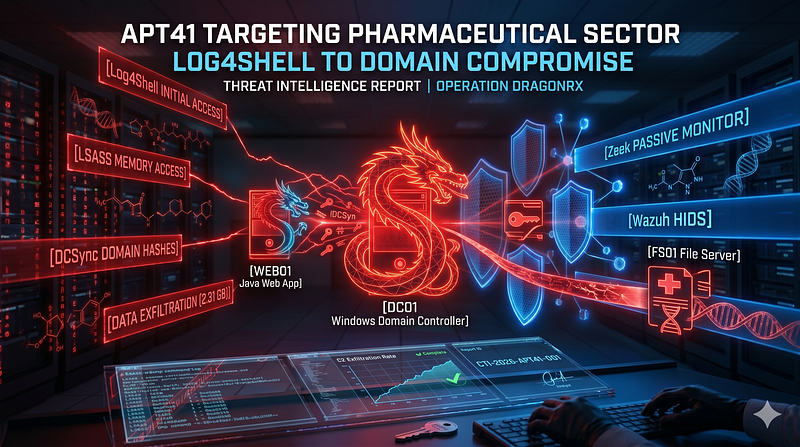
1200km CTI repository · explicit report mentionAPT41 Targeting Pharmaceutical Sector Log4Shell to Domain Compromise
1200km Medium · authored report mentionAttack Playbook Operation DragonRx
1200km Medium · authored report mentionOperation DragonRx Simulating an APT41 Attack End to End From Log4Shell to DFIR and Malware
1200km Medium · authored report mention
Cyber Knowledge context
Use these routes to move from the ATT&CK behavior into explanation, implementation, evidence handling, validation, and defensive operations. Relevance is generated from explicit identifiers/names and governed topic mappings; it is not attribution evidence.
OSINT & Reconnaissance · Governed topic match · 78/100Threat infrastructure, IOC enrichment, campaign pivots, and attribution restraint
OSINT & Reconnaissance · Governed topic match · 75/100Public code, packages, cloud artifacts, documents, and exposed secrets
OSINT & Reconnaissance · Governed topic match · 66/100Authority, ethics, privacy, safety, and operational security
OSINT & Reconnaissance · Tactic learning route · 24/100Module 4 — Collection Sources
Cyber Threat Intelligence (CTI) · Tactic learning route · 24/100
MITRE mitigations
MITRE detection strategies and analytics
- AN1946 · Analytic 1946 — Monitor for suspicious network traffic that could be indicative of probing for email addresses and/or usernames, such as large/iterative quantities of authentication requests originating from a single source (especially if the source is known to be associated with an adversary/botnet). Analyzing web metadata may also reveal artifacts that can be attributed to potentially malicious activity, such as referer or user-agent string HTTP/S fields.
Continue the investigation
Attack tools, simulations and detection rules
Follow explicit source relationships into the reference modules. Linked procedures and detectors are not claims of live validation or actor attribution.
- T1589.002 Email Addresses simulation — Exact active technique ID
- T1589.002 detection rules — Exact active technique ID; not actor-specific detector coverage