Set and enforce secure password policies for accounts to reduce the likelihood of unauthorized access. Strong password policies include enforcing password complexity, requiring regular password changes, and preventing password reuse. This mitigation can be implemented through the following measures: Windows Systems: - Use Group Policy Management Console (GPMC) to configure: - Minimum password length (e.g., 12+ characters). - Password complexity requirements. - Password history (e.g., disallow last 24 passwords). - Account lockout duration and thresholds. Linux Systems: - Configure Pluggable Authentication Modules (PAM): - Use `pam_pwquality` to enforce complexity and length requirements. - Implement `pam_tally2` or `pam_faillock` for account lockouts. - Use `pwunconv` to disable password reuse. Password Managers: - Enforce usage of enterprise password managers (e.g., Bitwarden, 1Passwor…
MITRE mitigation sourceAdversaryGraph public intelligence page
This page is part of Threat Matrix, the public browser workspace for the main AdversaryGraph platform. Use it for ATT&CK pivots, actor and technique context, similarity leads, detection coverage review, and analyst-ready investigation paths.
Validation disclaimer: TTP overlap, actor similarity, generated summaries, and coverage findings are investigation leads, not attribution proof or operational validation without analyst review.
Main AdversaryGraph project Documentation Malware Analysis GitHub
Kerberoasting
Adversaries may abuse a valid Kerberos ticket-granting ticket (TGT) or sniff network traffic to obtain a ticket-granting service (TGS) ticket that may be vulnerable to [Brute Force](https://attack.mitre.org/techniques/T1110).(Citation: Empire InvokeKerberoast Oct 2016)(Citation: AdSecurity Cracking Kerberos Dec 2015) Service principal names (SPNs) are used to uniquely identify each instance of a Windows service. To enable authentication, Kerberos requires that SPNs be associated with at least one service logon account (an account specifically tasked with running a service(Citation: Microsoft Detecting Kerberoasting Feb 2018)).(Citation: Microsoft SPN)(Citation: Microsoft SetSPN)(Citation: SANS Attacking Kerberos Nov 2014)(Citation: Harmj0y Kerberoast Nov 2016) Adversaries possessing a valid Kerberos ticket-granting ticket (TGT) may request one or more Kerberos ticket-granting service (TGS) service tickets for any SPN from a domain controller (DC).(Citation: Empire InvokeKerberoast Oct 2016)(Citation: AdSecurity Cracking Kerberos Dec 2015) Portions of these tickets may be encrypted with the RC4 algorithm, meaning the Kerberos 5 TGS-REP etype 23 hash of the service account associated with the SPN is used as the private key and is thus vulnerable to offline [Brute Force](https://attack.mitre.org/techniques/T1110) attacks that may expose plaintext credentials.(Citation: AdSecurity Cracking Kerberos Dec 2015)(Citation: Empire InvokeKerberoast Oct 2016) (Citation: Harmj0y Kerberoast Nov 2016) This same behavior could be executed using service tickets captured from network traffi…
Open detection, hunting, mitigation, and evidence workspace
Detection logic
Enable Audit Kerberos Service Ticket Operations to log Kerberos TGS service ticket requests. Particularly investigate irregular patterns of activity (ex: accounts making numerous requests, Event ID 4769, within a small time frame, especially if they also request RC4 encryption [Type 0x17]).
Observed actors
Correlated CTI and IR reports
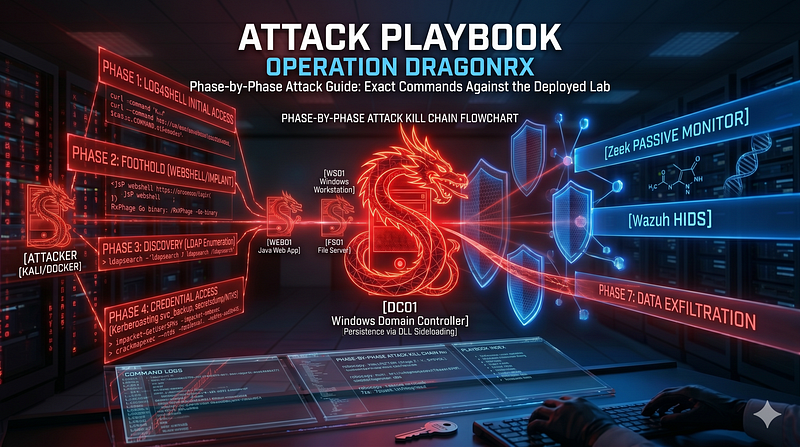
1200km CTI repository · explicit report mentionAttack Playbook — Operation DragonRx
1200km CTI repository · explicit report mentionDetection Guide — Operation DragonRx
1200km CTI repository · explicit report mentionMalicious Activity as a Statistical Signal: A Detection Engineering Analysis of Anomaly-Based Detection
1200km CTI repository · explicit report mentionOperation DragonRx — APT41 Full Attack Simulation
1200km CTI repository · explicit report mentionOperation DragonRx: Simulating an APT41 Attack End-to-End — From Log4Shell to DFIR and Malware Analysis
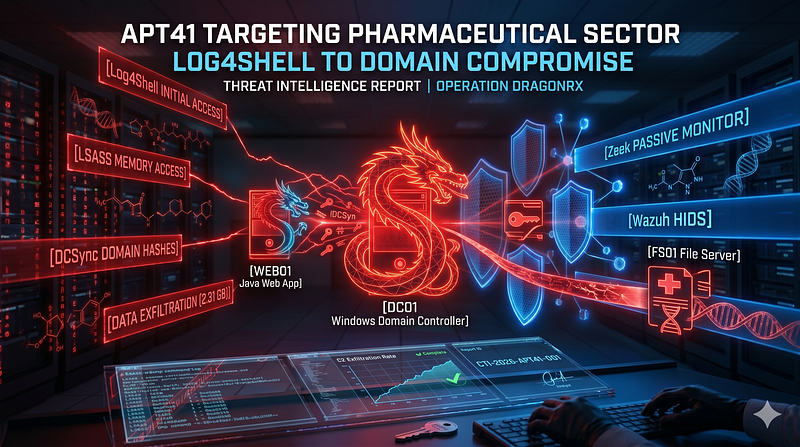
1200km CTI repository · explicit report mentionAPT41 Targeting Pharmaceutical Sector Log4Shell to Domain Compromise
1200km Medium · authored report mentionAttack Playbook Operation DragonRx
1200km Medium · authored report mentionMalicious Activity as a Statistical Signal A Detection Engineering Analysis of Anomaly Based
1200km Medium · authored report mentionOperation DragonRx Simulating an APT41 Attack End to End From Log4Shell to DFIR and Malware
1200km Medium · authored report mention
Cyber Knowledge context
Use these routes to move from the ATT&CK behavior into explanation, implementation, evidence handling, validation, and defensive operations. Relevance is generated from explicit identifiers/names and governed topic mappings; it is not attribution evidence.
Red Team & Offensive Security · Exact technique name · 92/100Module 9 — Identity defense and ITDR
Blue Team & Defensive Security · Exact technique name · 92/100Module 5 — Threat hunting
Blue Team & Defensive Security · Tactic learning route · 24/100Human, workload, pipeline, and emergency identity
Cloud Security · Tactic learning route · 24/100Disk, file-system, and persistence forensics
Digital Forensics & Incident Response (DFIR) · Tactic learning route · 24/100
MITRE mitigations
Protect sensitive information at rest, in transit, and during processing by using strong encryption algorithms. Encryption ensures the confidentiality and integrity of data, preventing unauthorized access or tampering. This mitigation can be implemented through the following measures: Encrypt Data at Rest: - Use Case: Use full-disk encryption or file-level encryption to secure sensitive data stored on devices. - Implementation: Implement BitLocker for Windows systems or FileVault for macOS devices to encrypt hard drives. Encrypt Data in Transit: - Use Case: Use secure communication protocols (e.g., TLS, HTTPS) to encrypt sensitive data as it travels over networks. - Implementation: Enable HTTPS for all web applications and configure mail servers to enforce STARTTLS for email encryption. Encrypt Backups: - Use Case: Ensure that backup data is encrypted both during storage and transfer to…
MITRE mitigation sourcePrivileged Account Management focuses on implementing policies, controls, and tools to securely manage privileged accounts (e.g., SYSTEM, root, or administrative accounts). This includes restricting access, limiting the scope of permissions, monitoring privileged account usage, and ensuring accountability through logging and auditing.This mitigation can be implemented through the following measures: Account Permissions and Roles: - Implement RBAC and least privilege principles to allocate permissions securely. - Use tools like Active Directory Group Policies to enforce access restrictions. Credential Security: - Deploy password vaulting tools like CyberArk, HashiCorp Vault, or KeePass for secure storage and rotation of credentials. - Enforce password policies for complexity, uniqueness, and expiration using tools like Microsoft Group Policy Objects (GPO). Multi-Factor Authentication (MF…
MITRE mitigation sourceMITRE detection strategies and analytics
- AN0444 · Analytic 0444 — Detects Kerberoasting attempts by monitoring for anomalous Kerberos TGS requests (Event ID 4769) with RC4 encryption (etype 0x17), accounts requesting an unusual number of service tickets in a short period, or service accounts targeted outside normal usage baselines. Also correlates suspicious process activity (e.g., Mimikatz invoking LSASS access) with Kerberos ticket anomalies.
Continue the investigation
Attack tools, simulations and detection rules
Follow explicit source relationships into the reference modules. Linked procedures and detectors are not claims of live validation or actor attribution.
- T1558.003 Kerberoasting simulation — Exact active technique ID
- T1558.003 detection rules — Exact active technique ID; not actor-specific detector coverage