Software updates ensure systems are protected against known vulnerabilities by applying patches and upgrades provided by vendors. Regular updates reduce the attack surface and prevent adversaries from exploiting known security gaps. This includes patching operating systems, applications, drivers, and firmware. This mitigation can be implemented through the following measures: Regular Operating System Updates - Implementation: Apply the latest Windows security updates monthly using WSUS (Windows Server Update Services) or a similar patch management solution. Configure systems to check for updates automatically and schedule reboots during maintenance windows. - Use Case: Prevents exploitation of OS vulnerabilities such as privilege escalation or remote code execution. Application Patching - Implementation: Monitor Apache's update release notes for security patches addressing vulnerabiliti…
MITRE mitigation sourceAdversaryGraph public intelligence page
This page is part of Threat Matrix, the public browser workspace for the main AdversaryGraph platform. Use it for ATT&CK pivots, actor and technique context, similarity leads, detection coverage review, and analyst-ready investigation paths.
Validation disclaimer: TTP overlap, actor similarity, generated summaries, and coverage findings are investigation leads, not attribution proof or operational validation without analyst review.
Main AdversaryGraph project Documentation Malware Analysis GitHub
Pass the Hash
Adversaries may “pass the hash” using stolen password hashes to move laterally within an environment, bypassing normal system access controls. Pass the hash (PtH) is a method of authenticating as a user without having access to the user's cleartext password. This method bypasses standard authentication steps that require a cleartext password, moving directly into the portion of the authentication that uses the password hash. When performing PtH, valid password hashes for the account being used are captured using a [Credential Access](https://attack.mitre.org/tactics/TA0006) technique. Captured hashes are used with PtH to authenticate as that user. Once authenticated, PtH may be used to perform actions on local or remote systems. Adversaries may also use stolen password hashes to "overpass the hash." Similar to PtH, this involves using a password hash to authenticate as a user but also uses the password hash to create a valid Kerberos ticket. This ticket can then be used to perform [Pass the Ticket](https://attack.mitre.org/techniques/T1550/003) attacks.(Citation: Stealthbits Overpass-the-Hash)
Open detection, hunting, mitigation, and evidence workspace
Detection logic
Audit all logon and credential use events and review for discrepancies. Unusual remote logins that correlate with other suspicious activity (such as writing and executing binaries) may indicate malicious activity. NTLM LogonType 3 authentications that are not associated to a domain login and are not anonymous logins are suspicious. Event ID 4768 and 4769 will also be generated on the Domain Controller when a user requests a new ticket granting ticket or service ticket. These events combined with the above activity may be indicative of an overpass the hash attempt.
Observed actors
Correlated CTI and IR reports
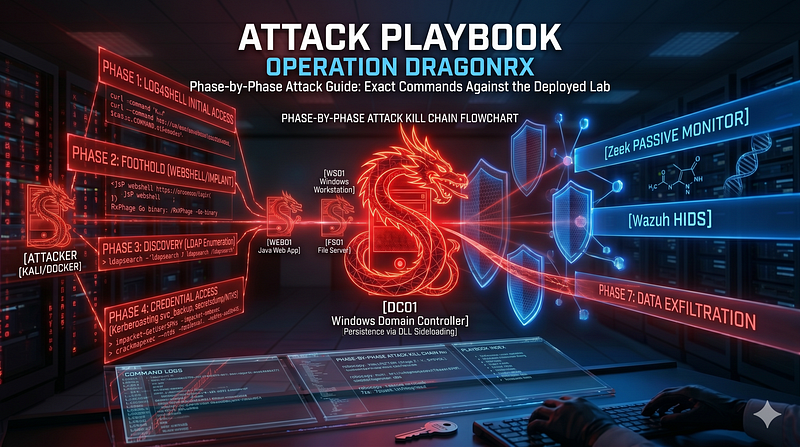
1200km CTI repository · explicit report mentionAttack Playbook — Operation DragonRx
1200km CTI repository · explicit report mentionDetection Guide — Operation DragonRx
1200km CTI repository · explicit report mentionOperation DragonRx — APT41 Full Attack Simulation
1200km CTI repository · explicit report mentionOperation DragonRx: Simulating an APT41 Attack End-to-End — From Log4Shell to DFIR and Malware Analysis
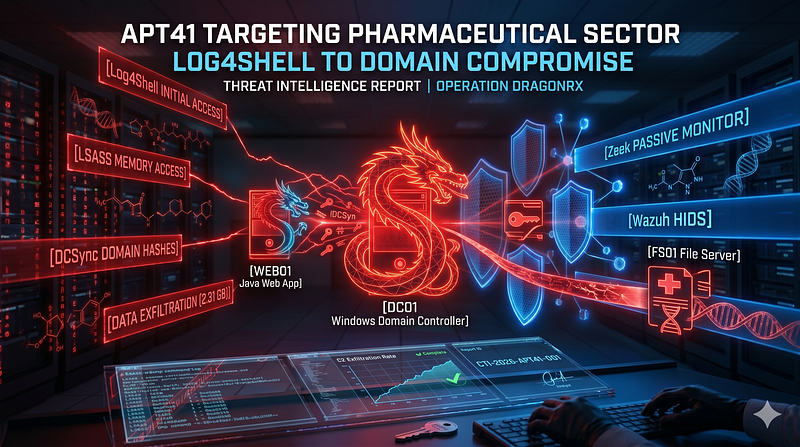
1200km CTI repository · explicit report mentionAPT41 Targeting Pharmaceutical Sector Log4Shell to Domain Compromise
1200km Medium · authored report mentionAttack Playbook Operation DragonRx
1200km Medium · authored report mentionOperation DragonRx Simulating an APT41 Attack End to End From Log4Shell to DFIR and Malware
1200km Medium · authored report mention
Cyber Knowledge context
Use these routes to move from the ATT&CK behavior into explanation, implementation, evidence handling, validation, and defensive operations. Relevance is generated from explicit identifiers/names and governed topic mappings; it is not attribution evidence.
Red Team & Offensive Security · Tactic learning route · 24/100Module 5 — Threat hunting
Blue Team & Defensive Security · Tactic learning route · 24/100Data classification, storage, cryptography, keys, backup, and deletion
Cloud Security · Tactic learning route · 24/100
MITRE mitigations
User Account Control (UAC) is a security feature in Microsoft Windows that prevents unauthorized changes to the operating system. UAC prompts users to confirm or provide administrator credentials when an action requires elevated privileges. Proper configuration of UAC reduces the risk of privilege escalation attacks. This mitigation can be implemented through the following measures: Enable UAC Globally: - Ensure UAC is enabled through Group Policy by setting `User Account Control: Run all administrators in Admin Approval Mode` to `Enabled`. Require Credential Prompt: - Use Group Policy to configure UAC to prompt for administrative credentials instead of just confirmation (`User Account Control: Behavior of the elevation prompt`). Restrict Built-in Administrator Account: Set `Admin Approval Mode` for the built-in Administrator account to `Enabled` in Group Policy. Secure the UAC Prompt:…
MITRE mitigation sourceUser Account Management involves implementing and enforcing policies for the lifecycle of user accounts, including creation, modification, and deactivation. Proper account management reduces the attack surface by limiting unauthorized access, managing account privileges, and ensuring accounts are used according to organizational policies. This mitigation can be implemented through the following measures: Enforcing the Principle of Least Privilege - Implementation: Assign users only the minimum permissions required to perform their job functions. Regularly audit accounts to ensure no excess permissions are granted. - Use Case: Reduces the risk of privilege escalation by ensuring accounts cannot perform unauthorized actions. Implementing Strong Password Policies - Implementation: Enforce password complexity requirements (e.g., length, character types). Require password expiration every 90…
MITRE mitigation sourcePrivileged Account Management focuses on implementing policies, controls, and tools to securely manage privileged accounts (e.g., SYSTEM, root, or administrative accounts). This includes restricting access, limiting the scope of permissions, monitoring privileged account usage, and ensuring accountability through logging and auditing.This mitigation can be implemented through the following measures: Account Permissions and Roles: - Implement RBAC and least privilege principles to allocate permissions securely. - Use tools like Active Directory Group Policies to enforce access restrictions. Credential Security: - Deploy password vaulting tools like CyberArk, HashiCorp Vault, or KeePass for secure storage and rotation of credentials. - Enforce password policies for complexity, uniqueness, and expiration using tools like Microsoft Group Policy Objects (GPO). Multi-Factor Authentication (MF…
MITRE mitigation sourceMITRE detection strategies and analytics
- AN1144 · Analytic 1144 — Detects anomalous NTLM LogonType 3 authentications that occur without accompanying domain logon events, especially from lateral systems or involving built-in administrative tools. Monitors for mismatches between source user context and system being accessed. Correlates LogonSession creation, NTLM authentications, and process/service initiation to identify suspicious use of stolen password hashes for remote access or service logon without password entry. Detects overpass-the-hash by combining Kerberos ticket issuance with NTLM-based lateral movement.
Continue the investigation
Attack tools, simulations and detection rules
Follow explicit source relationships into the reference modules. Linked procedures and detectors are not claims of live validation or actor attribution.
- T1550.002 Pass the Hash simulation — Exact active technique ID
- T1550.002 detection rules — Exact active technique ID; not actor-specific detector coverage