Account Use Policies help mitigate unauthorized access by configuring and enforcing rules that govern how and when accounts can be used. These policies include enforcing account lockout mechanisms, restricting login times, and setting inactivity timeouts. Proper configuration of these policies reduces the risk of brute-force attacks, credential theft, and unauthorized access by limiting the opportunities for malicious actors to exploit accounts. This mitigation can be implemented through the following measures: Account Lockout Policies: - Implementation: Configure account lockout settings so that after a defined number of failed login attempts (e.g., 3-5 attempts), the account is locked for a specific time period (e.g., 15 minutes) or requires an administrator to unlock it. - Use Case: This prevents brute-force attacks by limiting how many incorrect password attempts can be made before…
MITRE mitigation sourceAdversaryGraph public intelligence page
This page is part of Threat Matrix, the public browser workspace for the main AdversaryGraph platform. Use it for ATT&CK pivots, actor and technique context, similarity leads, detection coverage review, and analyst-ready investigation paths.
Validation disclaimer: TTP overlap, actor similarity, generated summaries, and coverage findings are investigation leads, not attribution proof or operational validation without analyst review.
Main AdversaryGraph project Documentation Malware Analysis GitHub
Application Access Token
Adversaries may use stolen application access tokens to bypass the typical authentication process and access restricted accounts, information, or services on remote systems. These tokens are typically stolen from users or services and used in lieu of login credentials. Application access tokens are used to make authorized API requests on behalf of a user or service and are commonly used to access resources in cloud, container-based applications, and software-as-a-service (SaaS).(Citation: Auth0 - Why You Should Always Use Access Tokens to Secure APIs Sept 2019) OAuth is one commonly implemented framework that issues tokens to users for access to systems. These frameworks are used collaboratively to verify the user and determine what actions the user is allowed to perform. Once identity is established, the token allows actions to be authorized, without passing the actual credentials of the user. Therefore, compromise of the token can grant the adversary access to resources of other sites through a malicious application.(Citation: okta) For example, with a cloud-based email service, once an OAuth access token is granted to a malicious application, it can potentially gain long-term access to features of the user account if a "refresh" token enabling background access is awarded.(Citation: Microsoft Identity Platform Access 2019) With an OAuth access token an adversary can use the user-granted REST API to perform functions such as email searching and contact enumeration.(Citation: Staaldraad Phishing with OAuth 2017) Compromised access tokens may be used as an initial step in…
Open detection, hunting, mitigation, and evidence workspace
Detection logic
Monitor access token activity for abnormal use and permissions granted to unusual or suspicious applications and APIs. Additionally, administrators should review logs for calls to the AWS Security Token Service (STS) and usage of GCP service accounts in order to identify anomalous actions.
Observed actors
Correlated CTI and IR reports
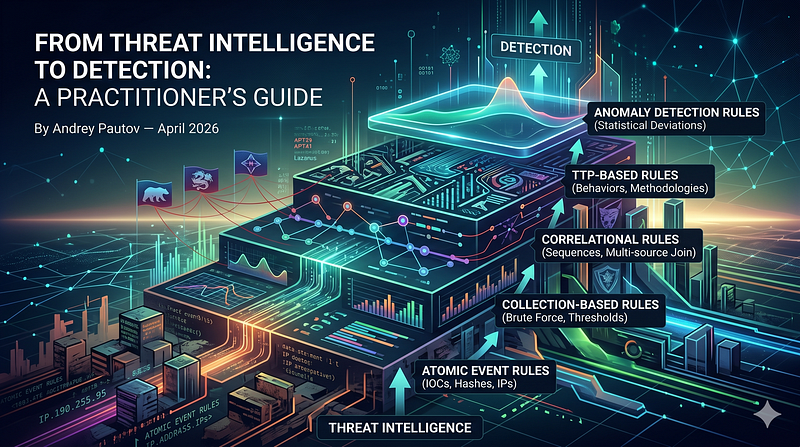
1200km CTI repository · explicit report mentionFrom Threat Intelligence to Detection: A Practitioner's Guide
1200km CTI repository · explicit report mentionFrom Threat Intelligence to Detection A Practitioner s Guide
1200km Medium · authored report mention
Cyber Knowledge context
Use these routes to move from the ATT&CK behavior into explanation, implementation, evidence handling, validation, and defensive operations. Relevance is generated from explicit identifiers/names and governed topic mappings; it is not attribution evidence.
Cloud Security · Governed topic match · 88/100Cloud incident response, forensics, containment, and recovery
Cloud Security · Governed topic match · 88/100Cloud AI/ML, agents, RAG, MCP, and autonomous operations
Cloud Security · Governed topic match · 88/100Network, edge, service communication, hybrid access, and zero trust
Cloud Security · Governed topic match · 87/100Data classification, storage, cryptography, keys, backup, and deletion
Cloud Security · Governed topic match · 87/100Compute, managed services, serverless, SaaS, and workload hardening
Cloud Security · Governed topic match · 87/100Cloud logging, detection engineering, ATT CK, and response automation
Cloud Security · Governed topic match · 87/100Posture management, exposure, vulnerabilities, attack paths, and validation
Cloud Security · Governed topic match · 87/100Human, workload, pipeline, and emergency identity
Cloud Security · Governed topic match · 78/100Multi-cloud, SaaS, suppliers, compliance, and continuous assurance
Cloud Security · Governed topic match · 75/100Container image, registry, runtime, and host security
Cloud Security · Governed topic match · 69/100Shared responsibility, governance, and service ownership
Cloud Security · Governed topic match · 66/100
MITRE mitigations
Auditing is the process of recording activity and systematically reviewing and analyzing the activity and system configurations. The primary purpose of auditing is to detect anomalies and identify potential threats or weaknesses in the environment. Proper auditing configurations can also help to meet compliance requirements. The process of auditing encompasses regular analysis of user behaviors and system logs in support of proactive security measures. Auditing is applicable to all systems used within an organization, from the front door of a building to accessing a file on a fileserver. It is considered more critical for regulated industries such as, healthcare, finance and government where compliance requirements demand stringent tracking of user and system activates.This mitigation can be implemented through the following measures: System Audit: - Use Case: Regularly assess system co…
MITRE mitigation sourceRestricting web-based content involves enforcing policies and technologies that limit access to potentially malicious websites, unsafe downloads, and unauthorized browser behaviors. This can include URL filtering, download restrictions, script blocking, and extension control to protect against exploitation, phishing, and malware delivery. This mitigation can be implemented through the following measures: Deploy Web Proxy Filtering: - Use solutions to filter web traffic based on categories, reputation, and content types. - Enforce policies that block unsafe websites or file types at the gateway level. Enable DNS-Based Filtering: - Implement tools to restrict access to domains associated with malware or phishing campaigns. - Use public DNS filtering services to enhance protection. Enforce Content Security Policies (CSP): - Configure CSP headers on internal and external web applications to…
MITRE mitigation sourceApplication Developer Guidance focuses on providing developers with the knowledge, tools, and best practices needed to write secure code, reduce vulnerabilities, and implement secure design principles. By integrating security throughout the software development lifecycle (SDLC), this mitigation aims to prevent the introduction of exploitable weaknesses in applications, systems, and APIs. This mitigation can be implemented through the following measures: Preventing SQL Injection (Secure Coding Practice): - Implementation: Train developers to use parameterized queries or prepared statements instead of directly embedding user input into SQL queries. - Use Case: A web application accepts user input to search a database. By sanitizing and validating user inputs, developers can prevent attackers from injecting malicious SQL commands. Cross-Site Scripting (XSS) Mitigation: - Implementation: Re…
MITRE mitigation sourceProtect sensitive information at rest, in transit, and during processing by using strong encryption algorithms. Encryption ensures the confidentiality and integrity of data, preventing unauthorized access or tampering. This mitigation can be implemented through the following measures: Encrypt Data at Rest: - Use Case: Use full-disk encryption or file-level encryption to secure sensitive data stored on devices. - Implementation: Implement BitLocker for Windows systems or FileVault for macOS devices to encrypt hard drives. Encrypt Data in Transit: - Use Case: Use secure communication protocols (e.g., TLS, HTTPS) to encrypt sensitive data as it travels over networks. - Implementation: Enable HTTPS for all web applications and configure mail servers to enforce STARTTLS for email encryption. Encrypt Backups: - Use Case: Ensure that backup data is encrypted both during storage and transfer to…
MITRE mitigation sourceMITRE detection strategies and analytics
- AN0526 · Analytic 0526 — Use of AWS STS or GCP IAM APIs to request temporary tokens or federation sessions inconsistent with normal account activity, including from unexpected principals or regions.
- AN0527 · Analytic 0527 — OAuth or SAML access tokens reused across multiple sessions or clients without corresponding MFA or login activity.
- AN0528 · Analytic 0528 — Application access tokens used to call APIs (e.g., Google Workspace, Salesforce) without interactive logins, often with unusual scopes or elevated permissions.
- AN0529 · Analytic 0529 — OAuth token usage for Exchange Online or SharePoint API access without preceding login or from unauthorized clients.
- AN0530 · Analytic 0530 — Compromised service account tokens mounted inside containers and reused for external API calls or lateral movement across services.
Continue the investigation
Attack tools, simulations and detection rules
Follow explicit source relationships into the reference modules. Linked procedures and detectors are not claims of live validation or actor attribution.
- T1550.001 Application Access Token simulation — Exact active technique ID
- T1550.001 detection rules — Exact active technique ID; not actor-specific detector coverage