Prevent the execution of unauthorized or malicious code on systems by implementing application control, script blocking, and other execution prevention mechanisms. This ensures that only trusted and authorized code is executed, reducing the risk of malware and unauthorized actions. This mitigation can be implemented through the following measures: Application Control: - Use Case: Use tools like AppLocker or Windows Defender Application Control (WDAC) to create whitelists of authorized applications and block unauthorized ones. On Linux, use tools like SELinux or AppArmor to define mandatory access control policies for application execution. - Implementation: Allow only digitally signed or pre-approved applications to execute on servers and endpoints. (e.g., `New-AppLockerPolicy -PolicyType Enforced -FilePath "C:\Policies\AppLocker.xml"`) Script Blocking: - Use Case: Use script control me…
MITRE mitigation sourceAdversaryGraph public intelligence page
This page is part of Threat Matrix, the public browser workspace for the main AdversaryGraph platform. Use it for ATT&CK pivots, actor and technique context, similarity leads, detection coverage review, and analyst-ready investigation paths.
Validation disclaimer: TTP overlap, actor similarity, generated summaries, and coverage findings are investigation leads, not attribution proof or operational validation without analyst review.
Main AdversaryGraph project Documentation Malware Analysis GitHub
Unix Shell
Adversaries may abuse Unix shell commands and scripts for execution. Unix shells are the primary command prompt on Linux, macOS, and ESXi systems, though many variations of the Unix shell exist (e.g. sh, ash, bash, zsh, etc.) depending on the specific OS or distribution.(Citation: DieNet Bash)(Citation: Apple ZShell) Unix shells can control every aspect of a system, with certain commands requiring elevated privileges. Unix shells also support scripts that enable sequential execution of commands as well as other typical programming operations such as conditionals and loops. Common uses of shell scripts include long or repetitive tasks, or the need to run the same set of commands on multiple systems. Adversaries may abuse Unix shells to execute various commands or payloads. Interactive shells may be accessed through command and control channels or during lateral movement such as with [SSH](https://attack.mitre.org/techniques/T1021/004). Adversaries may also leverage shell scripts to deliver and execute multiple commands on victims or as part of payloads used for persistence. Some systems, such as embedded devices, lightweight Linux distributions, and ESXi servers, may leverage stripped-down Unix shells via Busybox, a small executable that contains a variety of tools, including a simple shell.
Open detection, hunting, mitigation, and evidence workspace
Detection logic
Unix shell usage may be common on administrator, developer, or power user systems, depending on job function. If scripting is restricted for normal users, then any attempt to enable scripts running on a system would be considered suspicious. If scripts are not commonly used on a system, but enabled, scripts running out of cycle from patching or other administrator functions are suspicious. Scripts should be captured from the file system when possible to determine their actions and intent. Scripts are likely to perform actions with various effects on a system that may generate events, depending on the types of monitoring used. Monitor processes and command-line arguments for script execution and subsequent behavior. Actions may be related to network and system information discovery, collection, or other scriptable post-compromise behaviors and could be used as indicators of detection leading back to the source script.
Observed actors
Correlated CTI and IR reports
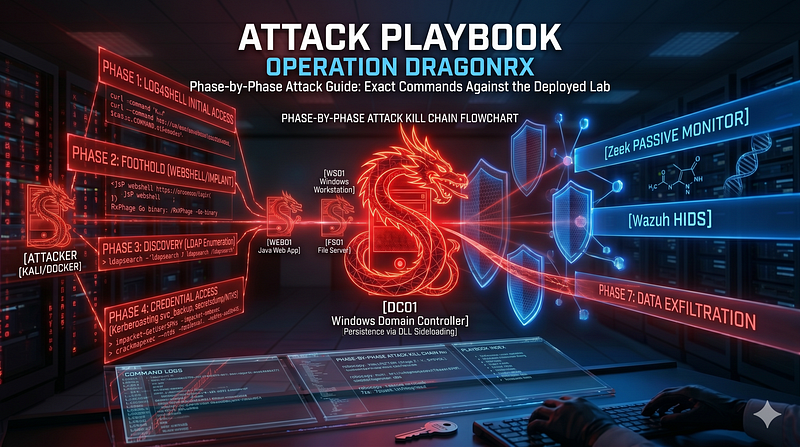
1200km CTI repository · explicit report mentionAttack Playbook — Operation DragonRx
1200km CTI repository · explicit report mentionOperation DragonRx — APT41 Full Attack Simulation
1200km CTI repository · explicit report mentionOperation DragonRx: Simulating an APT41 Attack End-to-End — From Log4Shell to DFIR and Malware Analysis
1200km CTI repository · explicit report mentionAttack Playbook Operation DragonRx
1200km Medium · authored report mention
Cyber Knowledge context
Use these routes to move from the ATT&CK behavior into explanation, implementation, evidence handling, validation, and defensive operations. Relevance is generated from explicit identifiers/names and governed topic mappings; it is not attribution evidence.
AI Security · Governed topic match · 66/100Module 5 — Cloud, containers, and Kubernetes
Red Team & Offensive Security · Tactic learning route · 24/100Static triage: strings, imports, resources, and capabilities
Malware Analysis & Reverse Engineering · Tactic learning route · 24/100Module 4 — Detection engineering and detection as code
Blue Team & Defensive Security · Tactic learning route · 24/100
MITRE mitigations
MITRE detection strategies and analytics
- AN1081 · Analytic 1081 — Detects bash, sh, zsh, or BusyBox shell execution initiated via remote sessions, unauthorized users, or embedded within secondary script interpreters. Focus is on chained behavior: shell > suspicious commands > network discovery or persistence indicators.
- AN1082 · Analytic 1082 — Identifies use of sh/bash/zsh in suspicious context, such as user scripts launched from non-standard apps (e.g., Preview.app), embedded in LaunchDaemons, or executed outside Terminal.app. Looks for misuse in Automator, LaunchAgents, or NSAppleScript-executed shell.
- AN1083 · Analytic 1083 — Detects BusyBox or Ash shell execution from unauthorized logins or remote connections. Focus is on rare shell invocations from DCUI, SSH sessions, or remote management paths. Also watches for payload droppers or persistence artifacts using shell.
- AN1084 · Analytic 1084 — Detects Unix shell usage on network appliances (e.g., routers, firewalls, embedded Linux) through rare console commands, CLI interfaces, or script injection via exposed APIs or SSH.
Continue the investigation
Attack tools, simulations and detection rules
Follow explicit source relationships into the reference modules. Linked procedures and detectors are not claims of live validation or actor attribution.
- T1059.004 Unix Shell simulation — Exact active technique ID
- T1059.004 detection rules — Exact active technique ID; not actor-specific detector coverage