User Training involves educating employees and contractors on recognizing, reporting, and preventing cyber threats that rely on human interaction, such as phishing, social engineering, and other manipulative techniques. Comprehensive training programs create a human firewall by empowering users to be an active component of the organization's cybersecurity defenses. This mitigation can be implemented through the following measures: Create Comprehensive Training Programs: - Design training modules tailored to the organization's risk profile, covering topics such as phishing, password management, and incident reporting. - Provide role-specific training for high-risk employees, such as helpdesk staff or executives. Use Simulated Exercises: - Conduct phishing simulations to measure user susceptibility and provide targeted follow-up training. - Run social engineering drills to evaluate employ…
MITRE mitigation sourceAdversaryGraph public intelligence page
This page is part of Threat Matrix, the public browser workspace for the main AdversaryGraph platform. Use it for ATT&CK pivots, actor and technique context, similarity leads, detection coverage review, and analyst-ready investigation paths.
Validation disclaimer: TTP overlap, actor similarity, generated summaries, and coverage findings are investigation leads, not attribution proof or operational validation without analyst review.
Main AdversaryGraph project Documentation Malware Analysis GitHub
GUI Input Capture
Adversaries may mimic common operating system GUI components to prompt users for credentials with a seemingly legitimate prompt. When programs are executed that need additional privileges than are present in the current user context, it is common for the operating system to prompt the user for proper credentials to authorize the elevated privileges for the task (ex: [Bypass User Account Control](https://attack.mitre.org/techniques/T1548/002)). Adversaries may mimic this functionality to prompt users for credentials with a seemingly legitimate prompt for a number of reasons that mimic normal usage, such as a fake installer requiring additional access or a fake malware removal suite.(Citation: OSX Malware Exploits MacKeeper) This type of prompt can be used to collect credentials via various languages such as [AppleScript](https://attack.mitre.org/techniques/T1059/002)(Citation: LogRhythm Do You Trust Oct 2014)(Citation: OSX Keydnap malware)(Citation: Spoofing credential dialogs) and [PowerShell](https://attack.mitre.org/techniques/T1059/001).(Citation: LogRhythm Do You Trust Oct 2014)(Citation: Enigma Phishing for Credentials Jan 2015)(Citation: Spoofing credential dialogs) On Linux systems adversaries may launch dialog boxes prompting users for credentials from malicious shell scripts or the command line (i.e. [Unix Shell](https://attack.mitre.org/techniques/T1059/004)).(Citation: Spoofing credential dialogs) Adversaries may also mimic common software authentication requests, such as those from browsers or email clients. This may also be paired with user activity monitoring…
Open detection, hunting, mitigation, and evidence workspace
Detection logic
Monitor process execution for unusual programs as well as malicious instances of Command and Scripting Interpreter that could be used to prompt users for credentials. For example, command/script history including abnormal parameters (such as requests for credentials and/or strings related to creating password prompts) may be malicious. Inspect and scrutinize input prompts for indicators of illegitimacy, such as non-traditional banners, text, timing, and/or sources.
Observed actors
Correlated CTI and IR reports
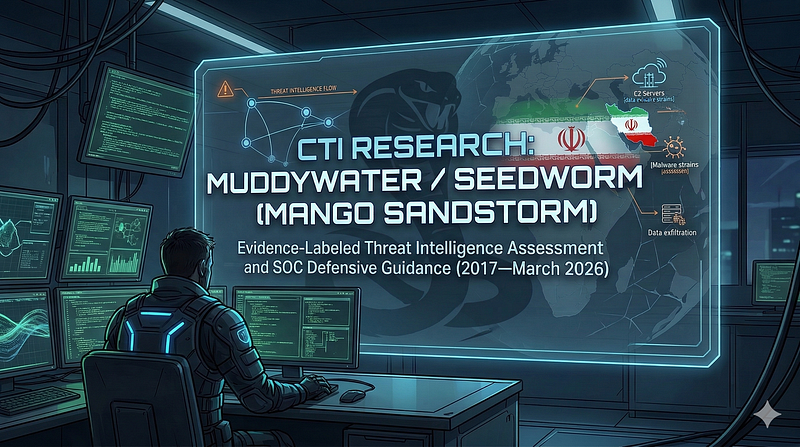
Israel Threat Actors CTI · explicit report mentionCTI Research: MuddyWater / Seedworm (Mango Sandstorm)
1200km CTI repository · explicit report mentionCTI Research: MuddyWater / Seedworm (Mango Sandstorm)
1200km CTI repository · explicit report mentionCTI Research MuddyWater Seedworm Mango Sandstorm
1200km Medium · authored report mention
Cyber Knowledge context
Use these routes to move from the ATT&CK behavior into explanation, implementation, evidence handling, validation, and defensive operations. Relevance is generated from explicit identifiers/names and governed topic mappings; it is not attribution evidence.
Cyber Threat Intelligence (CTI) · Tactic learning route · 24/100Endpoint live response and volatile acquisition
Digital Forensics & Incident Response (DFIR) · Tactic learning route · 24/100Module 5 — Threat hunting
Blue Team & Defensive Security · Tactic learning route · 24/100Human, workload, pipeline, and emergency identity
Cloud Security · Tactic learning route · 24/100Disk, file-system, and persistence forensics
Digital Forensics & Incident Response (DFIR) · Tactic learning route · 24/100
MITRE mitigations
MITRE detection strategies and analytics
- AN1440 · Analytic 1440 — Detects suspicious use of PowerShell, .NET, or script interpreters to spawn processes that mimic UAC prompts, often with credential capture dialogue boxes invoked from non-standard parent processes.
- AN1441 · Analytic 1441 — Detects GUI-based credential prompts invoked via zenity/kdialog/dialog or X11 APIs from non-user-facing scripts or background shell sessions, often with authentication-related text.
- AN1442 · Analytic 1442 — Detects AppleScript or Objective-C usage to generate fake authentication windows (e.g., using display dialog or NSAlert) from user-launched or persistence-related processes.
Continue the investigation
Attack tools, simulations and detection rules
Follow explicit source relationships into the reference modules. Linked procedures and detectors are not claims of live validation or actor attribution.
- T1056.002 GUI Input Capture simulation — Exact active technique ID
- T1056.002 detection rules — Exact active technique ID; not actor-specific detector coverage