Employ network appliances and endpoint software to filter ingress, egress, and lateral network traffic. This includes protocol-based filtering, enforcing firewall rules, and blocking or restricting traffic based on predefined conditions to limit adversary movement and data exfiltration. This mitigation can be implemented through the following measures: Ingress Traffic Filtering: - Use Case: Configure network firewalls to allow traffic only from authorized IP addresses to public-facing servers. - Implementation: Limit SSH (port 22) and RDP (port 3389) traffic to specific IP ranges. Egress Traffic Filtering: - Use Case: Use firewalls or endpoint security software to block unauthorized outbound traffic to prevent data exfiltration and command-and-control (C2) communications. - Implementation: Block outbound traffic to known malicious IPs or regions where communication is unexpected. Protoc…
MITRE mitigation sourceAdversaryGraph public intelligence page
This page is part of Threat Matrix, the public browser workspace for the main AdversaryGraph platform. Use it for ATT&CK pivots, actor and technique context, similarity leads, detection coverage review, and analyst-ready investigation paths.
Validation disclaimer: TTP overlap, actor similarity, generated summaries, and coverage findings are investigation leads, not attribution proof or operational validation without analyst review.
Main AdversaryGraph project Documentation Malware Analysis GitHub
Exfiltration Over Symmetric Encrypted Non-C2 Protocol
Adversaries may steal data by exfiltrating it over a symmetrically encrypted network protocol other than that of the existing command and control channel. The data may also be sent to an alternate network location from the main command and control server. Symmetric encryption algorithms are those that use shared or the same keys/secrets on each end of the channel. This requires an exchange or pre-arranged agreement/possession of the value used to encrypt and decrypt data.(Citation: Exfiltration Over Symmetric Encrypted Non-C2 Protocol) Network protocols that use asymmetric encryption often utilize symmetric encryption once keys are exchanged, but adversaries may opt to manually share keys and implement symmetric cryptographic algorithms (ex: RC4, AES) vice using mechanisms that are baked into a protocol. This may result in multiple layers of encryption (in protocols that are natively encrypted such as HTTPS) or encryption in protocols that not typically encrypted (such as HTTP or FTP).
Open detection, hunting, mitigation, and evidence workspace
Detection logic
Analyze network data for uncommon data flows (e.g., a client sending significantly more data than it receives from a server). Processes utilizing the network that do not normally have network communication or have never been seen before are suspicious. Artifacts and evidence of symmetric key exchange may be recoverable by analyzing network traffic or looking for hard-coded values within malware. If recovered, these keys can be used to decrypt network data from command and control channels.
Observed actors
No current Enterprise group relationship is published in this bundle.
Correlated CTI and IR reports
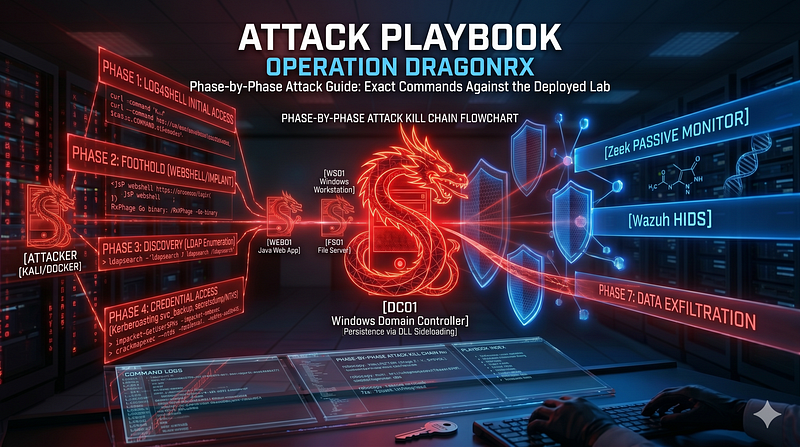
1200km CTI repository · explicit report mentionAttack Playbook — Operation DragonRx
1200km CTI repository · explicit report mentionOperation DragonRx — APT41 Full Attack Simulation
1200km CTI repository · explicit report mentionOperation DragonRx: Simulating an APT41 Attack End-to-End — From Log4Shell to DFIR and Malware Analysis
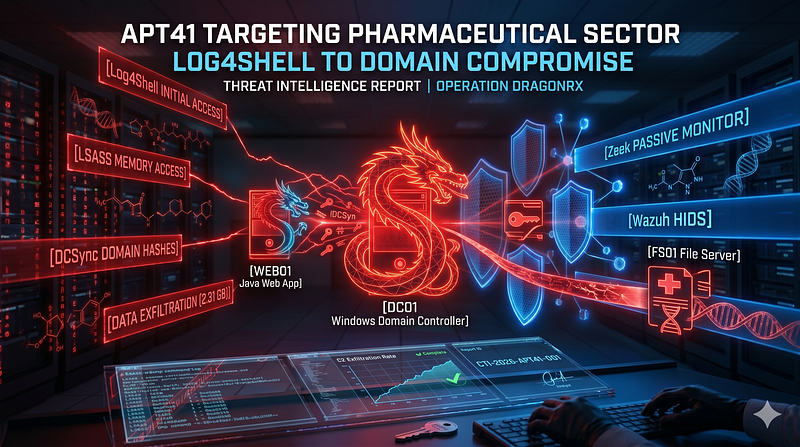
1200km CTI repository · explicit report mentionAPT41 Targeting Pharmaceutical Sector Log4Shell to Domain Compromise
1200km Medium · authored report mentionAttack Playbook Operation DragonRx
1200km Medium · authored report mentionOperation DragonRx Simulating an APT41 Attack End to End From Log4Shell to DFIR and Malware
1200km Medium · authored report mention
Cyber Knowledge context
Use these routes to move from the ATT&CK behavior into explanation, implementation, evidence handling, validation, and defensive operations. Relevance is generated from explicit identifiers/names and governed topic mappings; it is not attribution evidence.
Digital Forensics & Incident Response (DFIR) · Governed topic match · 42/100Windows endpoint and identity forensics
Digital Forensics & Incident Response (DFIR) · Tactic learning route · 24/100Module 6 — Alert triage, investigation, and escalation
Blue Team & Defensive Security · Tactic learning route · 24/100Infrastructure as code, CI/CD, artifact provenance, and policy as code
Cloud Security · Tactic learning route · 24/100
MITRE mitigations
Use intrusion detection signatures to block traffic at network boundaries.
MITRE mitigation sourceNetwork segmentation involves dividing a network into smaller, isolated segments to control and limit the flow of traffic between devices, systems, and applications. By segmenting networks, organizations can reduce the attack surface, restrict lateral movement by adversaries, and protect critical assets from compromise. Effective network segmentation leverages a combination of physical boundaries, logical separation through VLANs, and access control policies enforced by network appliances like firewalls, routers, and cloud-based configurations. This mitigation can be implemented through the following measures: Segment Critical Systems: - Identify and group systems based on their function, sensitivity, and risk. Examples include payment systems, HR databases, production systems, and internet-facing servers. - Use VLANs, firewalls, or routers to enforce logical separation. Implement DMZ f…
MITRE mitigation sourceMITRE detection strategies and analytics
- AN1389 · Analytic 1389 — Detects the execution of non-browser processes establishing outbound encrypted network connections using uncommon symmetric encryption protocols (e.g., AES via PowerShell or custom scripts) to alternate external destinations.
- AN1390 · Analytic 1390 — Detects command-line utilities or scripts using encryption libraries or symmetric algorithms (e.g., OpenSSL AES, GPG, Python + PyCrypto) in conjunction with outbound file transfers or traffic to external destinations.
- AN1391 · Analytic 1391 — Detects symmetric key-based encryption operations (e.g., AES via Python, AppleScript, or OpenSSL) followed by unusual outbound connections from non-browser applications or scripted tools.
- AN1392 · Analytic 1392 — Detects unexpected encrypted egress traffic from management services (e.g., hostd) or guest VMs utilizing symmetric encryption without traditional protocols (e.g., FTP with embedded AES ciphertext).
Continue the investigation
Attack tools, simulations and detection rules
Follow explicit source relationships into the reference modules. Linked procedures and detectors are not claims of live validation or actor attribution.
- T1048.001 Exfiltration Over Symmetric Encrypted Non-C2 Protocol simulation — Exact active technique ID
- T1048.001 detection rules — Exact active technique ID; not actor-specific detector coverage