Set and enforce secure password policies for accounts to reduce the likelihood of unauthorized access. Strong password policies include enforcing password complexity, requiring regular password changes, and preventing password reuse. This mitigation can be implemented through the following measures: Windows Systems: - Use Group Policy Management Console (GPMC) to configure: - Minimum password length (e.g., 12+ characters). - Password complexity requirements. - Password history (e.g., disallow last 24 passwords). - Account lockout duration and thresholds. Linux Systems: - Configure Pluggable Authentication Modules (PAM): - Use `pam_pwquality` to enforce complexity and length requirements. - Implement `pam_tally2` or `pam_faillock` for account lockouts. - Use `pwunconv` to disable password reuse. Password Managers: - Enforce usage of enterprise password managers (e.g., Bitwarden, 1Passwor…
MITRE mitigation sourceAdversaryGraph public intelligence page
This page is part of Threat Matrix, the public browser workspace for the main AdversaryGraph platform. Use it for ATT&CK pivots, actor and technique context, similarity leads, detection coverage review, and analyst-ready investigation paths.
Validation disclaimer: TTP overlap, actor similarity, generated summaries, and coverage findings are investigation leads, not attribution proof or operational validation without analyst review.
Main AdversaryGraph project Documentation Malware Analysis GitHub
DCSync
Adversaries may attempt to access credentials and other sensitive information by abusing a Windows Domain Controller's application programming interface (API)(Citation: Microsoft DRSR Dec 2017) (Citation: Microsoft GetNCCChanges) (Citation: Samba DRSUAPI) (Citation: Wine API samlib.dll) to simulate the replication process from a remote domain controller using a technique called DCSync. Members of the Administrators, Domain Admins, and Enterprise Admin groups or computer accounts on the domain controller are able to run DCSync to pull password data(Citation: ADSecurity Mimikatz DCSync) from Active Directory, which may include current and historical hashes of potentially useful accounts such as KRBTGT and Administrators. The hashes can then in turn be used to create a [Golden Ticket](https://attack.mitre.org/techniques/T1558/001) for use in [Pass the Ticket](https://attack.mitre.org/techniques/T1550/003)(Citation: Harmj0y Mimikatz and DCSync) or change an account's password as noted in [Account Manipulation](https://attack.mitre.org/techniques/T1098).(Citation: InsiderThreat ChangeNTLM July 2017) DCSync functionality has been included in the "lsadump" module in [Mimikatz](https://attack.mitre.org/software/S0002).(Citation: GitHub Mimikatz lsadump Module) Lsadump also includes NetSync, which performs DCSync over a legacy replication protocol.(Citation: Microsoft NRPC Dec 2017)
Open detection, hunting, mitigation, and evidence workspace
Detection logic
Monitor domain controller logs for replication requests and other unscheduled activity possibly associated with DCSync. Also monitor for network protocols and other replication requests from IPs not associated with known domain controllers. Note: Domain controllers may not log replication requests originating from the default domain controller account.
Observed actors
Correlated CTI and IR reports
1200km CTI repository · explicit report mentionATT&CK as a Working Tool: Theory and Hands-On Practical Usage
1200km CTI repository · explicit report mentionDetection Guide — Operation DragonRx
1200km CTI repository · explicit report mentionOperation DragonRx — APT41 Full Attack Simulation
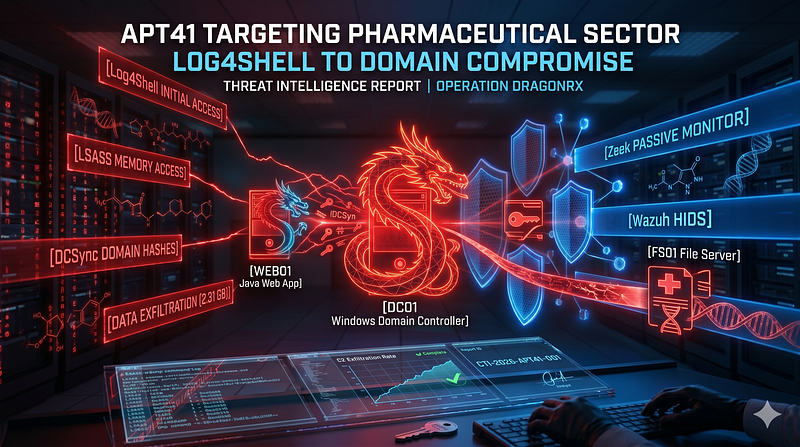
1200km CTI repository · explicit report mentionOperation DragonRx: Simulating an APT41 Attack End-to-End — From Log4Shell to DFIR and Malware Analysis
1200km CTI repository · explicit report mentionAPT41 Targeting Pharmaceutical Sector Log4Shell to Domain Compromise
1200km Medium · authored report mentionATT CK as a Working Tool Theory and Hands On Practical Usage
1200km Medium · authored report mentionOperation DragonRx Simulating an APT41 Attack End to End From Log4Shell to DFIR and Malware
1200km Medium · authored report mention
Cyber Knowledge context
Use these routes to move from the ATT&CK behavior into explanation, implementation, evidence handling, validation, and defensive operations. Relevance is generated from explicit identifiers/names and governed topic mappings; it is not attribution evidence.
Blue Team & Defensive Security · Exact technique name · 92/100Module 5 — Threat hunting
Blue Team & Defensive Security · Tactic learning route · 24/100Human, workload, pipeline, and emergency identity
Cloud Security · Tactic learning route · 24/100Disk, file-system, and persistence forensics
Digital Forensics & Incident Response (DFIR) · Tactic learning route · 24/100
MITRE mitigations
Implement robust Active Directory (AD) configurations using group policies to secure user accounts, control access, and minimize the attack surface. AD configurations enable centralized control over account settings, logon policies, and permissions, reducing the risk of unauthorized access and lateral movement within the network. This mitigation can be implemented through the following measures: Account Configuration: - Implementation: Use domain accounts instead of local accounts to leverage AD’s centralized management, including group policies, auditing, and access control. - Use Case: For IT staff managing shared resources, provision domain accounts that allow IT teams to log in centrally, reducing the risk of unmanaged, rogue local accounts on individual machines. Interactive Logon Restrictions: - Implementation: Configure group policies to restrict interactive logons (e.g., direct…
MITRE mitigation sourcePrivileged Account Management focuses on implementing policies, controls, and tools to securely manage privileged accounts (e.g., SYSTEM, root, or administrative accounts). This includes restricting access, limiting the scope of permissions, monitoring privileged account usage, and ensuring accountability through logging and auditing.This mitigation can be implemented through the following measures: Account Permissions and Roles: - Implement RBAC and least privilege principles to allocate permissions securely. - Use tools like Active Directory Group Policies to enforce access restrictions. Credential Security: - Deploy password vaulting tools like CyberArk, HashiCorp Vault, or KeePass for secure storage and rotation of credentials. - Enforce password policies for complexity, uniqueness, and expiration using tools like Microsoft Group Policy Objects (GPO). Multi-Factor Authentication (MF…
MITRE mitigation sourceMITRE detection strategies and analytics
- AN1632 · Analytic 1632 — Detects unauthorized invocation of replication operations (DCSync) via Directory Replication Service (DRS), often executed by threat actors using Mimikatz or similar tools from non-DC endpoints.
Continue the investigation
Attack tools, simulations and detection rules
Follow explicit source relationships into the reference modules. Linked procedures and detectors are not claims of live validation or actor attribution.
- T1003.006 DCSync simulation — Exact active technique ID
- T1003.006 detection rules — Exact active technique ID; not actor-specific detector coverage