Set and enforce secure password policies for accounts to reduce the likelihood of unauthorized access. Strong password policies include enforcing password complexity, requiring regular password changes, and preventing password reuse. This mitigation can be implemented through the following measures: Windows Systems: - Use Group Policy Management Console (GPMC) to configure: - Minimum password length (e.g., 12+ characters). - Password complexity requirements. - Password history (e.g., disallow last 24 passwords). - Account lockout duration and thresholds. Linux Systems: - Configure Pluggable Authentication Modules (PAM): - Use `pam_pwquality` to enforce complexity and length requirements. - Implement `pam_tally2` or `pam_faillock` for account lockouts. - Use `pwunconv` to disable password reuse. Password Managers: - Enforce usage of enterprise password managers (e.g., Bitwarden, 1Passwor…
MITRE mitigation sourceAdversaryGraph public intelligence page
This page is part of Threat Matrix, the public browser workspace for the main AdversaryGraph platform. Use it for ATT&CK pivots, actor and technique context, similarity leads, detection coverage review, and analyst-ready investigation paths.
Validation disclaimer: TTP overlap, actor similarity, generated summaries, and coverage findings are investigation leads, not attribution proof or operational validation without analyst review.
Main AdversaryGraph project Documentation Malware Analysis GitHub
NTDS
Adversaries may attempt to access or create a copy of the Active Directory domain database in order to steal credential information, as well as obtain other information about domain members such as devices, users, and access rights. By default, the NTDS file (NTDS.dit) is located in %SystemRoot%\NTDS\Ntds.dit of a domain controller. In addition to looking for NTDS files on active Domain Controllers, adversaries may search for backups that contain the same or similar information. The following tools and techniques can be used to enumerate the NTDS file and the contents of the entire Active Directory hashes. * Volume Shadow Copy * secretsdump.py * Using the in-built Windows tool, ntdsutil.exe * Invoke-NinjaCopy
Open detection, hunting, mitigation, and evidence workspace
Detection logic
Monitor processes and command-line arguments for program execution that may be indicative of credential dumping, especially attempts to access or copy the NTDS.dit.
Observed actors
Correlated CTI and IR reports
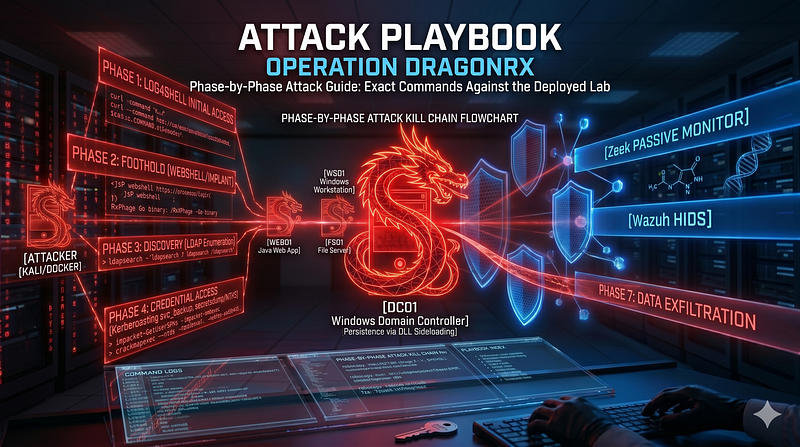
1200km CTI repository · explicit report mentionAttack Playbook — Operation DragonRx
1200km CTI repository · explicit report mentionCTI Research: Sandworm / APT44
1200km CTI repository · explicit report mentionATT CK as a Working Tool Theory and Hands On Practical Usage
1200km Medium · authored report mentionAttack Playbook Operation DragonRx
1200km Medium · authored report mentionCTI Research Sandworm APT44
1200km Medium · authored report mention
Cyber Knowledge context
Use these routes to move from the ATT&CK behavior into explanation, implementation, evidence handling, validation, and defensive operations. Relevance is generated from explicit identifiers/names and governed topic mappings; it is not attribution evidence.
Cyber Threat Intelligence (CTI) · Explicit ATT&CK ID · 100/100Module 5 — Threat hunting
Blue Team & Defensive Security · Tactic learning route · 24/100Human, workload, pipeline, and emergency identity
Cloud Security · Tactic learning route · 24/100Disk, file-system, and persistence forensics
Digital Forensics & Incident Response (DFIR) · Tactic learning route · 24/100
MITRE mitigations
Privileged Account Management focuses on implementing policies, controls, and tools to securely manage privileged accounts (e.g., SYSTEM, root, or administrative accounts). This includes restricting access, limiting the scope of permissions, monitoring privileged account usage, and ensuring accountability through logging and auditing.This mitigation can be implemented through the following measures: Account Permissions and Roles: - Implement RBAC and least privilege principles to allocate permissions securely. - Use tools like Active Directory Group Policies to enforce access restrictions. Credential Security: - Deploy password vaulting tools like CyberArk, HashiCorp Vault, or KeePass for secure storage and rotation of credentials. - Enforce password policies for complexity, uniqueness, and expiration using tools like Microsoft Group Policy Objects (GPO). Multi-Factor Authentication (MF…
MITRE mitigation sourceUser Training involves educating employees and contractors on recognizing, reporting, and preventing cyber threats that rely on human interaction, such as phishing, social engineering, and other manipulative techniques. Comprehensive training programs create a human firewall by empowering users to be an active component of the organization's cybersecurity defenses. This mitigation can be implemented through the following measures: Create Comprehensive Training Programs: - Design training modules tailored to the organization's risk profile, covering topics such as phishing, password management, and incident reporting. - Provide role-specific training for high-risk employees, such as helpdesk staff or executives. Use Simulated Exercises: - Conduct phishing simulations to measure user susceptibility and provide targeted follow-up training. - Run social engineering drills to evaluate employ…
MITRE mitigation sourceProtect sensitive information at rest, in transit, and during processing by using strong encryption algorithms. Encryption ensures the confidentiality and integrity of data, preventing unauthorized access or tampering. This mitigation can be implemented through the following measures: Encrypt Data at Rest: - Use Case: Use full-disk encryption or file-level encryption to secure sensitive data stored on devices. - Implementation: Implement BitLocker for Windows systems or FileVault for macOS devices to encrypt hard drives. Encrypt Data in Transit: - Use Case: Use secure communication protocols (e.g., TLS, HTTPS) to encrypt sensitive data as it travels over networks. - Implementation: Enable HTTPS for all web applications and configure mail servers to enforce STARTTLS for email encryption. Encrypt Backups: - Use Case: Ensure that backup data is encrypted both during storage and transfer to…
MITRE mitigation sourceMITRE detection strategies and analytics
- AN1611 · Analytic 1611 — Detects credential dumping attempts targeting the NTDS.dit database by monitoring shadow copy creation, suspicious file access to %SystemRoot%\NTDS\ntds.dit, and the use of tooling like ntdsutil.exe or volume management APIs.